


Table of Contents
Overview
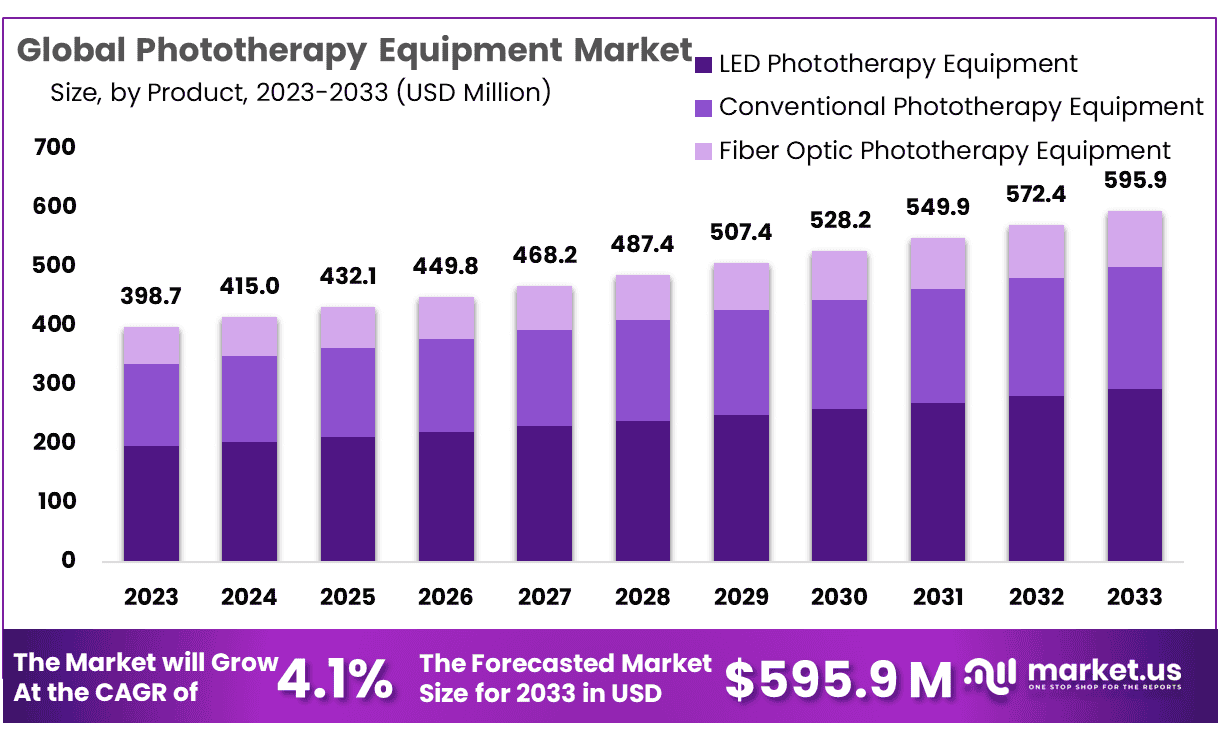
New York, NY – Jan 14, 2026 – The Global Phototherapy Equipment Market size is expected to be worth around USD 595.9 Million by 2032 from USD 415.0 Million in 2024, growing at a CAGR of 4.1% during the forecast period from 2023 to 2032.
Phototherapy equipment refers to medical devices designed to deliver controlled light exposure for therapeutic purposes. These systems are widely used in hospitals, dermatology clinics, neonatal care units, and homecare settings. The basic formation of phototherapy equipment is structured to ensure consistent light delivery, patient safety, and clinical effectiveness.
At its core, phototherapy equipment consists of a light source, control system, support structure, and safety components. The light source is the primary element and is typically based on light-emitting diodes (LEDs), fluorescent lamps, or halogen bulbs. In recent years, LED-based systems have been increasingly adopted due to their energy efficiency, longer lifespan, and stable wavelength output. The light is calibrated to specific wavelengths depending on the treatment requirement, such as blue light for neonatal jaundice or ultraviolet light for dermatological conditions.
The control system regulates light intensity, exposure duration, and treatment cycles. Digital control panels are commonly integrated to allow precise adjustments and monitoring. These controls support standardized treatment protocols and reduce the risk of overexposure.
The support structure includes adjustable stands, overhead units, or enclosed chambers, depending on the application. Flexibility in positioning is incorporated to improve patient comfort and clinical workflow. Safety components, such as cooling systems, protective shields, and automatic shut-off features, are included to ensure thermal management and user protection.
Overall, the basic formation of phototherapy equipment is designed to deliver reliable therapeutic light while maintaining operational safety and efficiency. Continuous technological advancements are expected to further improve device performance, usability, and clinical outcomes across multiple healthcare segments.
Key Takeaways
- Market Size and Growth: The phototherapy equipment market is projected to reach approximately USD 595.9 million by 2032, increasing from USD 398.7 million in 2022. This growth is expected to occur at a compound annual growth rate (CAGR) of 4.1% during the forecast period.
- Type Analysis: Conventional phototherapy equipment represented the largest product category, accounting for 49.1% of the total revenue share in 2023, supported by its widespread clinical use and established treatment protocols.
- Application Analysis: The skin diseases segment emerged as the leading application area, dominating the phototherapy equipment market with a 68.2% revenue share, driven by the rising prevalence of dermatological disorders.
- End-Use Analysis: Hospitals and clinics remained the primary end users, contributing approximately 84% of total market revenue in 2023, reflecting strong institutional demand and higher patient volumes.
- Regional Analysis: North America led the global market in 2023, capturing a 39.8% share and generating revenues of around USD 158.8 million, supported by advanced healthcare infrastructure and early adoption of medical technologies.
- Treatment Methods: Narrowband UVB (NB-UVB) and PUVA therapy continue to be widely adopted treatment methods, as they enable controlled exposure to specific light wavelengths for effective management of various skin conditions.
- Geographical Differences: Market adoption shows clear regional variation, with developed economies demonstrating faster uptake of advanced phototherapy technologies compared to emerging markets, where adoption remains gradual due to cost and infrastructure constraints.
Regional Analysis
- Market Size and Growth: The phototherapy equipment market is projected to reach approximately USD 595.9 million by 2032, increasing from USD 398.7 million in 2022. This growth is expected to occur at a compound annual growth rate (CAGR) of 4.1% during the forecast period.
- Type Analysis: Conventional phototherapy equipment represented the largest product category, accounting for 49.1% of the total revenue share in 2023, supported by its widespread clinical use and established treatment protocols.
- Application Analysis: The skin diseases segment emerged as the leading application area, dominating the phototherapy equipment market with a 68.2% revenue share, driven by the rising prevalence of dermatological disorders.
- End-Use Analysis: Hospitals and clinics remained the primary end users, contributing approximately 84% of total market revenue in 2023, reflecting strong institutional demand and higher patient volumes.
- Regional Analysis: North America led the global market in 2023, capturing a 39.8% share and generating revenues of around USD 158.8 million, supported by advanced healthcare infrastructure and early adoption of medical technologies.
- Treatment Methods: Narrowband UVB (NB-UVB) and PUVA therapy continue to be widely adopted treatment methods, as they enable controlled exposure to specific light wavelengths for effective management of various skin conditions.
- Geographical Differences: Market adoption shows clear regional variation, with developed economies demonstrating faster uptake of advanced phototherapy technologies compared to emerging markets, where adoption remains gradual due to cost and infrastructure constraints.
Emerging Trends
- Technological Advancements: The adoption of light-emitting diode (LED) technology has substantially improved the performance of phototherapy devices. LED-based systems deliver higher treatment efficiency, enhanced energy savings, and extended operational life. These improvements contribute to lower maintenance requirements and overall reductions in healthcare operating costs.
- Increased Emphasis on Infant Care: Advancements in neonatal phototherapy have resulted in the development of cost-effective and intelligent treatment systems with integrated monitoring features. These innovations are designed to enhance the management of neonatal jaundice, particularly in low- and middle-income regions where access to advanced healthcare infrastructure remains limited.
- Expansion of Home-based Treatment Solutions: The market is witnessing a growing shift toward home-based phototherapy devices, especially for dermatological applications. This trend supports improved patient compliance and convenience while reducing dependence on hospital-based care and easing pressure on healthcare facilities.
- Adoption of Combination Therapies: The integration of photothermal and photodynamic therapies is gaining momentum across clinical applications. This combined therapeutic approach has demonstrated improved outcomes in the treatment of skin infections and wound management, driven by enhanced antimicrobial activity and accelerated tissue regeneration.
Key Use Cases
- Treatment of Neonatal Jaundice: Phototherapy remains the standard of care for neonatal jaundice, a condition affecting approximately 60% of full-term infants and nearly 80% of preterm infants globally. Timely and effective phototherapy significantly reduces bilirubin levels, thereby minimizing the risk of neurological damage and other severe complications.
- Psoriasis Management: In the United States, an estimated 150,000 new psoriasis cases are diagnosed each year. Phototherapy is widely used as a non-invasive treatment modality that helps regulate abnormal skin cell proliferation, leading to symptom relief and improved disease management.
- Acne Treatment: Red light therapy is increasingly utilized for acne management due to its anti-inflammatory properties. Clinical evidence suggests that exposure to specific light wavelengths can reduce lesion severity, redness, and inflammation, supporting its role as a complementary dermatological treatment.
- Wound Healing Applications: Phototherapy has been shown to accelerate wound healing by stimulating cellular activity and promoting tissue repair. Research findings indicate that targeted light wavelengths can shorten healing times and improve overall wound outcomes.
- Hair Growth Stimulation: Low-level light therapy (LLLT) devices have received regulatory approval for the treatment of androgenetic alopecia. Clinical trials indicate that red LED therapy, particularly at a wavelength of 655 nm, is associated with measurable increases in hair density and follicular activity.
Frequently Asked Questions on Phototherapy Equipment
- How does phototherapy equipment work?
Phototherapy equipment works by emitting specific wavelengths of light that penetrate the skin and alter cellular activity. This process helps reduce inflammation, slow excessive skin cell growth, and break down bilirubin levels in newborns. - What are the main types of phototherapy equipment available?
The main types include UVB phototherapy units, PUVA systems, LED-based devices, and fiber-optic phototherapy blankets. Each type is designed for specific medical applications across dermatology and neonatal care settings. - Is phototherapy equipment safe for long-term use?
Phototherapy equipment is considered safe when used under medical supervision and prescribed exposure limits. Long-term use may require monitoring, as excessive exposure to ultraviolet light can increase the risk of skin aging or irritation. - Where is phototherapy equipment commonly used?
Phototherapy equipment is commonly used in hospitals, dermatology clinics, neonatal intensive care units, and homecare settings. The growing adoption of portable devices has further expanded usage in outpatient and residential environments. - What factors are driving the growth of the phototherapy equipment market?
Market growth is driven by rising prevalence of skin disorders, increasing cases of neonatal jaundice, technological advancements in light-based therapies, and growing demand for non-invasive treatment options across healthcare facilities globally. - Which end-users dominate the phototherapy equipment market?
Hospitals and specialty clinics dominate the market due to higher patient volumes and advanced infrastructure. However, the homecare segment is witnessing steady growth, supported by increased awareness and availability of compact phototherapy devices. - How is technology influencing the phototherapy equipment market?
Technological innovation has led to the development of energy-efficient LED systems, portable devices, and smart controls. These advancements improve treatment accuracy, reduce operating costs, and enhance patient comfort and compliance. - What regions show strong demand for phototherapy equipment?
North America and Europe show strong demand due to advanced healthcare systems and high disease awareness. Meanwhile, Asia-Pacific is experiencing rapid growth, supported by improving healthcare infrastructure and rising neonatal birth rates.
Conclusion
The phototherapy equipment market demonstrates steady and sustainable growth, supported by rising demand across dermatology, neonatal care, and homecare settings. Technological advancements, particularly the adoption of LED-based systems and smart controls, have improved treatment efficiency, safety, and cost-effectiveness.
Hospitals and clinics continue to dominate end-use due to high patient volumes, while home-based solutions are gaining gradual acceptance. Strong demand in North America reflects advanced healthcare infrastructure, whereas emerging markets show long-term growth potential. Overall, phototherapy equipment remains a clinically effective, non-invasive therapeutic solution with expanding applications across global healthcare systems.
Discuss your needs with our analyst
Please share your requirements with more details so our analyst can check if they can solve your problem(s)




