


Table of Contents
Overview
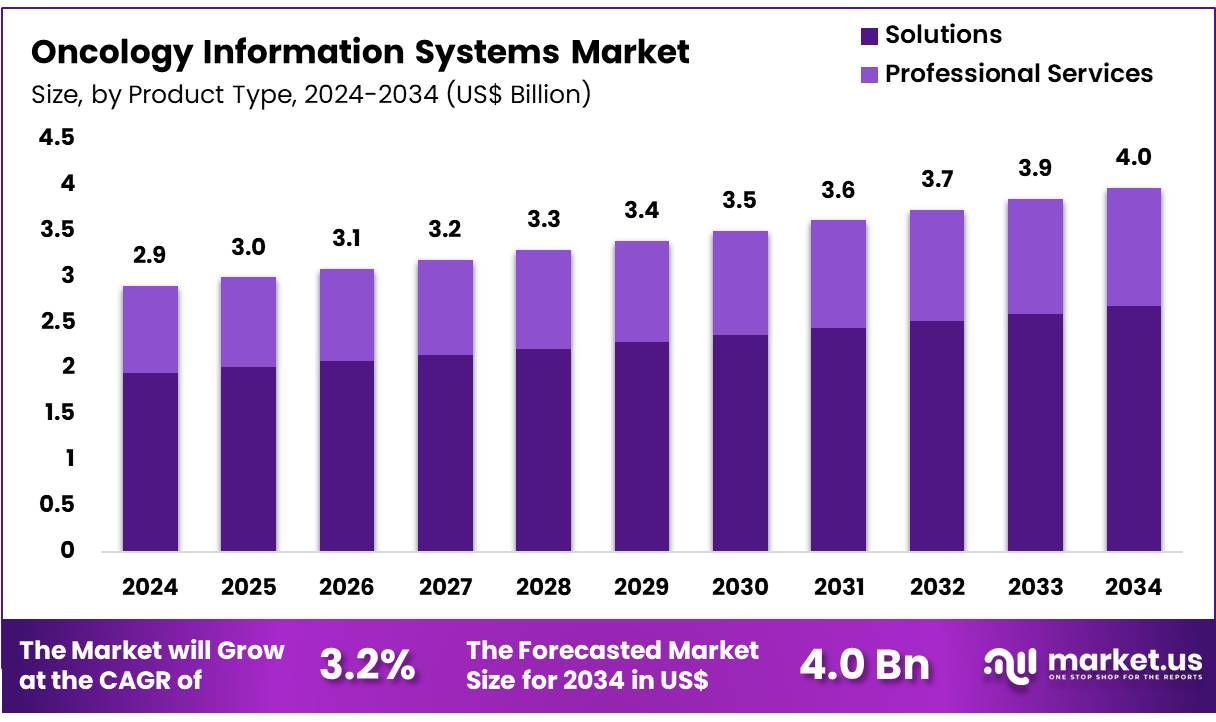
New York, NY – Dec 16, 2025 – Global Oncology Information Systems Market size is expected to be worth around US$ 4.0 Billion by 2034 from US$ 2.9 Billion in 2024, growing at a CAGR of 3.2% during the forecast period 2025 to 2034. In 2024, North America led the market, achieving over 39.9% share with a revenue of US$ 1.2 Billion.
Oncology Information Systems (OIS) are increasingly being adopted across healthcare facilities to support the management, planning, and delivery of cancer care. These systems are designed to integrate clinical, administrative, and operational data, enabling oncology departments to improve workflow efficiency and clinical accuracy.
An Oncology Information System supports key oncology functions, including patient scheduling, treatment planning, chemotherapy management, radiation therapy coordination, and electronic medical record integration. By centralizing patient information, OIS enables clinicians to access real-time data across the entire care pathway, supporting informed clinical decision-making and continuity of care.
The adoption of Oncology Information Systems has been driven by the rising global cancer burden, increasing demand for personalized treatment, and the need for improved data accuracy in complex oncology workflows. Healthcare providers are focusing on digital solutions that enhance patient safety, reduce manual errors, and streamline interdisciplinary coordination.
Advanced OIS platforms also support data analytics, reporting, and compliance with regulatory standards. These capabilities are being used to improve clinical outcomes, optimize resource utilization, and support research activities. Integration with hospital information systems and imaging platforms further strengthens care coordination.
As healthcare systems continue to invest in digital infrastructure, Oncology Information Systems are expected to play a critical role in supporting efficient, data-driven oncology services. Their adoption reflects a broader shift toward technology-enabled cancer care delivery focused on quality, safety, and operational excellence.
Key Takeaways
- In 2024, the oncology information systems market recorded revenue of US$ 2.9 billion and is projected to expand at a compound annual growth rate (CAGR) of 3.2%, reaching approximately US$ 4.0 billion by 2034.
- Based on product type, the market is categorized into solutions and professional services, with the solutions segment dominating the market in 2024, accounting for a 67.4% revenue share.
- By application, the market is segmented into medical oncology, surgical oncology, and radiation oncology. Among these, medical oncology emerged as the leading application, capturing a 42.1% share of the total market.
- In terms of end users, the market comprises hospitals & diagnostic imaging centers, research facilities, and others. The hospitals & diagnostic imaging centers segment held the largest share, contributing 52.3% of total market revenue.
- Regionally, North America maintained its leadership position, representing 39.9% of the global oncology information systems market in 2024.
Regional Analysis
North America dominated the market with a revenue share of 39.9%, driven by the rising cancer burden, high adoption of electronic health records (EHRs) in oncology centers, and the growing need for integrated data management to improve patient care. As cancer incidence increases, healthcare providers are relying on advanced information systems to manage complex clinical data, streamline workflows, and support multidisciplinary collaboration.
According to the National Cancer Institute, the incidence rate of new cancer cases in the U.S. reached 445.8 per 100,000 population during 2018–2022, reinforcing sustained demand for robust oncology management solutions. In parallel, widespread EHR and telemedicine adoption installed in 78.6% of U.S. hospitals as of February 2024 has created a strong foundation for integrating specialized cancer care platforms. The market expansion is further reflected in the financial performance of key players, with Siemens Healthineers reporting 4.7% comparable revenue growth in FY2024 and Varian posting a 10.5% increase in Q4 FY2024.
Asia Pacific is projected to register the fastest CAGR over the forecast period due to rapidly increasing cancer incidence, expanding healthcare infrastructure, and strong government support for digital health. High cancer case volumes in China and India, combined with regional digital health initiatives, are accelerating the adoption of integrated oncology information systems, supporting improved care coordination and clinical outcomes.
Emerging Trends
- AI and Machine Learning for Better Cancer Care: Artificial intelligence and machine learning are being adopted in oncology information systems to support clinical decision-making. These tools analyze real-time patient data, predict treatment responses, enhance therapy planning, and continuously improve accuracy, enabling timely interventions and improved clinical outcomes.
- Cloud-Based Oncology Platforms: Cloud-based oncology information systems are increasingly deployed to improve accessibility, scalability, and collaboration. These platforms enable secure, real-time access to patient records across locations, reduce infrastructure costs, simplify system updates, and support seamless integration with other healthcare technologies.
- Integration with Genomic Data: Oncology information systems are integrating genomic data to support precision medicine. By analyzing genetic markers and DNA profiles, clinicians can personalize treatment strategies, predict therapy effectiveness, reduce adverse effects, and improve early cancer detection, resulting in more targeted and efficient care delivery.
- Tele-oncology Services: Tele-oncology capabilities are expanding through advanced oncology information systems that support virtual consultations. These systems enable remote access to patient records, imaging, and test results, improving care access for rural populations, reducing hospital visits, and ensuring continuous, high-quality oncology care delivery.
- Real-Time Data Sharing Across Teams: Modern oncology information systems enable real-time data sharing among multidisciplinary care teams. Instant access to updated patient information improves collaboration, reduces communication errors, accelerates clinical decision-making, and ensures coordinated treatment planning, ultimately enhancing patient safety and treatment outcomes.
- Patient Engagement Features: Oncology information systems increasingly include patient engagement tools such as portals and mobile applications. These features provide access to treatment plans, test results, and communication channels, encouraging active patient participation, improving adherence, reducing anxiety, and strengthening transparency throughout the cancer care journey.
- Advanced Analytics for Research: Advanced analytics within oncology information systems support clinical research and performance evaluation. By analyzing large datasets, these tools identify treatment trends, support clinical trials, improve protocol effectiveness, and promote evidence-based decision-making, contributing to continuous improvements in oncology care quality.
Use Cases
- Coordinating Cancer Treatment Plans: Oncology information systems centralize treatment schedules, including surgery, chemotherapy, and radiation plans. This ensures clear visibility for all care providers, improves coordination among specialists, reduces delays, minimizes errors, and provides patients with a structured and predictable treatment pathway.
- Tracking Patient Progress: Oncology information systems enable continuous monitoring of patient responses by recording clinical outcomes, side effects, and diagnostic results. This longitudinal data supports timely treatment adjustments, personalized care decisions, and improved outcome evaluation, ensuring patients receive responsive and data-driven cancer management.
- Reducing Duplicate Tests: By consolidating patient records, oncology information systems reduce unnecessary duplicate tests. Easy access to prior diagnostics lowers healthcare costs, minimizes patient discomfort, improves resource utilization, and accelerates clinical decisions by ensuring care teams rely on complete and up-to-date information.
- Supporting Remote Cancer Care: Oncology information systems support remote cancer care by integrating telehealth services with centralized patient data. Specialists can review records, collaborate virtually, and provide expert guidance regardless of location, improving access to high-quality oncology care for rural and underserved populations.
- Helping Research and Clinical Trials: Oncology information systems streamline clinical trial management by identifying eligible patients and tracking outcomes in real time. Structured data collection improves research accuracy, accelerates recruitment, supports therapy evaluation, and strengthens collaboration between clinical care and oncology research initiatives.
- Billing and Compliance Management: Oncology information systems automate billing, coding, and regulatory documentation processes. These capabilities reduce administrative burden, improve billing accuracy, ensure compliance with healthcare regulations, and allow providers to focus more on patient care while enhancing financial and operational efficiency.
Frequently Asked Questions on Oncology Information Systems
- What are the core components of an Oncology Information System?
Core components typically include patient information management, treatment planning systems, radiation dose tracking, imaging integration, clinical decision support, scheduling, and billing modules, enabling coordinated and accurate oncology care delivery across multidisciplinary teams. - How do Oncology Information Systems improve clinical efficiency?
Clinical efficiency is improved through workflow automation, centralized patient data access, reduced documentation errors, and streamlined coordination between oncologists, radiologists, and therapists, resulting in faster treatment decisions and enhanced care continuity. - What types of healthcare facilities use Oncology Information Systems?
Oncology Information Systems are widely adopted by hospitals, cancer specialty centers, academic medical institutions, and large outpatient clinics, particularly facilities managing high patient volumes and complex radiation or medical oncology treatment protocols. - Are Oncology Information Systems interoperable with other health IT systems?
Most modern Oncology Information Systems are designed with interoperability standards, allowing seamless integration with electronic health records, laboratory systems, imaging platforms, and hospital information systems to ensure comprehensive and synchronized patient data exchange. - What factors are driving the growth of the Oncology Information Systems market?
Market growth is driven by rising global cancer incidence, increasing adoption of digital healthcare solutions, demand for precision oncology, and growing investments in healthcare IT infrastructure to improve treatment accuracy and operational efficiency. - Which regions dominate the Oncology Information Systems market?
North America holds a dominant market position due to advanced healthcare infrastructure, early technology adoption, and strong presence of leading vendors, while Asia-Pacific is expected to register faster growth due to expanding cancer care investments. - What role does cloud-based deployment play in market expansion?
Cloud-based deployment supports market expansion by offering scalable infrastructure, lower upfront costs, remote accessibility, and easier system updates, making Oncology Information Systems more accessible to small and mid-sized healthcare providers.
Conclusion
Oncology Information Systems have become a critical component of modern cancer care delivery, supporting the growing complexity of oncology workflows. By integrating clinical, administrative, and operational data, these systems enhance care coordination, improve clinical accuracy, and strengthen patient safety. Market growth is being driven by rising cancer incidence, increased adoption of digital health solutions, and demand for precision medicine.
Advanced capabilities such as analytics, cloud deployment, AI integration, and genomic data support further reinforce their value. As healthcare systems continue digital transformation, Oncology Information Systems are expected to play a central role in delivering efficient, data-driven, and high-quality oncology services globally.
Discuss your needs with our analyst
Please share your requirements with more details so our analyst can check if they can solve your problem(s)




