


Table of Contents
Overview
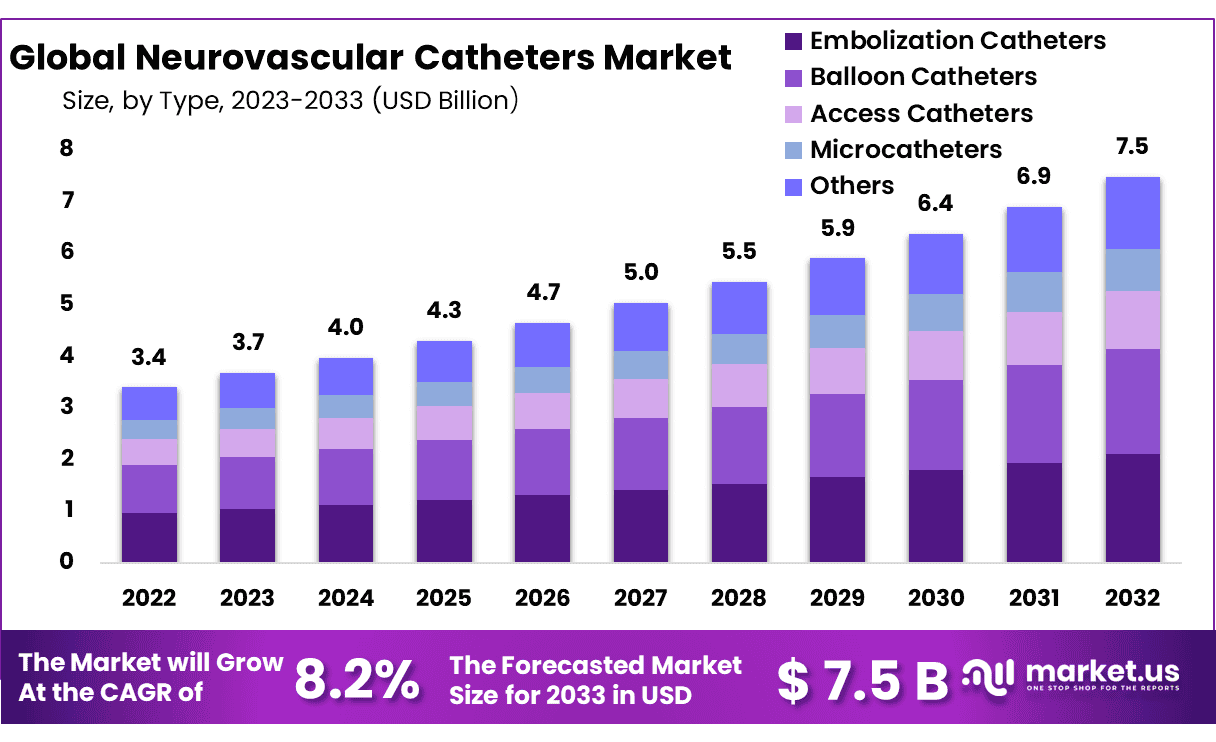
New York, NY – Jan 14, 2026 – The Global Neurovascular Catheters Market size is expected to be worth around USD 7.5 Billion by 2033 from USD 3.4 Billion in 2023, growing at a CAGR of 8.2% during the forecast period from 2024 to 2033.
Neurovascular catheters are specialized medical devices designed to access and treat blood vessels within the brain and central nervous system. These devices play a critical role in the diagnosis and management of complex neurological conditions, including ischemic stroke, cerebral aneurysms, arteriovenous malformations, and intracranial stenosis. Their development has supported the growing adoption of minimally invasive neurointerventional procedures worldwide.
Neurovascular catheters are typically manufactured using advanced polymer materials, often reinforced with braided or coiled structures to ensure flexibility, strength, and torque control. The basic formation includes a long, thin, and flexible tube engineered to navigate the intricate and delicate pathways of cerebral vasculature. Hydrophilic coatings are commonly applied to the catheter surface to reduce friction and improve maneuverability during procedures.
These catheters are available in various designs, including guiding catheters, microcatheters, and aspiration catheters, each serving a specific clinical function. Guiding catheters provide stable access to target vessels, microcatheters enable precise delivery of therapeutic devices such as coils or stents, and aspiration catheters assist in clot removal during acute stroke interventions.
The demand for neurovascular catheters is being driven by the rising prevalence of neurological disorders, increasing geriatric population, and continuous advancements in interventional neuroradiology. In addition, improvements in catheter design, imaging compatibility, and material science have enhanced procedural safety and clinical outcomes.
Overall, neurovascular catheters are considered a foundational component of modern neurovascular intervention, supporting efficient, accurate, and minimally invasive treatment approaches across global healthcare systems.
Key Takeaways
- Market Size & Growth: The global neurovascular catheters market was valued at USD 3.4 billion in 2023 and is projected to reach approximately USD 7.5 billion by 2033, expanding at a CAGR of 8.2% over the forecast period.
- Product Analysis: Based on product type, embolization catheters represented the leading segment, accounting for over 28.1% of the total market share in 2023.
- Application Analysis: By application, the brain aneurysm segment generated the highest revenue contribution, capturing nearly 33.4% of the market in 2023.
- End-Use Analysis: In 2023, hospitals emerged as the dominant end-use segment, holding a revenue share exceeding 56.7%.
- Regional Analysis: North America led the global market, securing more than 34.2% of total market share and generating revenues of approximately USD 1.162 billion in 2023.
- Recent Trends: The neurovascular catheters market is characterized by ongoing technological innovation, with manufacturers focusing on advanced catheter designs, enhanced materials, and improved coating technologies to strengthen competitive positioning.
- Future Prognosis: Steady market growth is anticipated, supported by rising adoption of minimally invasive neurovascular procedures and the increasing aging population worldwide.
Regional Analysis
North America emerged as the leading regional market in 2023, accounting for over 34.2% of the total market share and generating revenues of approximately USD 1.162 billion. This dominance can be attributed to the rising prevalence of neurological disorders, the presence of favorable reimbursement frameworks, and increasing awareness among patients and healthcare professionals regarding advanced neurovascular interventions.
The Asia Pacific region is projected to register the fastest revenue growth, with a compound annual growth rate (CAGR) of 9.5% during the forecast period from 2023 to 2033. Strong growth prospects in this region are supported by improving awareness and expanding access to neurovascular catheter technologies. In addition, the increasing incidence of neurological conditions such as stroke and brain aneurysms is expected to significantly contribute to regional market expansion.
The volume of neurosurgical procedures has increased across several highly affected countries, including the United States and Russia, which have reported a substantial number of confirmed cases and related fatalities. However, during the early stages of the COVID-19 pandemic, procedural volumes were temporarily constrained.
In March 2020, the American College of Surgeons (ACS) recommended the cancellation, postponement, or limitation of elective surgeries in response to the rapid escalation of COVID-19 cases in the U.S. Similar guidance was subsequently issued by the Centers for Medicare & Medicaid Services and the American Hospital Association to mitigate virus transmission and preserve healthcare system capacity.
Emerging Trends
- Technological Advancements: Recent advancements in neurovascular catheter design have significantly improved the stability and safety of endovascular procedures. Devices such as advanced guide catheters are engineered to provide enhanced support while maintaining sufficient flexibility to navigate complex and tortuous vascular anatomies. This combination has improved access to anatomically challenging regions and has contributed to better procedural control.
- Integration with Advanced Imaging and Robotics: The increasing integration of advanced imaging systems, robotics, and automation within catheterization laboratories is reshaping neurovascular interventions. These technologies are designed to improve procedural accuracy, minimize operator fatigue, and reduce radiation exposure. In addition, the adoption of robotic-assisted systems has enabled the exploration of remote interventions and partial automation, which are expected to enhance both patient safety and clinical outcomes over time.
- Expansion of Clinical Indications: Neurovascular catheters are being applied across a broader range of cerebrovascular conditions, including intracranial aneurysms and acute ischemic stroke. Their ability to deliver therapeutic devices and agents directly to targeted intracranial locations has improved treatment precision and efficacy, supporting their growing adoption in endovascular neurointerventions.
Key Use Cases
- Acute Ischemic Stroke Management: In patients experiencing acute ischemic stroke caused by large vessel occlusion, neurovascular catheters play a central role in mechanical thrombectomy procedures. These interventions are aimed at removing thrombi to rapidly restore cerebral perfusion. The use of distal access catheters has been associated with improved procedural safety and higher recanalization success rates.
- Intracranial Aneurysm Treatment: Neurovascular catheters are essential in the endovascular management of intracranial aneurysms, enabling the precise delivery of coils, flow diverters, or stents to the aneurysm site. This approach reduces the risk of rupture and stabilizes abnormal blood flow. Endovascular therapy has become the standard of care for ruptured intracranial aneurysms, supported by strong evidence from randomized controlled clinical trials.
- Management of Traumatic Arterial Injuries: For traumatic vascular injuries such as pseudoaneurysms and arteriovenous fistulas, neurovascular catheters are commonly used to perform embolization procedures. These minimally invasive techniques allow for targeted vessel occlusion, with coil embolization representing the most frequently utilized treatment modality. Clinical outcomes have demonstrated high effectiveness and reduced procedural morbidity.
- Diagnostic Cerebral Angiography: Neurovascular catheters are widely used in diagnostic cerebral angiography to visualize intracranial and extracranial vascular structures. This imaging modality is critical for the accurate diagnosis of cerebrovascular disorders and serves as a foundation for treatment planning and therapeutic decision-making.
Frequently Asked Questions on Neurovascular Catheters
- What clinical applications use neurovascular catheters?
Neurovascular catheters are widely used in neurointerventional procedures including thrombectomy, embolization, angiography, and stent placement. Their flexibility and precision allow safe navigation through complex cerebral vasculature, reducing procedural risks and recovery time. - What materials are commonly used in neurovascular catheters?
These catheters are typically manufactured using polymers such as polyurethane and nylon, often combined with braided metal reinforcements. Advanced coatings are applied to improve trackability, torque control, and biocompatibility during delicate neurovascular interventions. - What are the key benefits of neurovascular catheters?
The primary benefits include minimally invasive access, high procedural accuracy, reduced trauma to vessels, and shorter hospital stays. These advantages support improved patient outcomes, particularly in time-sensitive conditions such as acute ischemic stroke. - What is driving the growth of the neurovascular catheters market?
Market growth is driven by the rising prevalence of stroke and neurovascular disorders, increasing adoption of minimally invasive procedures, and continuous technological advancements that enhance catheter performance and clinical success rates. - How does the aging population impact market demand?
An expanding elderly population significantly increases the incidence of neurovascular diseases. This demographic trend is contributing to higher procedural volumes, thereby supporting sustained demand for neurovascular catheters across hospitals and specialized care centers. - Which regions dominate the neurovascular catheters market?
North America holds a leading market share due to advanced healthcare infrastructure and early technology adoption. However, Asia-Pacific is expected to register strong growth, supported by improving healthcare access and rising awareness of neurointerventional treatments.
Conclusion
Neurovascular catheters have become an essential component of modern neurointerventional care, enabling safe, precise, and minimally invasive management of complex cerebrovascular conditions. Continuous advancements in materials, coatings, and catheter design have enhanced procedural efficiency and clinical outcomes.
Market growth is being supported by the rising burden of neurological disorders, expanding elderly population, and increasing adoption of endovascular techniques across healthcare systems. While North America maintains market leadership, Asia Pacific is expected to witness accelerated growth. Overall, sustained technological innovation and expanding clinical applications are expected to reinforce the long-term growth outlook of the neurovascular catheters market.
Discuss your needs with our analyst
Please share your requirements with more details so our analyst can check if they can solve your problem(s)




