


Table of Contents
Overview
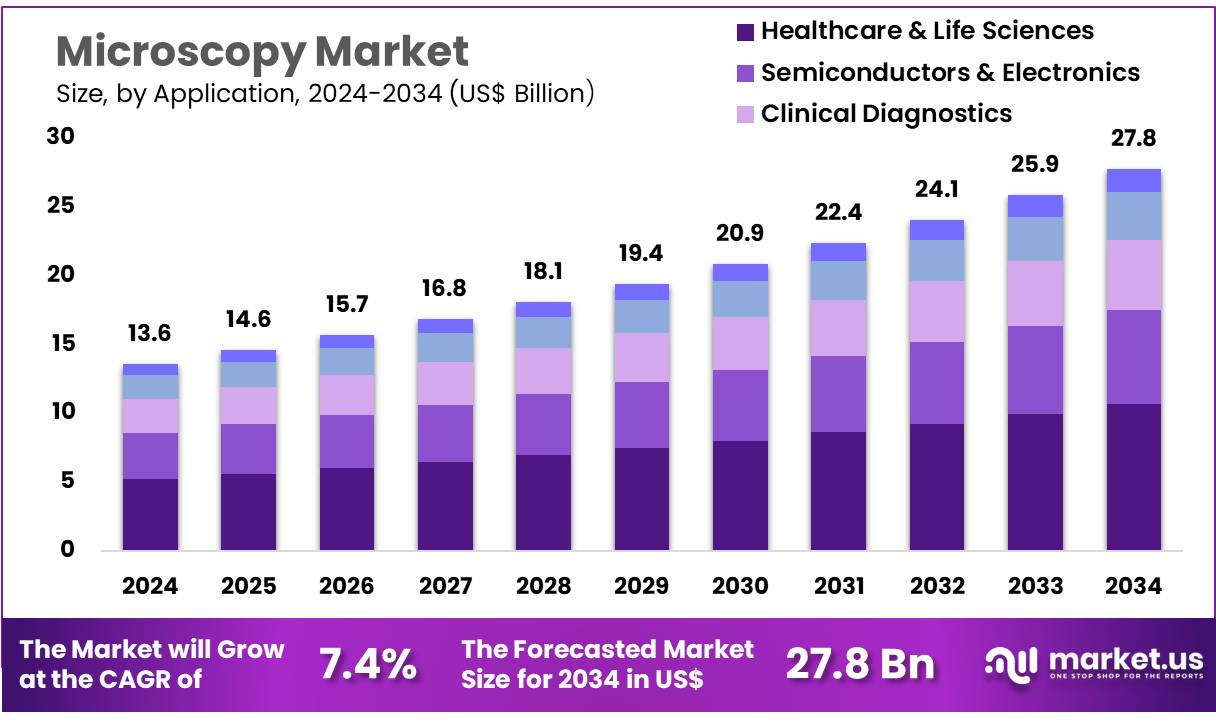
New York, NY – Jan 01, 2026 – The Global Microscopy Market size is expected to be worth around US$ 27.8 billion by 2034 from US$ 13.6 billion in 2024, growing at a CAGR of 7.4% during the forecast period 2025 to 2034. In 2023, North America led the market, achieving over 39.4% share with a revenue of US$ 5.4 Billion.
Microscopy is a fundamental scientific technique used to observe objects that are too small to be seen with the naked eye. The basic formation of microscopy is centered on the use of magnification, illumination, and resolution to produce detailed images of microscopic structures. This technique plays a critical role across life sciences, material science, clinical diagnostics, and industrial research.
At its core, a microscope consists of an optical or electronic system, a light or electron source, and a series of lenses or detectors. In optical microscopy, visible light is directed onto the sample and focused through objective and eyepiece lenses to create an enlarged image. The clarity of this image depends on resolution, which is influenced by wavelength, numerical aperture, and lens quality. In advanced systems, digital sensors are used to capture and analyze images with high precision.
Sample preparation is a key component of microscopy formation. Samples are often stained, fixed, or sectioned to enhance contrast and structural visibility. Proper preparation ensures accurate observation and reproducible results. The integration of automated stages, image processing software, and high-resolution detectors has further improved analytical efficiency and data reliability.
Microscopy continues to evolve with technological advancements, supporting deeper insights into cellular structures, material properties, and nanoscale phenomena. Its foundational principles remain essential for scientific discovery, quality control, and innovation. As research demands increase, microscopy is expected to maintain its position as a critical tool enabling precise visualization and data-driven decision-making across multiple industries.
Key Takeaways
- In 2024, the global microscopy market recorded revenue of US$ 13.6 billion and is projected to expand at a CAGR of 7.4%, reaching approximately US$ 27.8 billion by 2033.
- By product type, the market is categorized into microscopes, accessories, and software, with microscopes emerging as the leading segment, accounting for 54.7% of total market share in 2023.
- Based on application, the market is segmented into semiconductors & electronics, healthcare & life sciences, clinical diagnostics, drug delivery & development, and others. Among these, healthcare & life sciences represented the largest share at 38.4%.
- In terms of end users, the market is divided into industrial users, semiconductor & electronics industry, automotive, food & beverage, and others, with industrial users dominating the market and capturing 42.6% of total revenue.
- Regionally, North America maintained market leadership, holding a 39.4% share of the global microscopy market in 2023.
Microscope Market Statistics
- Market Size: The global microscope market was estimated at around USD 7.5 billion in 2023, supported by continuous technological progress and rising research and development activities worldwide.
- Growth Rate: The market is projected to expand at a compound annual growth rate (CAGR) of approximately 7% between 2023 and 2032, driven by increasing adoption in healthcare, nanotechnology, and material science applications.
- Electron Microscopy: Electron microscopes account for nearly 40% of total market revenue, reflecting their extensive use in advanced medical research and nanotechnology due to superior imaging resolution.
- Healthcare Sector: Healthcare remains a key end-use industry, with microscopes widely utilized in pathology, clinical diagnostics, cancer research, and genetic testing.
- Education and Research: Academic and research institutions contribute over 30% of overall demand, supported by rising public and private funding for scientific research programs.
- Digital Microscopes: Digital microscopy represents about 20% of the market, favored for ease of use, image storage, and seamless electronic data sharing.
- Portable Microscopes: Portable and handheld microscopes comprise approximately 10% of the market, primarily used in field studies and point-of-care diagnostic settings.
- AI Integration: The integration of artificial intelligence in microscopy is enhancing image analysis, automation, and workflow efficiency, leading to improved diagnostic and research accuracy.
- Material Science Applications: Around 15% of market demand is attributed to material science, where microscopes are essential for examining material structures and properties.
- Government Funding: Substantial government investments, including USD 42.5 billion allocated by the National Institutes of Health (NIH), are accelerating the adoption of advanced microscopy systems.
- Cryo-Electron Microscopy: Cryo-electron microscopy is emerging as a high-growth segment, particularly in structural biology and virology, and is expected to grow at a CAGR of about 8% over the next decade.
- Automation: Automated microscopy solutions support high-throughput analysis in drug discovery and pathology laboratories, with related sales forecasted to reach USD 1.2 billion by 2030.
- Sustainability Initiatives: Manufacturers are increasingly focusing on energy-efficient and sustainable designs, with industry targets aiming to reduce environmental impact by approximately 20% by 2025.
- Technological Advancements: Innovations such as super-resolution and multiphoton microscopy continue to enhance imaging capabilities and broaden application areas.
- Microscope Rentals: Rental and leasing services are gaining popularity as cost-effective alternatives, with the segment expected to grow at around 6% annually, reaching USD 500 million by 2028.
Regional Analysis
North America Leading the Microscopy Market
North America accounted for the largest revenue share of 39.4%, supported by continuous advancements in imaging technologies and strong investment in life sciences research. The rising requirement for high-resolution imaging in biomedical fields, such as oncology research and neuroscience, has accelerated the adoption of advanced microscopy systems. Growth in the biotechnology and pharmaceutical sectors further increased demand for sophisticated imaging tools used in drug discovery and cellular-level analysis.
The strong presence of established research institutions, along with active collaborations between academic bodies and industry participants, has reinforced innovation across the region. Increased use of digital microscopy integrated with artificial intelligence has enhanced automated analysis, diagnostic precision, and operational efficiency. In addition, government funding for nanotechnology and material science research has contributed to sustained market development. The adoption of digital platforms and remote-access imaging has also improved data sharing and supported collaborative research environments.
Asia Pacific Expected to Register the Fastest Growth
The Asia Pacific microscopy market is projected to record the highest CAGR during the forecast period, driven by rising investments in research activities and the expansion of healthcare infrastructure. Product innovations, such as the launch of the ECLIPSE Ui by Nikon Corporation in April 2023, reflect the region’s growing focus on digital imaging solutions. Increasing demand for precision imaging in medical diagnostics and semiconductor manufacturing is expected to support market expansion.
Government initiatives promoting research and development in life sciences and materials engineering are likely to stimulate investment in advanced microscopy technologies. Strategic partnerships between global manufacturers and regional research institutions are anticipated to improve accessibility and cost efficiency. Furthermore, the rising adoption of AI-enabled imaging solutions in pathology and disease diagnosis is expected to enhance clinical efficiency and drive sustained market growth across Asia Pacific.
Emerging Trends in Microscopy
- Advancements in Electron Microscopy: Continuous improvements in electron microscopy, particularly cryo-electron microscopy (cryo-EM), are significantly enhancing research outcomes in structural biology and virology.
- Integration of Artificial Intelligence: Artificial intelligence is increasingly being incorporated into microscopy workflows, enabling automated image acquisition, faster data processing, and higher diagnostic accuracy.
- Expansion of Digital Microscopy: The growing adoption of digital microscopes is enabling remote diagnostics, image sharing, and virtual learning, supporting applications in education and telemedicine.
- Rising Demand for Portable Microscopes: Handheld and portable microscopes are gaining traction due to their mobility, ease of operation, and suitability for field research and point-of-care diagnostics.
- Growth of Nanotechnology Applications: Microscopy remains critical for nanoscale imaging and analysis, supporting innovations in nanomedicine, electronics, and industrial manufacturing.
- Clinical Application Innovations: Microscopes are being increasingly utilized in personalized medicine, molecular diagnostics, and advanced clinical testing, expanding their role in healthcare delivery.
- Government Funding and Support: Strong financial support from government agencies, including organizations such as the National Institutes of Health (NIH), continues to stimulate research activities and adoption of advanced microscopy systems.
- Increasing Educational Investments: Educational institutions are investing in modern microscopy technologies to strengthen science education and laboratory-based learning.
- Ongoing Technological Progress: Developments such as super-resolution and multiphoton microscopy are extending imaging depth and resolution, broadening research and clinical capabilities.
- Growth in Automation: Automated and high-throughput microscopy systems are increasingly adopted in drug discovery, life sciences research, and clinical laboratories, improving efficiency and scalability.
Key Use Cases of Microscopy
- Medical Diagnostics: Advanced microscopy is essential in pathology and cytology, enabling accurate diagnosis of diseases such as cancer and infectious conditions through high-resolution imaging.
- Research and Development: Microscopes play a central role in biomedical and pharmaceutical research, allowing detailed visualization of cellular mechanisms and supporting drug and therapy development.
- Nanotechnology: Electron and scanning probe microscopes are widely used for imaging, characterization, and manipulation of nanomaterials, driving innovation in advanced materials and devices.
- Education: Microscopes are fundamental tools in biology and life science education, with digital platforms improving accessibility and interactive learning in academic settings.
- Environmental Science: Microscopy supports the analysis of microorganisms, contaminants, and particulate matter in environmental samples, contributing to ecosystem monitoring and protection.
- Material Science: High-precision microscopes are used to analyze material microstructures, supporting the development of advanced materials such as composites, ceramics, and polymers.
- Forensic Science: Forensic laboratories rely on microscopy to examine trace evidence, including fibers, residues, and biological samples, supporting criminal investigations.
- Agriculture: Microscopes assist in plant pathology, pest identification, and soil analysis, helping improve crop productivity and sustainable agricultural practices.
- Clinical Research: In clinical research, microscopy enables detailed investigation of disease mechanisms, supporting the development of new diagnostic methods and therapeutic approaches.
Frequently Asked Questions on Microscopy
- What is microscopy and why is it important?
Microscopy is a scientific technique used to visualize structures that are not visible to the naked eye. It is essential for studying cells, materials, and microorganisms, enabling advancements in medical research, diagnostics, and industrial quality control. - What are the main types of microscopy used today?
The primary types of microscopy include optical, electron, and scanning probe microscopy. Each type differs in resolution, imaging method, and application, supporting diverse uses across life sciences, nanotechnology, semiconductor analysis, and material research. - What factors are driving the growth of the microscopy market?
Market growth is driven by rising investments in life sciences research, increasing demand for high-resolution imaging, technological advancements such as AI-enabled analysis, and expanding applications in healthcare, semiconductors, and industrial inspection. - Which industries are the major users of microscopy systems?
Microscopy systems are widely used in healthcare and life sciences, semiconductor manufacturing, pharmaceuticals, biotechnology, automotive testing, and industrial research, where precise visualization and structural analysis are critical for innovation and quality assurance. - Why does North America lead the microscopy market?
North America leads due to strong research infrastructure, high funding for life sciences and nanotechnology, early adoption of advanced imaging technologies, and the presence of major manufacturers and research institutions supporting continuous innovation. - Why is Asia Pacific expected to grow at the fastest rate?
Asia Pacific is expected to grow rapidly due to expanding healthcare infrastructure, increasing government support for research, growth in semiconductor manufacturing, and rising adoption of advanced and digital microscopy technologies across emerging economies. - What role does artificial intelligence play in modern microscopy?
Artificial intelligence enhances microscopy by enabling automated image analysis, faster data interpretation, improved diagnostic accuracy, and higher workflow efficiency, particularly in pathology, clinical diagnostics, and large-scale research environments. - What is the future outlook for the microscopy market?
The microscopy market is expected to witness sustained growth, supported by continuous technological innovation, rising demand for precision imaging, expanding research activities, and increasing adoption across healthcare, industrial, and semiconductor applications worldwide.
Conclusion
Microscopy remains a cornerstone technology underpinning scientific research, clinical diagnostics, and industrial innovation. The market demonstrates strong and sustained growth, driven by rising demand for high-resolution imaging, expanding healthcare and life sciences applications, and continuous technological advancements such as AI integration, automation, and digital microscopy.
Strong government funding, particularly in North America, and rapid infrastructure development in Asia Pacific further support market expansion. As applications broaden across nanotechnology, material science, and personalized medicine, microscopy is expected to maintain its critical role in enabling precision analysis, data-driven decision-making, and long-term innovation across multiple industries.
Discuss your needs with our analyst
Please share your requirements with more details so our analyst can check if they can solve your problem(s)




