


Table of Contents
Overview
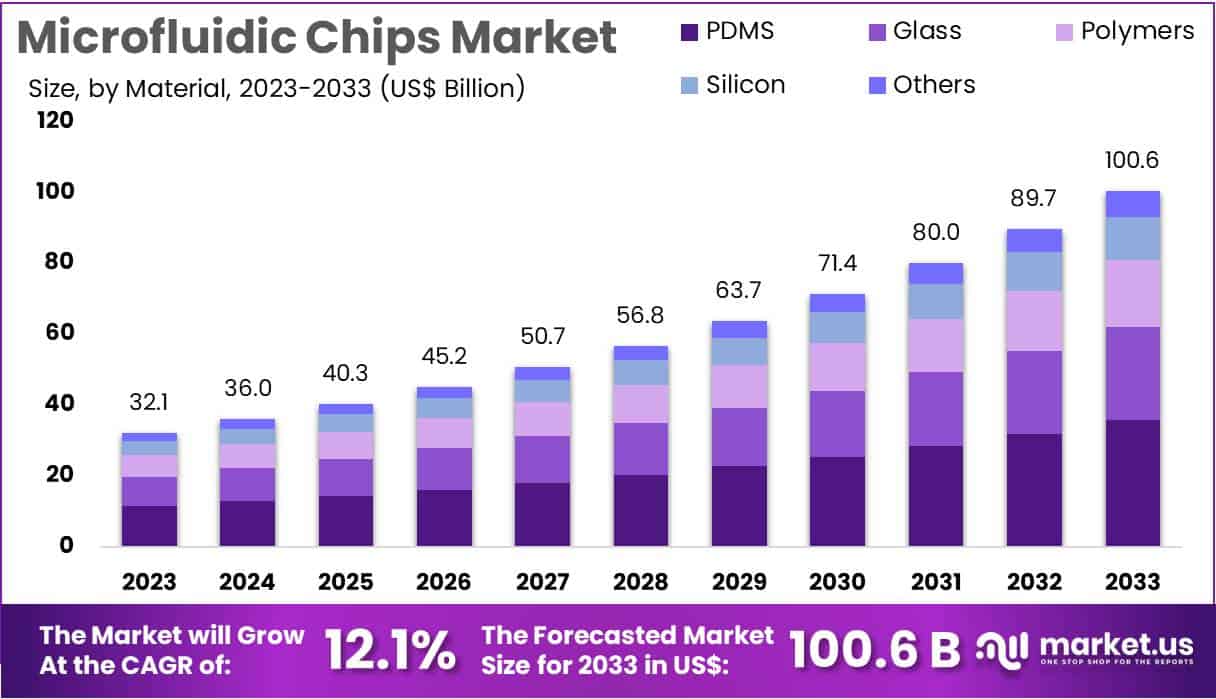
New York, NY – Feb 25, 2026 – The Global Microfluidic Chips Market Size is expected to be worth around US$ 100.6 Billion by 2033, from US$ 32.1 Billion in 2023, growing at a CAGR of 12.1% during the forecast period from 2024 to 2033.
Microfluidic chips are being recognized as a foundational technology enabling precise manipulation of very small volumes of fluids for applications across healthcare, diagnostics, pharmaceuticals, and research. The basic formation of these chips involves the design and fabrication of microscopic channels, chambers, and valves on substrates such as glass, silicon, or polymers, where fluid flow can be accurately controlled.
The process typically begins with microchannel design using computer-aided tools to define fluid pathways and functional structures. Fabrication is then carried out through techniques such as photolithography, soft lithography, or micromachining, depending on the material and performance requirements. In polymer-based chips, molds are often created and used to cast materials like polydimethylsiloxane (PDMS), which are subsequently bonded to form sealed channels.
Surface treatment is applied to ensure appropriate fluid behavior, including control of wettability and reduction of nonspecific adsorption. Integration of sensors, electrodes, or optical components may be incorporated to enable real-time monitoring and analysis. Quality testing is conducted to verify channel integrity, flow consistency, and device reliability before deployment.
The structured formation process supports high precision, low reagent consumption, and scalability, making microfluidic chips suitable for point-of-care testing, drug screening, and lab-on-a-chip systems. Continued advancements in fabrication methods and materials are expected to enhance performance and expand commercial adoption across multiple industries.
Key Takeaways
- In 2023, the microfluidic chips market recorded revenue of US$ 32.1 billion and is projected to grow at a CAGR of 12.1%, reaching approximately US$ 100.6 billion by 2033.
- By material type, the market is segmented into glass, silicon, PDMS, polymers, and others, with PDMS leading in 2023 by accounting for 35.6% of the total share.
- Based on technology classification, the market is categorized into medical and non-medical segments, with the medical segment holding a dominant share of 68.5%.
- In terms of applications, the lab-on-a-chip segment emerged as the leading category, capturing the highest revenue share of 37.8% in the market.
- Regionally, North America accounted for the largest market share, representing 39.2% in 2023.
Regional Analysis
North America led the microfluidic chips market with a 39.2% revenue share, supported by strong healthcare infrastructure, advancements in diagnostics, and growing adoption of precision medicine. Increasing use of microfluidics in drug development, point-of-care testing, and personalized treatments supported regional growth.
Regulatory progress, including 510(k) clearance from the U.S. Food and Drug Administration for a laser-assisted irrigation system developed by BIOLASE, Inc. and EdgeEndo, strengthened innovation and clinical adoption. Continued investments across biotechnology and pharmaceutical research further reinforced demand.
Meanwhile, Asia Pacific is projected to register the fastest growth due to rising healthcare spending and technology partnerships. Collaboration between HORIBA and SigTuple to expand AI-enabled diagnostics highlights regional momentum. Expanding healthcare modernization initiatives in China and India are expected to support broader adoption of microfluidic technologies.
Emerging Trends
- Wider Adoption of Flexible, Low-Cost Materials: Affordable polymers, paper, and films are replacing glass and silicon in microfluidic chips, enabling disposable devices, reducing sterilization needs, lowering costs, supporting mass production, and expanding diagnostics in low-resource and remote settings globally.
- Integration with Digital and Connected Technologies: Microfluidic chips integrated with smartphones, sensors, and cloud systems enable real-time monitoring, rapid data sharing, improved accuracy, and support telemedicine by transforming complex laboratory testing into portable, connected diagnostic solutions.
- Innovations in 3D Printing for Chip Fabrication: 3D printing enables rapid production of complex microfluidic chips with customizable designs, reduced waste, lower costs, and faster prototyping, enhancing research flexibility and supporting scalable applications across diagnostics, biology, and chemistry.
- Expansion of Organ-on-a-Chip Applications: Organ-on-a-chip systems replicate human organ functions using living cells, improving disease modeling, reducing animal testing, accelerating drug development, lowering costs, and enabling more accurate, personalized approaches in medical research and clinical studies.
Use Cases
- Drug Development and Testing: Microfluidic chips allow pharmaceutical researchers to simulate human organ responses, test drug effects, optimize dosing, reduce reliance on animal studies, shorten development timelines, lower costs, and improve safety and effectiveness of treatments.
- Genetic and Cancer Research: Researchers use microfluidic chips to analyze DNA, detect cancer biomarkers, study single cells, enable early diagnosis, support personalized therapies, improve research accuracy, and accelerate discoveries in oncology and genetic medicine.
- Food and Water Safety: Microfluidic chips enable rapid detection of pathogens, toxins, and contaminants in food and water, allowing on-site testing, faster response, improved public health protection, reduced risks, and enhanced safety monitoring across supply chains.
- Agricultural Monitoring: Microfluidic chips help monitor soil nutrients, detect plant diseases, track environmental conditions, support precision farming, improve crop yields, reduce resource waste, and enable informed decisions for sustainable agricultural management.
Frequently Asked Questions on Microfluidic Chips
- How do microfluidic chips work?
Microfluidic chips operate by directing fluids through tiny channels using pressure, capillary forces, or electric fields. Controlled mixing, separation, or reaction occurs within the chip, allowing complex laboratory processes to be miniaturized and performed efficiently with high reproducibility and automation capabilities. - What materials are commonly used to manufacture microfluidic chips?
Materials such as glass, silicon, and polymers like PDMS and thermoplastics are commonly utilized. The selection is determined by factors including chemical compatibility, optical transparency, cost efficiency, and scalability, ensuring suitability for research applications as well as commercial production environments. - What are the key applications of microfluidic chips?
Applications span clinical diagnostics, point-of-care testing, genomics, proteomics, environmental monitoring, and cell analysis. Their ability to perform multiple laboratory functions on a single platform supports faster decision-making, improved accuracy, and reduced operational costs across healthcare and research settings. - What advantages do microfluidic chips offer over traditional laboratory methods?
Microfluidic chips offer benefits such as lower sample and reagent requirements, faster processing times, enhanced precision, and portability. These advantages contribute to increased efficiency and enable decentralized testing, supporting innovation in personalized medicine and real-time analytical workflows. - Which regions are leading in the microfluidic chips market?
North America and Europe are leading due to strong research infrastructure, significant funding, and early technology adoption. Rapid growth is also being observed in Asia-Pacific, supported by expanding healthcare investments, increasing biotechnology activities, and rising demand for advanced diagnostic solutions. - Who are the key end users in the microfluidic chips market?
Primary end users include pharmaceutical and biotechnology companies, academic and research institutes, diagnostic laboratories, and hospitals. Growing utilization in clinical settings and industrial research has been observed as organizations seek efficient, high-throughput analytical technologies. - What is the future outlook for the microfluidic chips market?
A positive outlook is anticipated, supported by continuous innovation, integration with digital health technologies, and expanding use in personalized medicine. Increasing commercialization efforts and growing demand for rapid diagnostics are expected to sustain long-term market expansion globally.
Conclusion
The microfluidic chips market is positioned for sustained expansion, supported by strong demand across diagnostics, drug development, and research applications. Advancements in fabrication techniques, integration with digital technologies, and growing adoption of cost-effective materials are enhancing scalability and accessibility.
Increasing investments in precision medicine, point-of-care testing, and organ-on-a-chip platforms are strengthening innovation pipelines. Regional growth is being driven by healthcare modernization and expanding biotechnology activities, particularly in emerging economies.
Overall, the technology is expected to play a critical role in improving analytical efficiency, reducing costs, and enabling decentralized healthcare solutions, reinforcing its importance across multiple industries in the coming decade.
Discuss your needs with our analyst
Please share your requirements with more details so our analyst can check if they can solve your problem(s)




