


Table of Contents
Overview
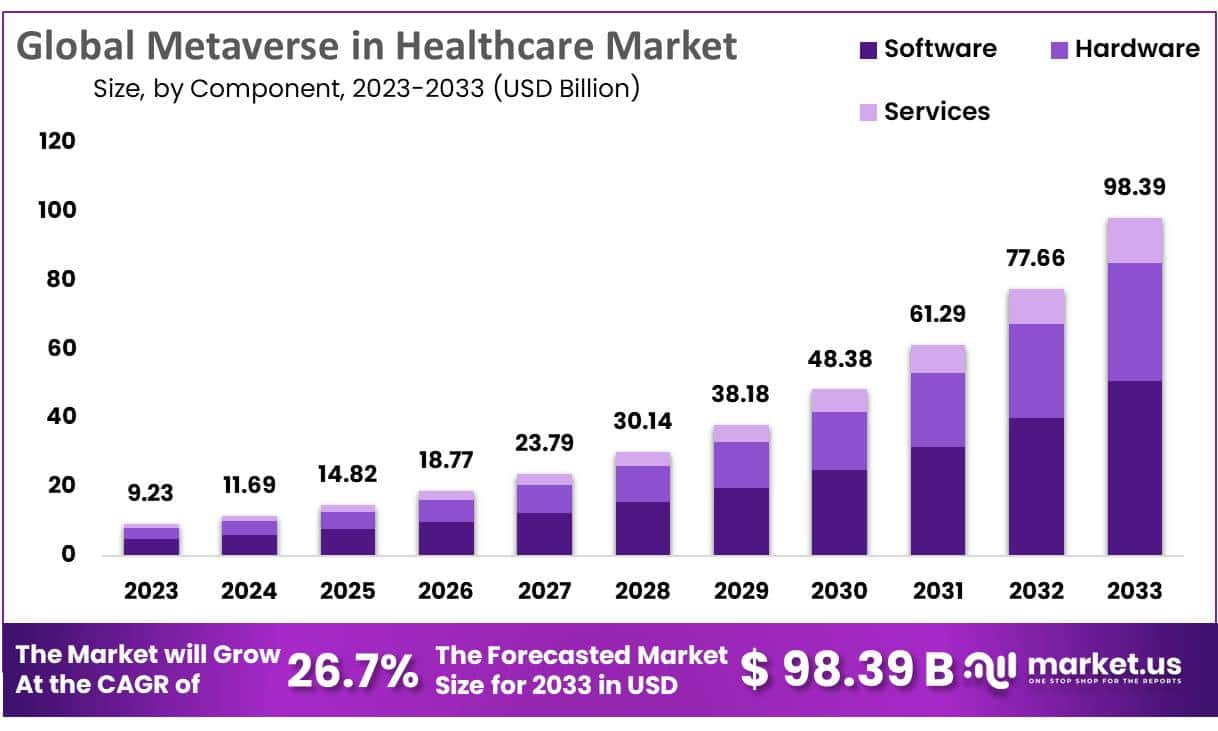
New York, NY – Dec 24, 2025 – The Global Metaverse in Healthcare Market size is expected to be worth around USD 98.39 Billion by 2033 from USD 9.23 Billion in 2023, growing at a CAGR of 26.7% during the forecast period from 2024 to 2033.
The metaverse is increasingly being recognized as a foundational digital environment with the potential to reshape healthcare delivery, training, and patient engagement. Built on a combination of extended reality (XR), artificial intelligence (AI), blockchain, and advanced data networks, the metaverse enables immersive, real-time, and interactive virtual experiences that extend beyond traditional digital health tools.
In healthcare, the basic formation of the metaverse involves the creation of secure virtual environments where patients, healthcare professionals, and medical institutions can interact through digital avatars. These environments are supported by virtual reality (VR) and augmented reality (AR) technologies, allowing realistic simulations of clinical settings, human anatomy, and treatment procedures. As a result, medical education and professional training are being enhanced through risk-free, repeatable, and highly visual learning experiences.
From a clinical perspective, the metaverse supports remote consultations, virtual therapy sessions, and digital rehabilitation programs. Patients are able to access care in immersive spaces that improve engagement and adherence, particularly in mental health, chronic disease management, and physical rehabilitation. In parallel, digital twins and simulated patient models are being developed to assist in personalized treatment planning and clinical decision-making.
Data security and interoperability are addressed through blockchain-based frameworks and cloud infrastructure, ensuring patient data integrity and compliance with regulatory standards. As investment and innovation continue to accelerate, the metaverse is positioned as a scalable and patient-centric ecosystem that supports efficiency, accessibility, and improved healthcare outcomes.
Key Takeaways
- The Metaverse in Healthcare market recorded revenue of USD 9.23 billion in 2023 and is projected to surpass USD 98.39 billion by 2033, expanding at a CAGR of 26.7% over the forecast period.
- By component, the software segment dominated the market in 2023, accounting for 51.7% of the total market share.
- Based on technology, augmented reality (AR) and virtual reality (VR) held a leading position in 2023, capturing 39.2% of the market share.
- In terms of application, the medical education and surgical training segment emerged as the largest contributor, representing 38.4% of market revenue.
- Among end users, healthcare providers remained the primary adopters, securing 41.3% of the overall market share.
- From a regional perspective, North America led the market in 2023, with a 40.8% share of global revenue.
Metaverse in Healthcare: Key Statistics
- According to Accenture’s Digital Health Technology Vision report, 81% of global healthcare leaders perceive the Metaverse as having a positive impact on healthcare delivery, reflecting strong industry confidence and acceptance.
- The virtual care model adopted by Mayo Clinic serves more than 20,000 patients each year, demonstrating the scalability and real-world viability of Metaverse-enabled healthcare solutions.
- Adoption of virtual clinics operating within Metaverse environments is expected to grow by over 200% over the next five years, indicating accelerated demand for immersive care models.
- Remote surgical assistance supported by Metaverse technologies has resulted in a 35% improvement in surgical precision and patient safety outcomes.
- Virtual medical simulations are now widely used for professional training, with approximately 70% of medical institutions having adopted simulation-based learning tools.
- VR-based therapy solutions have proven effective in clinical settings, with patients reporting an average reduction of 30% in pain levels and 20% in anxiety levels.
- The use of virtual laboratories for collaborative research has enabled healthcare organizations to reduce research-related costs by an average of 40%.
- Integration of Metaverse technologies into telemedicine platforms is projected to increase patient reach by 50% by 2026, significantly improving access to care.
- Metaverse-driven training programs have enhanced professional efficiency, with healthcare practitioners reporting a 25% improvement in skill acquisition compared to conventional training methods.
- Patient engagement levels have improved substantially, with healthcare providers reporting a 45% increase in patient satisfaction scores following Metaverse adoption.
- Implementation of VR therapy during medical procedures has led to a 25% reduction in patient anxiety, improving overall care experiences.
- Virtual laboratories are accelerating pharmaceutical innovation, with drug discovery timelines projected to shorten by approximately 30%.
- Cross-border collaboration enabled by Metaverse platforms has contributed to a 50% increase in medical innovations and clinical advancements.
- Medical education programs utilizing immersive technologies have reported a 40% improvement in learning outcomes among students.
- Access to specialized healthcare services has expanded, with virtual consultations driving a 60% increase in patient access to medical specialists.
- Adoption of virtual healthcare environments has reduced operational costs for healthcare institutions by nearly 30%.
- Despite these benefits, regulatory concerns persist, with 80% of healthcare organizations citing data privacy and security as key challenges.
- Informed consent processes have become more complex in virtual care settings, with 70% of providers reporting difficulties in explaining virtual interactions to patients.
- Liability determination in Metaverse-based healthcare remains unclear, with 60% of institutions expressing concern over legal accountability.
- Continuous professional development is critical, as 75% of healthcare organizations emphasize the need for ongoing training to effectively use Metaverse technologies.
- Investment activity in Metaverse healthcare solutions continues to expand, with venture capital funding projected to reach approximately USD 1 billion by 2025.
Regional Analysis
North America Dominates the Metaverse in Healthcare Market
North America continues to hold a dominant position in the Metaverse in Healthcare market, accounting for approximately 40.8% of the total market share. This leadership is largely attributed to the strong presence of established market participants and sustained investments in advanced healthcare infrastructure. Rising healthcare expenditure across the region has been directed toward the modernization of medical facilities, thereby strengthening the adoption of Metaverse-based solutions.
Furthermore, the increasing integration of augmented reality (AR), virtual reality (VR), and artificial intelligence (AI) in clinical training, patient engagement, and medical education is expected to support continued market expansion over the forecast period.
Asia Pacific Projected to Record the Fastest Growth Rate
The Asia Pacific region is projected to register the highest compound annual growth rate (CAGR) in the Metaverse in Healthcare market during the forecast timeframe. This accelerated growth is driven by a large and expanding population, coupled with rising healthcare demand and the need for scalable, technology-enabled solutions.
In addition, rapid digital transformation, increasing investments in healthcare systems, and favorable government policies promoting advanced technologies are contributing to the growing adoption of VR, AR, and AI-based Metaverse applications. Collectively, these factors are expected to position Asia Pacific as a key growth engine for the market in the coming years.
Key Use Cases of the Metaverse in Healthcare
- Medical Training and Simulation: Immersive virtual reality platforms enable healthcare professionals to practice complex procedures in risk-free environments. This approach enhances technical proficiency, improves clinical confidence, and significantly reduces training costs.
- Patient Therapy and Support: Metaverse-based therapeutic applications leverage virtual reality to manage pain, stress, and anxiety. These immersive experiences support patient recovery and have demonstrated measurable improvements in emotional and physical well-being.
- Virtual Hospitals and Remote Consultations: Virtual hospitals allow consultations, diagnostics, and follow-up care to be conducted within digital environments. This model expands access to healthcare services, particularly in underserved regions, while optimizing resource utilization.
- Digital Twins for Personalized Medicine: Digital twin technology enables the creation of virtual replicas of patients, supporting personalized treatment planning, surgical simulations, and real-time monitoring. This approach enhances diagnostic accuracy and treatment precision.
- Gamification of Healthcare: Game-based design elements are increasingly incorporated into healthcare applications to improve patient engagement and treatment adherence. Interactive experiences help transform complex or routine healthcare activities into motivating and outcome-driven processes.
- Immersive Medical Education: Virtual reality-based education provides medical students with realistic, hands-on learning experiences using virtual patients. This immersive approach bridges the gap between theory and practice, resulting in improved knowledge retention and clinical readiness.
Frequently Asked Questions on Metaverse in Healthcare
- How is the Metaverse used in clinical training and education?
The metaverse enables realistic virtual simulations for surgeons, nurses, and medical students, allowing repetitive skill practice, risk-free procedure training, and improved learning outcomes through immersive, interactive, and standardized digital healthcare education environments. - What role does the Metaverse play in patient care?
In patient care, the metaverse supports virtual therapy, pain management, mental health treatment, and remote rehabilitation by providing immersive experiences that improve patient engagement, treatment adherence, and clinical outcomes through personalized digital healthcare interactions. - Is data security a concern in the healthcare Metaverse?
Data security remains a critical concern, as metaverse platforms handle sensitive patient information. Robust cybersecurity frameworks, encryption technologies, regulatory compliance, and secure identity management systems are required to protect healthcare data and maintain patient privacy. - What factors are driving the growth of the Metaverse in Healthcare Market?
Market growth is driven by rising demand for remote healthcare services, increasing adoption of virtual reality technologies, advancements in digital infrastructure, and growing investments by healthcare providers aiming to improve efficiency, training quality, and patient experience. - Which healthcare segments are adopting the Metaverse most rapidly?
Medical education, mental health therapy, surgical simulation, rehabilitation, and telemedicine are among the fastest-adopting segments, as these areas benefit significantly from immersive visualization, real-time interaction, and scalable virtual care delivery models. - What is the future outlook for the Metaverse in Healthcare Market?
The market outlook remains cautiously optimistic, with sustained growth expected as technology matures, costs decline, and regulatory frameworks evolve, enabling broader adoption of immersive healthcare solutions across hospitals, clinics, and academic institutions globally.
Conclusion
The Metaverse in healthcare is emerging as a transformative digital ecosystem that enhances care delivery, medical training, and patient engagement through immersive and data-driven technologies. Supported by XR, AI, and secure data infrastructures, it enables scalable virtual care models, advanced clinical simulations, and personalized treatment planning.
Strong market growth, high adoption among healthcare providers, and measurable improvements in efficiency and patient outcomes highlight its commercial and clinical relevance. While regulatory, data security, and liability challenges persist, continued investment, technological maturity, and policy alignment are expected to support sustained adoption, positioning the Metaverse as a foundational component of future healthcare systems.
Discuss your needs with our analyst
Please share your requirements with more details so our analyst can check if they can solve your problem(s)




