


Table of Contents
Overview
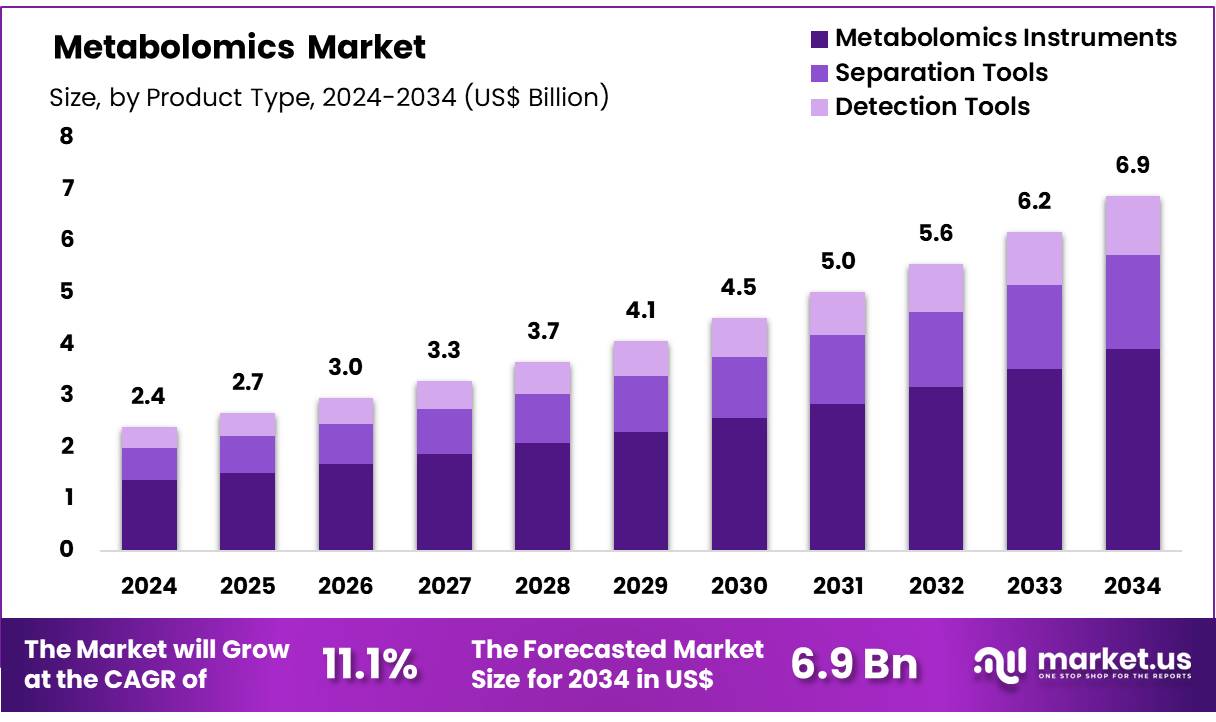
New York, NY – Nov 17, 2025 – Global Metabolomics Market size is expected to be worth around US$ 6.9 Billion by 2034 from US$ 2.4 Billion in 2024, growing at a CAGR of 11.1% during the forecast period 2025 to 2034. In 2024, North America led the market, achieving over 43.1% share with a revenue of US$ 0.3 Billion.
Metabolomics has been recognized as a rapidly advancing field that focuses on the comprehensive analysis of small-molecule metabolites present in biological systems. These metabolites serve as direct indicators of cellular activity, and their measurement provides a precise snapshot of physiological states. The growth of metabolomics has been driven by increasing adoption in healthcare, biotechnology, nutrition science, and pharmaceutical development, where enhanced understanding of metabolic pathways is supporting data-driven decision-making.
In this field, advanced analytical platforms such as mass spectrometry and nuclear magnetic resonance spectroscopy are being utilized to quantify metabolites with high accuracy and reproducibility. The integration of these technologies with computational tools has enabled the identification of biomarkers associated with disease progression, therapeutic response, and metabolic dysfunction. As a result, metabolomics has been positioned as a critical component in personalized medicine, where interventions can be tailored according to individual metabolic profiles.
The global expansion of metabolomics research can be attributed to rising investments in life sciences, increasing emphasis on precision diagnostics, and growing demand for improved drug development processes. Its applications have extended across oncology, cardiology, neurology, and nutrition, where metabolic signatures are being leveraged to support early detection and targeted therapy.
The continued advancement of this field is expected to strengthen innovation in clinical research and product development. As organizations adopt metabolomics to gain deeper biological insights, the discipline is anticipated to contribute significantly to improved patient outcomes, optimized treatment strategies, and enhanced scientific discovery across industries.
Key Takeaways
- The global metabolomics market generated revenue of US$ 2.4 Billion in 2024, and the market expansion has been supported by a CAGR of 11.1%. The market size is projected to reach US$ 6.9 Billion by 2033.
- Based on product type, the market has been categorized into metabolomics instruments, separation tools, and detection tools. Metabolomics instruments accounted for 56.9% of total revenue in 2024, indicating their dominant contribution.
- By indication, the market has been segmented into cancer, neurological disorders, metabolic disorders, cardiovascular disorders, and others. The cancer segment captured 49.8% of the market, reflecting its significant clinical and research relevance.
- In terms of application, the market includes biomarker discovery, toxicology testing, personalized medicine, nutrigenomics, functional genomics, drug discovery, and others. The biomarker discovery segment held the leading revenue share of 53.1%, demonstrating its central role in metabolomics research and diagnostics.
- The end-user segmentation comprises academic & research institutes, pharmaceutical & biotechnology companies, and contract research organizations. Academic & research institutes led the market with a 47.2% share, indicating their strong involvement in metabolomics-based studies.
- Regionally, North America dominated the market with a 43.1% share in 2024, driven by advanced research infrastructure and high adoption of omics technologies.
Regional Analysis
North America Maintains Leadership in the Metabolomics Market
North America held the largest revenue share of 43.1% in the metabolomics market, supported by advancements in precision medicine, substantial funding for life sciences research, and the growing burden of chronic diseases. According to the National Institutes of Health (NIH), the U.S. government allocated US$ 45 billion to biomedical research in 2023, drawn from the nation’s US$ 4.1 trillion healthcare expenditure.
This level of investment has accelerated the integration of metabolomics within clinical workflows, as the technology enables deeper understanding of disease pathways and supports personalized therapeutic decisions. Collaborative initiatives between leading academic institutions and industry participants such as the partnership between Metabolon Inc. and the Mayo Clinic have further strengthened translational research efforts, enhancing the practical application of metabolomics and reinforcing market expansion in the region.
Asia Pacific Expected to Record the Fastest Growth Rate
The Asia Pacific region is projected to achieve the highest CAGR during the forecast period, driven by rising healthcare investments, expanding research capabilities, and government-backed programs aimed at addressing non-communicable diseases. Data from the World Health Organization (WHO) indicates that countries such as China and India have increased healthcare spending by 20% since 2022, with a clear emphasis on advanced diagnostics.
In 2023, the Chinese Academy of Sciences committed US$ 1.2 billion to support national omics research initiatives, including metabolomics. Similarly, the Indian Council of Medical Research (ICMR) allocated US$ 500 million to strengthen precision medicine infrastructure, positioning metabolomics as a key component of its strategic focus.
Major industry players are also contributing to the region’s momentum. Shimadzu Corporation reported 15% revenue growth in its life sciences segment in 2023, reflecting increasing demand for metabolomics instrumentation. The region’s high prevalence of chronic diseases, particularly diabetes and cancer, continues to shape the need for advanced diagnostic solutions. The International Diabetes Federation (IDF) estimates that Asia Pacific accounts for 60% of global diabetes cases, highlighting a substantial market opportunity for metabolomics applications.
Furthermore, academic-industry collaborations such as the partnership between Thermo Fisher Scientific and the National University of Singapore are expected to support innovation and accelerate technology adoption. These combined factors establish Asia Pacific as a rapidly expanding and strategically important market for metabolomics in the years ahead.
Emerging Trends
- High-Resolution Mass Spectrometry (MS): High-resolution MS platforms are now capable of detecting more than 1,000 small-molecule metabolites in a single analytical run. This improved sensitivity enables deeper metabolome coverage and supports more reliable identification of clinically relevant biomarkers.
- Spatial (Imaging) Metabolomics: Imaging MS technologies are being applied to map metabolite distributions across tissue sections with spatial resolutions of approximately 10–20 µm. This capability allows chemical alterations to be linked directly with underlying histological structures.
- Single-Cell Metabolomics: Rapid progress in single-cell profiling techniques is enabling analysis of metabolites at individual cell resolution. These methods uncover metabolic variations between cells that previously remained obscured in bulk sample assessments.
- Multi-Omics Integration: Metabolomics is increasingly integrated with genomic and proteomic datasets to generate systems-level biological insights. This combined approach strengthens precision medicine efforts by revealing interconnected molecular pathways and improving predictive modeling.
Use Cases
- Disease Biomarker Discovery: Extensive research activity has identified hundreds of metabolite biomarkers for diseases such as cancer and metabolic syndrome. Recent cancer investigations alone have reported over 200 differential metabolites associated with early-stage diagnostic potential.
- Personalized Medicine: Metabolomics-guided clinical tools are being evaluated to refine drug dosing strategies. As of early 2025, a minimum of 10 NIH-registered clinical trials are employing metabolite signatures to customize therapeutic regimens and assess treatment response.
- Safety and Toxicology Screening: EPA’s ENTACT program demonstrated that standards-free metabolomics workflows achieved 96% accuracy in detecting toxic responses within complex chemical mixtures. This performance supports broader adoption of rapid, non-targeted toxicity evaluation methods.
Frequently Asked Questions on Metabolomics
- How does metabolomics work?
Metabolomics operates through advanced analytical platforms such as mass spectrometry and nuclear magnetic resonance spectroscopy. These technologies measure metabolite concentrations and patterns, enabling detailed interpretation of biochemical responses to genetic, environmental, or therapeutic influences in biological systems. - What are the key applications of metabolomics?
Major applications include biomarker discovery, drug development, toxicology testing, agriculture optimization, and personalized medicine. Its capability to detect metabolic alterations enables improved disease diagnosis, treatment response monitoring, and enhanced understanding of biological functions in clinical and research environments. - Why is metabolomics important in disease research?
Metabolomics is vital because metabolic changes often appear earlier than anatomical or physiological symptoms. Its data help identify disease-specific biomarkers, enabling early detection, improved therapeutic targeting, and more efficient evaluation of disease progression and treatment effectiveness across multiple conditions. - What technologies are commonly used in metabolomics?
The field relies on mass spectrometry, gas chromatography, liquid chromatography, and NMR spectroscopy. These platforms enable comprehensive profiling of metabolites with high accuracy, supporting reliable quantification, structural identification, and robust interpretation of biochemical variations in complex biological samples. - Which sectors are adopting metabolomics the most?
Pharmaceutical and biotechnology companies represent the largest adopters due to heavy focus on drug discovery and clinical research. Academic institutions, diagnostic laboratories, and agricultural research centers also increasingly implement metabolomics to support data-driven decision-making and advanced biological investigations. - What are the main components of the metabolomics market?
The market comprises analytical instruments, bioinformatics platforms, and consumables. Instruments and software generate and interpret metabolite data, while consumables such as reagents, columns, and kits support continuous workflow operations required for metabolite extraction, separation, and detailed profiling. - Which regions lead the global metabolomics market?
North America dominates due to strong research infrastructure, early technology adoption, and significant funding for life-science innovation. Europe follows with extensive academic participation, while Asia-Pacific exhibits rapid growth supported by expanding biotechnology sectors and increasing investment in omics research. - What future opportunities exist for the metabolomics market?
Significant opportunities include integration with artificial intelligence, expansion of clinical metabolomics, and rising demand for personalized therapies. Increasing recognition of metabolic biomarkers in chronic diseases is expected to enhance commercialization and adoption of advanced analytical platforms globally.
Conclusion
The metabolomics market is expected to advance significantly as growing investments, technological improvements, and wider clinical adoption strengthen its role in modern healthcare and research. Its capacity to deliver precise metabolic insights supports early disease detection, personalized therapy development, and enhanced drug discovery workflows.
Regional momentum is led by North America, while Asia Pacific is emerging as the fastest-growing market due to expanding research infrastructure and rising healthcare spending. The integration of high-resolution platforms, multi-omics tools, and single-cell technologies further enhances scientific capabilities. As adoption increases, metabolomics is positioned to drive impactful innovations across clinical, pharmaceutical, and academic sectors.
Discuss your needs with our analyst
Please share your requirements with more details so our analyst can check if they can solve your problem(s)




