


Table of Contents
Overview
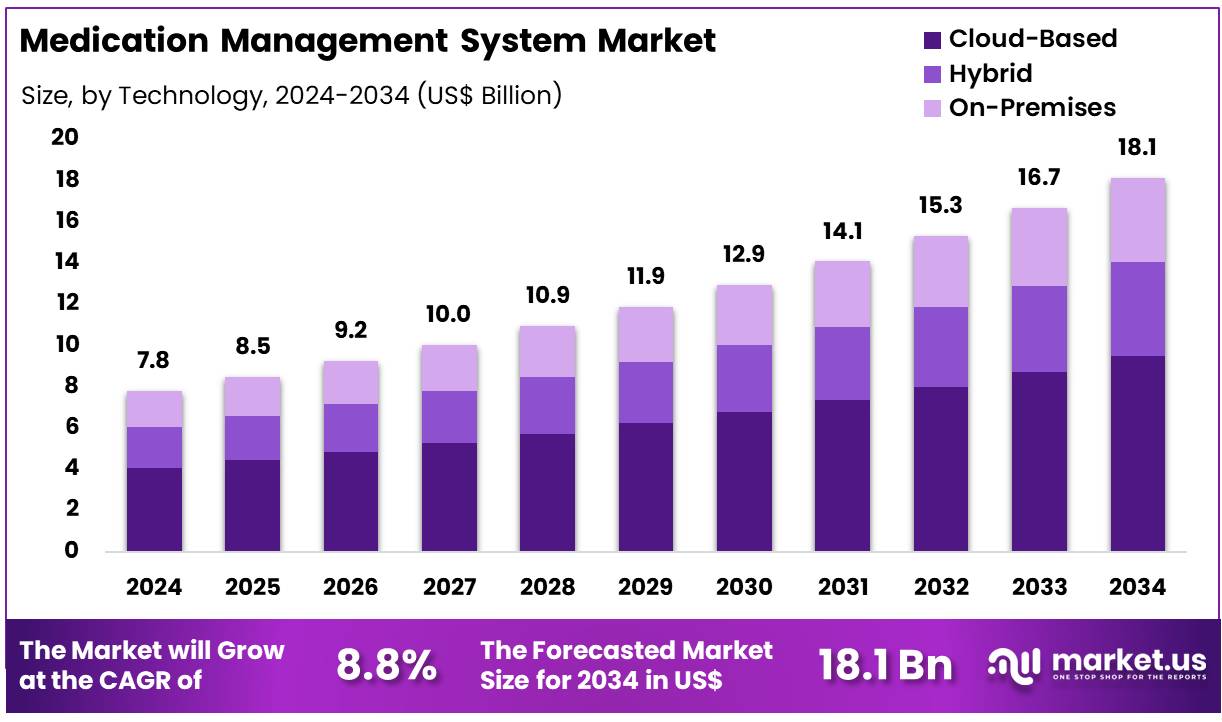
New York, NY – Dec 15, 2025 – Global Medication Management System Market size is expected to be worth around US$ 18.1 Billion by 2034 from US$ 7.8 Billion in 2024, growing at a CAGR of 8.8% during the forecast period 2025 to 2034. North America led the market, achieving over 44.5% share with a revenue of US$ 3.5 Billion.
A new Medication Management System has been introduced to support healthcare providers in improving medication accuracy, patient safety, and workflow efficiency across clinical settings. The system has been designed to address growing challenges related to medication errors, complex treatment regimens, and increasing patient volumes.
The Medication Management System enables automated medication scheduling, dosage tracking, and real-time alerts, ensuring that medications are administered accurately and on time. By integrating digital records and centralized data access, the solution reduces reliance on manual processes and minimizes the risk of human error. Improved visibility into medication histories is expected to support better clinical decision-making and treatment outcomes.
The adoption of digital medication management solutions is being driven by the increasing focus on patient safety, regulatory compliance, and cost containment within healthcare systems. According to industry observations, technology-enabled medication management can significantly reduce adverse drug events and improve overall care quality.
The system is designed to be scalable and adaptable, making it suitable for hospitals, clinics, long-term care facilities, and home healthcare environments. Secure data management and compliance with healthcare data protection standards have been prioritized to ensure patient confidentiality. The launch of this Medication Management System reflects continued innovation in healthcare IT, supporting the transition toward more efficient, data-driven, and patient-centered care delivery models.
Key Takeaways
- In 2024, revenue in the medication management system market was valued at US$ 7.8 billion. The market is projected to expand at a CAGR of 8.8% and is expected to reach US$ 18.1 billion by 2034.
- By product type, the market is categorized into clinical decision support systems, medication dispensing systems, medication reconciliation solutions, medication administration systems, and electronic health records integration. Among these, clinical decision support systems accounted for the largest share, capturing 28.4% of the market in 2024.
- Based on technology, the market is segmented into cloud-based, hybrid, and on-premises solutions. The cloud-based segment dominated the market, holding a 52.3% revenue share.
- In terms of components, the market is divided into hardware, software, and services. The software segment emerged as the leading contributor, accounting for 53.7% of total market revenue.
- The end-user landscape includes hospitals, home care settings, outpatient clinics, pharmacies, and long-term care facilities. Hospitals represented the largest end-user group, with a 38.8% revenue share.
- North America maintained its leading position in the global market, securing a 44.5% market share.
Regional Analysis
North America continues to lead the medication management system market, accounting for approximately 44.5% of total revenue. This dominance is primarily driven by sustained efforts to improve patient safety, minimize medication errors, and enhance operational efficiency across healthcare facilities. The widespread adoption of digital health technologies, particularly electronic health records (EHRs), has played a critical role in supporting advanced medication management solutions.
Federal initiatives, such as the Medicare Promoting Interoperability Program, have encouraged hospitals and Critical Access Hospitals to integrate EHR systems, creating a strong foundation for automated and interoperable medication workflows. In parallel, patient safety initiatives have contributed to measurable improvements, with a decline in adverse events among Medicare patients, reinforcing the value of technology-enabled medication oversight. Leading industry players continue to invest in platform innovation, reflecting sustained demand for solutions that reduce risk and improve clinical outcomes.
The Asia Pacific region is projected to register the highest compound annual growth rate during the forecast period. This growth is supported by rapid healthcare digitalization, increasing chronic disease burden, and strong government backing for health IT adoption. National digital health programs in countries such as India, China, and Australia are strengthening health data integration, improving medication access, and enabling real-time information sharing. Combined with large, aging populations and rising standards of care, these factors are expected to accelerate demand for medication management systems across the region.
Emerging Trends in Medication Management Systems
- Automation and Artificial Intelligence (AI): The adoption of automation and artificial intelligence is significantly reshaping medication management practices. Automated Medication Management Systems (AMMS) are being widely implemented to support accurate medication scheduling, real-time monitoring, and seamless integration with electronic health records (EHRs) and wearable health devices. These systems contribute to enhanced patient safety by reducing medication errors, improving adherence, and enabling proactive clinical interventions.
- Telehealth Integration: The integration of medication management systems with telehealth and virtual care platforms is increasing steadily. This integration supports remote consultations, medication reviews, and patient education, thereby improving access to healthcare services. The approach has proven particularly beneficial in underserved and remote regions, where access to in-person care remains limited.
- Smart Medication Devices: Technological advancements have led to the development of smart medication devices, including smart inhalers and digital pills. These devices are designed to track medication usage and transmit real-time adherence data to healthcare providers. The availability of continuous usage data enables timely interventions and supports improved treatment outcomes.
- Clinical Decision Support Systems (CDSS): The evolution of intelligent Clinical Decision Support Systems, increasingly powered by large language models, is enhancing clinical decision-making. These systems analyze patient-specific data to identify potential medication errors, flag drug interactions, and support optimized treatment planning through evidence-based recommendations, thereby strengthening medication safety.
Key Use Cases of Medication Management Systems
- Hospital Automation: Hospitals are increasingly deploying automated dispensing cabinets (ADCs) to manage medication storage and distribution at the point of care. These systems provide controlled access, track medication usage, and support inventory optimization, resulting in reduced medication errors and improved operational efficiency.
- Chronic Disease Management: Medication management applications are being widely adopted for chronic disease management, particularly for conditions such as asthma and diabetes. These solutions offer personalized medication reminders, prescription refill alerts, and detailed tracking of medication intake, enabling patients to manage long-term conditions more effectively.
- Polypharmacy Management: For patients prescribed multiple medications, intelligent medication management systems support comprehensive medication reviews. Clinical decision support tools assist healthcare providers in identifying potential drug–drug interactions, minimizing adverse effects, and optimizing therapeutic regimens, thereby improving patient safety.
- School-Based Health Programs: Educational institutions are implementing medication management systems to ensure the safe and compliant administration of medications to students. These systems often integrate telemedicine capabilities, allowing healthcare professionals to remotely oversee and manage students’ medication requirements.
- Virtual Hospitals: The emergence of virtual hospital models is enabling patients to receive clinical care within home-based settings. Medication management systems play a critical role in this model by supporting accurate medication administration, monitoring adherence, and facilitating coordination between patients and healthcare providers through remote monitoring technologies.
Frequently Asked Questions on Medication Management System
- How does a Medication Management System improve patient safety?
Patient safety is improved through automated dose calculations, real-time alerts for drug interactions, barcode verification, and electronic documentation, which collectively reduce medication errors, adverse drug events, and compliance-related risks in clinical settings. - Who are the primary users of Medication Management Systems?
Primary users include hospitals, retail and hospital pharmacies, ambulatory care centers, and long-term care facilities, where healthcare professionals rely on these systems to streamline workflows, enhance accuracy, and maintain regulatory compliance. - What are the key components of a Medication Management System?
Core components typically include computerized physician order entry, pharmacy information systems, automated dispensing cabinets, medication administration records, and clinical decision support tools that collectively ensure end-to-end medication lifecycle management. - Are Medication Management Systems integrated with electronic health records?
Integration with electronic health records is commonly implemented, enabling seamless data exchange, unified patient profiles, improved clinical decision-making, and better coordination among healthcare providers across different departments and care settings. - What factors are driving the growth of the Medication Management System Market?
Market growth is driven by rising medication errors, increasing healthcare digitization, regulatory mandates for patient safety, and growing adoption of automation technologies across hospitals, pharmacies, and long-term care facilities globally. - Which regions dominate the Medication Management System Market?
North America dominates the market due to advanced healthcare infrastructure and high technology adoption, while Asia-Pacific is experiencing rapid growth driven by expanding healthcare access, government initiatives, and increasing digital transformation. - How is technology shaping the future of the Medication Management System Market?
Technological advancements such as artificial intelligence, cloud-based platforms, and data analytics are shaping market evolution by enabling predictive insights, personalized medication management, improved interoperability, and scalable solutions for diverse healthcare environments.
Conclusion
The Medication Management System market reflects strong and sustained momentum, driven by rising patient safety requirements, increasing medication complexity, and rapid healthcare digitalization. In 2024, the market demonstrated robust scale and is expected to expand steadily through 2034, supported by high adoption across hospitals and cloud-based platforms.
North America continues to lead due to advanced infrastructure and regulatory support, while Asia Pacific is emerging as the fastest-growing region. Ongoing advancements in automation, artificial intelligence, and system interoperability are expected to further enhance medication accuracy, operational efficiency, and patient-centered care delivery across diverse clinical settings.
Discuss your needs with our analyst
Please share your requirements with more details so our analyst can check if they can solve your problem(s)




