


Table of Contents
Overview
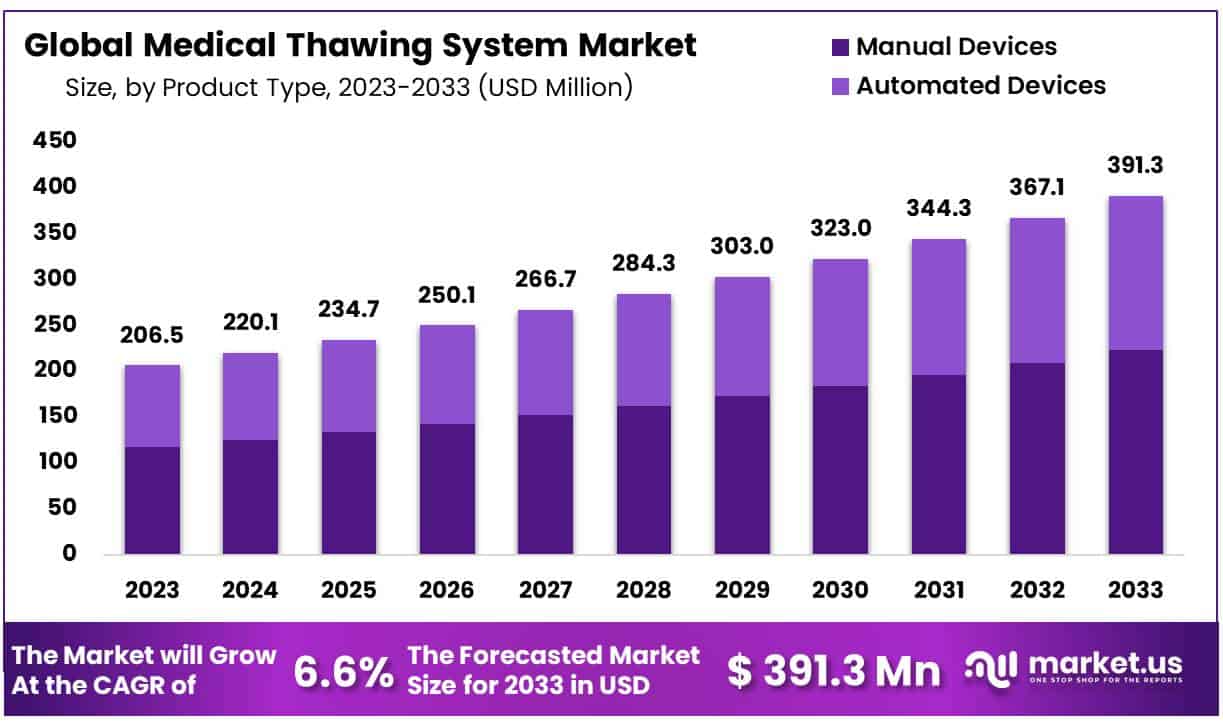
New York, NY – Dec 31, 2025 – The Global Medical Thawing System Market size is expected to be worth around USD 391.3 Million by 2033 from USD 206.5 Million in 2023, growing at a CAGR of 6.6% during the forecast period from 2024 to 2033.
The Medical Thawing System has been developed to support safe, controlled, and efficient thawing of temperature-sensitive medical products. The system is primarily designed for use in hospitals, blood banks, diagnostic laboratories, and biopharmaceutical facilities, where precision and compliance with clinical standards are essential.
The basic formation of a Medical Thawing System consists of a temperature-controlled chamber, an integrated heating mechanism, and an advanced control interface. The chamber is engineered using medical-grade materials to ensure hygiene, durability, and resistance to contamination. Uniform heat distribution within the chamber is achieved through water-based or dry heating technology, depending on the model configuration.
A digital control unit forms a critical component of the system. It allows precise temperature setting, real-time monitoring, and automatic adjustment throughout the thawing cycle. Built-in sensors continuously track temperature and time parameters, ensuring consistent performance and minimizing the risk of overheating or product degradation. Audible and visual alarms are incorporated to alert operators to deviations or process completion.
The system is designed to accommodate a range of medical products, including blood plasma, vaccines, cell therapies, and other biologics. Modular racks or holders are included to secure products during the thawing process, supporting standardized workflows and operational efficiency.
Overall, the Medical Thawing System is positioned as a reliable solution that enhances safety, reduces manual handling, and supports regulatory compliance. Its basic formation reflects current clinical requirements and growing demand for controlled, automated thawing solutions across modern healthcare environments.
Key Takeaways
- Market Size: The medical thawing system market was valued at USD 206.5 million in 2023 and is projected to reach approximately USD 391.3 million by 2033.
- Market Growth: The market is expected to expand at a compound annual growth rate (CAGR) of 6.6% during the forecast period from 2024 to 2033.
- Product Type Analysis: Manual thawing systems accounted for the largest share of the market, representing 57% of total revenue.
- Sample Analysis: The blood sample segment held a dominant market share of 54.0% in 2023.
- End-Use Analysis: Blood banks and transfusion centers emerged as the leading end-use segment, capturing a 32% market share in 2023.
- Regional Analysis: North America dominated the market with a 48% share in 2023, generating revenue of USD 99.1 million.
Regional Analysis
North America accounted for the largest share of the medical thawing system market in 2023, capturing 48% of total revenue and generating USD 99.1 million. The global market is geographically segmented into North America, Europe, Asia Pacific, Latin America, and the Middle East & Africa. The strong market position of North America can be attributed to high adoption of advanced medical technologies, a rising prevalence of chronic diseases, and the established presence of leading market players, all of which are expected to support continued market growth over the forecast period.
The Asia Pacific region is anticipated to register the fastest growth rate during the forecast timeline. The region includes major developing economies such as China, India, and Japan, which are characterized by large patient populations and a high burden of chronic diseases.
Demand for thawed blood products is expected to increase in Asia Pacific due to the growing incidence of chronic conditions that often result in organ dysfunction. In addition, ongoing advancements in medical technologies, expanding availability of advanced surgical procedures, and the rapid growth of healthcare tourism are contributing to regional market expansion. The comparatively lower cost of treatment continues to attract international patients, further supporting market growth in the region.
Emerging Trends
- Automation and Precision Control: The adoption of automated thawing systems is increasing across healthcare facilities. These systems provide precise temperature regulation, minimize operator variability, and reduce the risk of human error. As a result, the structural and functional integrity of sensitive biological materials is better preserved. In emergency care settings, automated plasma thawers are capable of thawing plasma in less than three minutes, significantly improving response times and operational efficiency.
- Enhanced Safety and Contamination Control: Recent advancements in thawing technologies emphasize improved safety outcomes. Rapid dry thawing systems are increasingly preferred over conventional water bath methods, as they significantly reduce the risk of bacterial contamination. This shift is contributing to higher patient safety standards, particularly in transfusion and transplant procedures.
- Standardization of Protocols and Workforce Training: Industry stakeholders and clinical workgroups are actively working toward the standardization of thawing protocols. Formal guidelines and structured training programs, particularly for cord blood thawing and washing procedures, are being recommended to ensure procedural consistency, reduce variability, and enhance safety across transplant and treatment centers.
Key Use Cases
- Blood and Plasma Transfusions: Medical thawing systems play a critical role in the preparation of frozen blood components for transfusion. Rapid and controlled thawing is essential during emergency situations and massive transfusion events, where timely plasma availability can be life-saving.
- Cord Blood Transplantation: Thawing systems are widely used to prepare cryopreserved cord blood units prior to transplantation. Standardized thawing and washing processes are essential to preserve cell viability, ensure graft safety, and improve transplant outcomes.
- Cellular and Regenerative Therapies: In regenerative medicine and advanced cellular therapies, thawing systems are used to prepare stem cells and other therapeutic cell products for clinical administration. Controlled thawing procedures are critical to maintaining cell integrity, viability, and overall therapeutic effectiveness.
Frequently Asked Questions on Medical Thawing System
- Where are medical thawing systems commonly used?
Medical thawing systems are widely used in hospitals, blood banks, transplant centers, fertility clinics, and research laboratories, where precise temperature control is essential to ensure the safety, viability, and therapeutic effectiveness of thawed biological products. - What materials can be thawed using medical thawing systems?
Medical thawing systems are used to thaw blood plasma, red blood cells, stem cells, reproductive cells, tissues, and organs, ensuring uniform warming and compliance with strict regulatory and quality standards in medical and laboratory settings. - How do medical thawing systems improve patient safety?
Patient safety is enhanced through automated temperature control, closed-system designs, and reduced manual handling, which collectively minimize contamination risks, prevent overheating, and ensure consistent thawing outcomes critical for transfusion and transplantation procedures. - What are the key features of modern medical thawing systems?
Modern systems typically feature digital temperature monitoring, programmable thawing cycles, alarm systems, closed waterless designs, and compliance with healthcare regulations, supporting operational efficiency, safety, and reproducibility in clinical workflows. - What factors are driving growth in the medical thawing system market?
Market growth is driven by rising blood transfusion volumes, increasing organ and stem cell transplants, expanding biobanking activities, and greater adoption of advanced laboratory automation to improve safety, efficiency, and regulatory compliance in healthcare facilities. - How does the medical thawing system market vary by region?
The market shows strong demand in North America and Europe due to advanced healthcare infrastructure, while Asia-Pacific is experiencing rapid growth supported by expanding hospital networks, increasing medical tourism, and rising investments in biotechnology and research. - Who are the primary end users in the medical thawing system market?
Hospitals, blood banks, diagnostic laboratories, research institutes, and fertility clinics represent the primary end users, as these facilities require reliable thawing solutions to support transfusion services, transplantation procedures, and clinical research activities. - What technological trends are shaping the medical thawing system market?
Key trends include the adoption of waterless thawing technology, automation, digital integration with laboratory systems, and enhanced safety features, which collectively improve operational efficiency, reduce contamination risks, and support standardized clinical practices.
Conclusion
The medical thawing system market reflects the growing need for safe, precise, and standardized thawing of temperature-sensitive medical products across modern healthcare settings. The system’s core design combining controlled heating, digital monitoring, and contamination-resistant materials supports clinical accuracy, patient safety, and regulatory compliance.
Market growth is being driven by rising blood transfusion volumes, expanding cell and regenerative therapies, and increased biobanking activities. While North America currently leads in adoption, Asia Pacific is emerging as the fastest-growing region. Overall, continued automation, safety enhancements, and protocol standardization are expected to sustain long-term market expansion.
Discuss your needs with our analyst
Please share your requirements with more details so our analyst can check if they can solve your problem(s)




