


Table of Contents
Overview
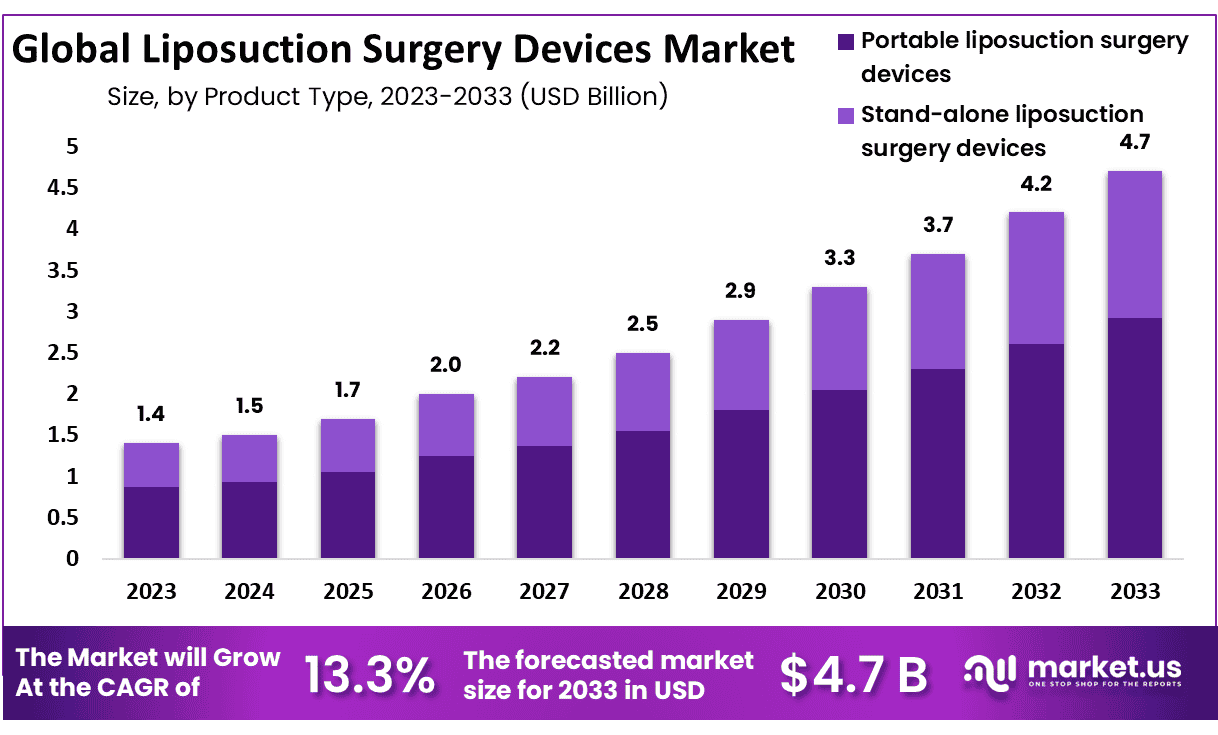
New York, NY – Jan 22, 2026 – The Global Liposuction Surgery Devices Market size is expected to be worth around USD 4.7 Billion by 2033 from USD 1.4 Billion in 2023, growing at a CAGR of 13.3% during the forecast period from 2024 to 2033.
The liposuction surgery devices market is witnessing steady development, driven by the rising demand for aesthetic procedures and continuous technological advancement in surgical equipment. Liposuction devices are widely used in cosmetic and reconstructive surgeries to remove excess adipose tissue and enhance body contouring outcomes. These devices play a critical role in improving procedural efficiency, patient safety, and clinical results.
Market growth can be attributed to the increasing prevalence of obesity, growing awareness of physical appearance, and the rising acceptance of minimally invasive cosmetic procedures across both developed and emerging economies. Technological innovations, such as power-assisted, ultrasound-assisted, laser-assisted, and radiofrequency-assisted liposuction systems, have significantly improved precision and reduced recovery time. As a result, adoption rates among hospitals, ambulatory surgical centers, and specialty clinics have increased.
The market is also supported by a growing number of aesthetic practitioners and favorable demographic trends, including an expanding middle-aged population seeking body contouring solutions. In addition, improvements in device ergonomics and safety mechanisms have enhanced surgeon confidence and patient satisfaction.
North America holds a significant share of the liposuction surgery devices market, supported by advanced healthcare infrastructure and high procedure volumes. Meanwhile, Asia-Pacific is expected to experience notable growth due to rising medical tourism, increasing disposable income, and expanding cosmetic surgery awareness.
Overall, the liposuction surgery devices market is expected to maintain a cautiously optimistic growth outlook, supported by innovation, increasing procedure demand, and broader access to aesthetic surgical solutions.
Key Takeaways
- Market Size: The global liposuction surgery devices market is projected to reach approximately USD 4.7 billion by 2033, rising from an estimated value of USD 1.4 billion in 2023.
- Market Growth: The market is anticipated to expand at a compound annual growth rate (CAGR) of 13.3% over the forecast period spanning 2024 to 2033.
- Product Analysis: Portable liposuction surgery devices accounted for the largest share of the market in 2023, capturing 62.1% of total revenue.
- Technology Analysis: Laser-assisted liposuction (LAL) emerged as the leading technology segment, representing 23.5% of the overall market share in 2023.
- End-Use Analysis: Cosmetic surgery centers held a dominant position in the market, contributing 64.7% of total market share in 2023.
- Regional Analysis: North America led the global market with a 37.5% revenue share, generating approximately USD 0.52 billion in revenue in 2023.
Regional Analysis
North America emerged as the leading regional market, capturing 37.5% of global revenue and generating approximately USD 0.52 billion in 2023. Market dominance is supported by the early adoption of advanced medical technologies and the strong presence of key industry participants across the region.
The high prevalence of obesity has increased the demand for liposuction procedures, while growing awareness regarding obesity-related health concerns continues to support market expansion. In addition, well-established healthcare infrastructure and a high volume of cosmetic procedures further contribute to regional growth.
The Asia Pacific market is projected to register a compound annual growth rate (CAGR) of 12.8% during the forecast period. Growth in the region can be attributed to rising awareness of the benefits, safety, and convenience of liposuction procedures. Increasing disposable income levels, coupled with growing demand for targeted aesthetic surgeries, particularly within the fashion and film industries, are supporting market development. Furthermore, rapid expansion of the healthcare sector and the rising influx of medical tourists are expected to accelerate demand for liposuction surgery devices across the region.
Emerging Trends
- Integration of Advanced Technologies: The liposuction surgery devices market is increasingly adopting advanced technologies aimed at improving procedural precision and patient safety. Laser-assisted liposuction uses controlled laser energy to liquefy fat cells, enabling smoother extraction and enhanced skin tightening. Similarly, ultrasound-assisted liposuction applies ultrasonic waves to disrupt fat tissue while reducing damage to surrounding structures, resulting in improved outcomes and shorter recovery periods.
- Growing Adoption of Non-Invasive Fat Reduction Techniques: A notable shift toward non-invasive fat reduction solutions is being observed as patients seek alternatives to conventional surgical liposuction. Techniques such as cryolipolysis use controlled cooling to destroy fat cells, which are subsequently eliminated through natural metabolic processes. This trend reflects rising demand for procedures associated with minimal downtime, reduced procedural risk, and improved patient convenience.
- Rising Demand for Targeted Liposuction Procedures: Targeted liposuction procedures focusing on specific anatomical areas, including submental and jawline regions, are gaining significant traction. These minimally invasive treatments aim to enhance localized contours with high precision. Increased social media exposure and the growing emphasis on facial aesthetics in digital interactions have contributed to higher demand for such procedures.
Use Cases
- Management of Lipedema: Liposuction surgery devices are widely used in the treatment of lipedema, a chronic disorder marked by disproportionate fat accumulation, particularly in the lower limbs. Liposuction helps remove pathological fat deposits, leading to symptom relief, improved mobility, and enhanced quality of life for affected patients.
- Treatment of Gynecomastia: Liposuction is a commonly adopted solution for gynecomastia, a condition involving excessive male breast tissue development. By removing excess fat and glandular tissue, liposuction supports restoration of a more typical chest contour while addressing associated physical discomfort and psychological concerns.
- Body Contouring After Bariatric Surgery: Following substantial weight loss from bariatric surgery, patients often experience excess skin and localized fat deposits. Liposuction surgery devices are used in post-bariatric body contouring procedures to eliminate residual fat, helping patients achieve improved body proportions and aesthetic outcomes.
- Correction of Lipodystrophy Syndromes: Liposuction is applied in the management of lipodystrophy syndromes characterized by abnormal fat distribution caused by genetic conditions or long-term antiretroviral therapy. Targeted fat removal supports restoration of a balanced appearance and improves patient confidence and overall physical symmetry.
Frequently Asked Questions on Liposuction Surgery Devices
- What types of liposuction surgery devices are commonly used?
Common liposuction surgery devices include suction-assisted, ultrasound-assisted, laser-assisted, power-assisted, and radiofrequency-assisted systems. Each technology varies in fat disruption method, precision, recovery time, and suitability for different patient profiles. - How do advanced liposuction devices improve surgical outcomes?
Advanced liposuction devices improve outcomes by enhancing fat emulsification, minimizing tissue trauma, and improving skin tightening. These features support reduced blood loss, shorter recovery periods, and more consistent contouring results for patients. - Are liposuction surgery devices considered safe?
Liposuction surgery devices are considered safe when used by trained professionals and approved by regulatory authorities. Safety depends on proper patient selection, device quality, adherence to clinical protocols, and post-operative monitoring practices. - What factors influence the selection of a liposuction device?
Device selection is influenced by procedure type, treatment area, surgeon expertise, patient health condition, desired precision level, and cost considerations. Technological features and compatibility with minimally invasive approaches are also key decision factors. - What are the key drivers of market growth?
Market growth is driven by increasing demand for minimally invasive cosmetic procedures, rising obesity prevalence, growing medical tourism, and continuous advancements in device technology that enhance safety, precision, and patient comfort. - Which regions dominate the liposuction surgery devices market?
North America dominates the market due to high procedure volumes, advanced healthcare infrastructure, and strong adoption of innovative technologies. Europe and Asia-Pacific follow, supported by growing disposable income and expanding aesthetic surgery markets. - How is the market expected to evolve in the coming years?
The market is expected to grow steadily, supported by technological advancements, increased focus on non-invasive body contouring, and expanding applications in reconstructive surgery. Innovation and emerging markets are anticipated to create new growth opportunities.
Conclusion
The liposuction surgery devices market is positioned for sustained growth, supported by rising demand for aesthetic and reconstructive procedures, continuous technological innovation, and expanding acceptance of minimally invasive treatments.
Advancements in laser, ultrasound, and power-assisted technologies have improved procedural efficiency, safety, and patient outcomes, driving adoption across diverse healthcare settings. North America continues to lead due to advanced infrastructure, while Asia-Pacific presents strong growth potential fueled by medical tourism and increasing disposable income.
Overall, the market outlook remains cautiously optimistic, underpinned by innovation, demographic trends, and growing global awareness of body contouring solutions.
Discuss your needs with our analyst
Please share your requirements with more details so our analyst can check if they can solve your problem(s)




