


Table of Contents
Overview
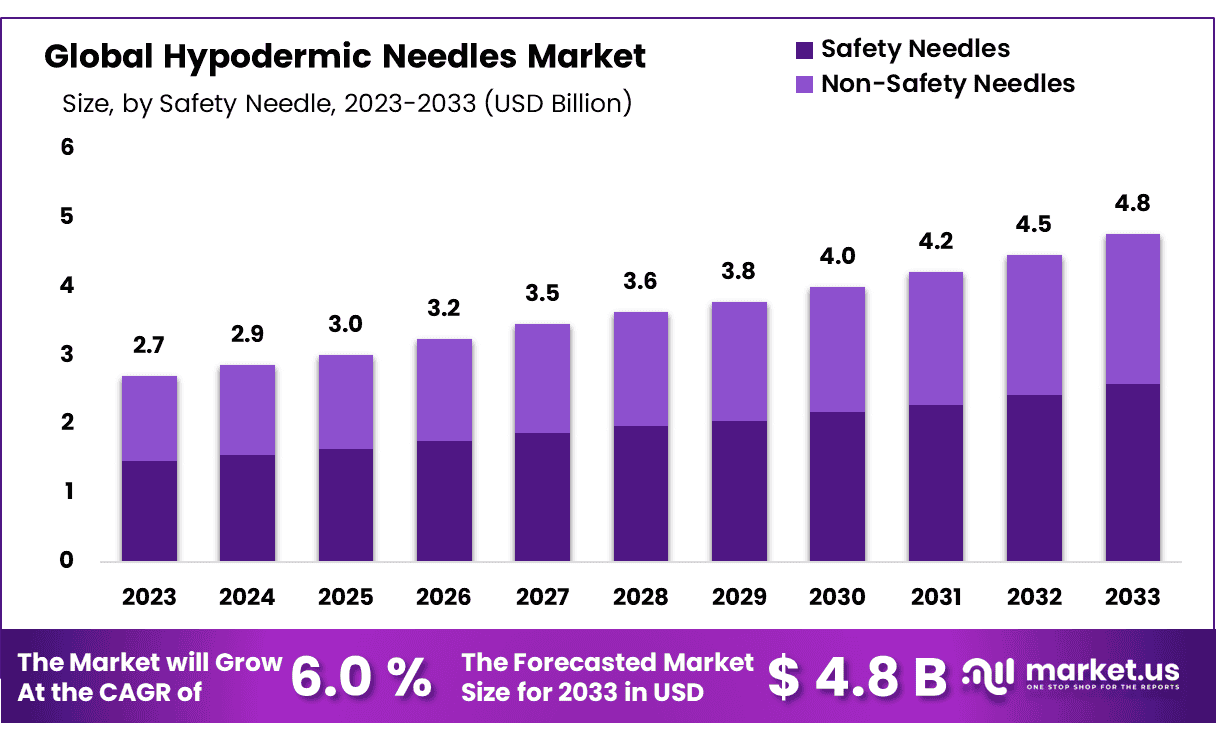
New York, NY – Jan 14, 2026 – The Global Hypodermic Needles Market size is expected to be worth around USD 4.8 Billion by 2033 from USD 2.7 Billion in 2023, growing at a CAGR of 6.0% during the forecast period from 2024 to 2033.
Hypodermic needles are essential medical devices widely used for drug delivery, blood collection, and vaccination procedures across healthcare settings. Their basic formation follows a precise and standardized manufacturing process to ensure safety, accuracy, and regulatory compliance.
The formation of hypodermic needles typically begins with high-grade stainless steel, selected for its strength, corrosion resistance, and biocompatibility. The steel is drawn into thin tubes through a series of controlled stretching and shaping processes. This step defines the needle’s diameter, commonly referred to as the gauge, which directly influences fluid flow and patient comfort.
Once the tubing is formed, it is cut into specific lengths according to clinical requirements. The needle tips are then ground and beveled using precision machinery to create sharp, multi-facet points. This sharpening process is critical, as it reduces insertion force and minimizes tissue trauma during use.
Following tip formation, the needles undergo thorough cleaning and surface treatment to remove residues and enhance smoothness. Many products are coated with silicone to further improve penetration efficiency. The needles are then assembled with plastic hubs, which allow secure attachment to syringes or medical devices.
Quality control is a key stage in hypodermic needle formation. Each batch is inspected for dimensional accuracy, strength, and sterility. Final sterilization is performed using methods such as ethylene oxide or gamma radiation before packaging.
The standardized formation of hypodermic needles supports consistent performance, patient safety, and widespread adoption in modern medical practice. Continued advancements in materials and manufacturing techniques are expected to further improve product reliability and user experience.
Key Takeaways
- Market Size & Growth: The hypodermic needles market is projected to reach approximately USD 4.8 billion by 2033, rising from USD 2.7 billion in 2023, supported by a steady compound annual growth rate (CAGR) of 6.0% over the forecast period.
- Product Type Analysis: Safety needles emerged as the leading product category, capturing 54.6% of the total market share in 2023, driven by increased focus on needlestick injury prevention.
- Application Analysis: Drug delivery applications represented the largest revenue contributor in 2023, accounting for nearly 47% of the overall market, supported by high usage in routine and chronic treatments.
- End-user Analysis: The hospital segment dominated the market landscape, holding approximately 51% market share in 2023, reflecting high procedural volumes and advanced healthcare infrastructure.
- Regional Analysis: North America led the global market with a 38% share in 2023, generating around USD 1.2 billion in sales revenue, supported by strong healthcare spending and early adoption of safety devices.
- Rising Demand for Self-Administration Devices: Growing patient preference for home-based care and chronic disease management is driving increased demand for self-administration needle solutions.
- Regulatory Scrutiny and Safety Concerns: The market operates under strict regulatory oversight, with stringent safety standards aimed at protecting both patients and healthcare professionals, posing compliance-related challenges for manufacturers.
- Technological Advances to Promote Needle Safety: Ongoing technological innovations focused on enhancing needle safety features continue to shape product development and market competitiveness.
Regional Analysis
North America held a dominant position in the global hypodermic needles market in 2023, accounting for 38% of total market share and generating approximately USD 1.2 billion in sales revenue. This strong market performance is driven by several structural and demand-side factors, including rising blood donation activities, a growing incidence of infectious diseases, and the widespread availability of advanced healthcare infrastructure across hospitals and clinical laboratories. In addition, the increasing volume of surgical procedures performed on a daily basis and ongoing product innovations introduced by leading market participants continue to reinforce the region’s market leadership.
Within North America, the United States represents the largest contributing market. Growth is primarily supported by a rapidly expanding elderly population that is more vulnerable to chronic and age-related conditions. The rising prevalence of cancer, diabetes, chronic pain, and gastrointestinal disorders is significantly increasing the demand for medical treatments and diagnostic procedures that rely on hypodermic needles. Furthermore, demographic aging is intensifying the overall requirement for routine medical interventions, thereby supporting sustained market expansion across healthcare settings.
Emerging Trends
- Adoption of Safety-Engineered Devices: To mitigate needlestick injuries among healthcare professionals, the adoption of safety-engineered hypodermic needles is increasing globally. These devices incorporate retractable mechanisms or protective shields. The World Health Organization has estimated that unsafe injections caused approximately 37% of hepatitis B infections among healthcare workers in 2000.
- Implementation of Syringe Services Programs (SSPs): The implementation of Syringe Services Programs is expanding across communities to promote safe needle disposal and minimize accidental injuries. The Centers for Disease Control and Prevention has indicated that SSPs significantly reduce discarded needles in public spaces, thereby improving occupational and community safety.
- Technological Advancements in Needle Design: Continuous innovation in needle design has led to the development of ultra-fine and shorter needles aimed at reducing patient discomfort. In parallel, integration with digital health technologies is emerging, enabling improved monitoring, traceability, and data capture during medication administration.
Use Cases
- Medication Administration: Hypodermic needles are extensively used for administering therapeutic drugs, including insulin for diabetes treatment. According to the World Health Organization, nearly 16 billion injections are administered globally each year, with approximately 90% dedicated to therapeutic applications.
- Vaccination Programs: Hypodermic needles play a critical role in global immunization initiatives. Around 5% of all injections administered annually are used for vaccinating children and adults, underscoring their importance in preventing and controlling infectious diseases.
- Blood Sample Collection: In diagnostic settings, hypodermic needles are commonly used for blood sample collection during phlebotomy procedures. These applications are essential for disease diagnosis, treatment monitoring, and routine health assessments.
- Emergency and Critical Care Applications: In emergency medical situations, hypodermic needles enable rapid drug delivery and fluid administration. Their use is vital in trauma care, intensive care units, and acute medical interventions where timely response is critical for patient survival.
Frequently Asked Questions on Hypodermic Needles
- What materials are commonly used in hypodermic needles?
Hypodermic needles are primarily manufactured using medical-grade stainless steel due to its strength, corrosion resistance, and biocompatibility. Some designs also incorporate polymer hubs to improve handling, stability, and compatibility with disposable syringes. - How are hypodermic needles classified?
Hypodermic needles are classified by gauge size and length, which determine fluid flow rate and penetration depth. Smaller gauge numbers indicate larger diameters, while length selection depends on injection type, patient anatomy, and clinical application. - Are hypodermic needles safe for single use only?
Hypodermic needles are designed for single-use to minimize infection risk and prevent cross-contamination. Disposable usage is mandated in most healthcare systems, supported by regulatory guidelines to improve patient safety and reduce needle-stick injuries. - What factors are driving the growth of the hypodermic needles market?
The growth of the hypodermic needles market is driven by rising vaccination programs, increasing prevalence of chronic diseases, and expanding geriatric populations. Higher demand for injectable drug delivery and improved healthcare access further supports market expansion. - How does chronic disease prevalence impact market demand?
The increasing incidence of diabetes, cancer, and autoimmune disorders has increased reliance on injectable therapies. This trend has significantly raised demand for hypodermic needles across hospitals, clinics, and homecare environments worldwide. - Which end users dominate the hypodermic needles market?
Hospitals and clinics represent the largest end-user segment due to high patient volumes and frequent injection procedures. However, home healthcare settings are witnessing steady growth, supported by self-administration trends and rising adoption of insulin therapies. - What role does regulation play in the hypodermic needles market?
Strict regulatory standards govern the manufacturing, sterilization, and disposal of hypodermic needles. Compliance with healthcare safety regulations has increased production costs but has also improved product quality, patient safety, and long-term market credibility.
Conclusion
The hypodermic needles market represents a critical component of modern healthcare delivery, supported by standardized manufacturing processes that ensure safety, precision, and regulatory compliance. Market growth is being sustained by rising demand for drug delivery, vaccination programs, and diagnostic procedures, alongside the increasing prevalence of chronic diseases and aging populations.
The growing adoption of safety-engineered devices, technological advancements in needle design, and expansion of home-based care are reshaping product development and usage patterns. Despite stringent regulatory requirements, continued innovation and strong healthcare infrastructure, particularly in North America, are expected to support long-term market expansion and reliability.
Discuss your needs with our analyst
Please share your requirements with more details so our analyst can check if they can solve your problem(s)




