


Table of Contents
Overview
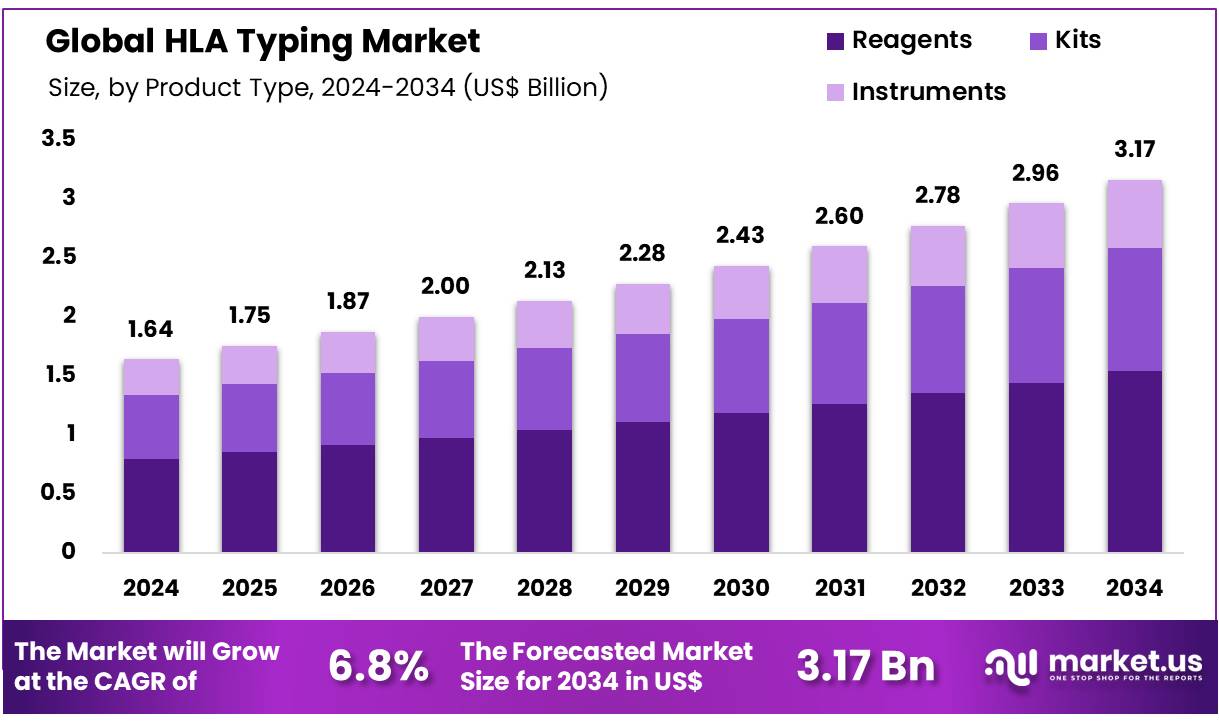
New York, NY – Dec 15, 2025 – Global HLA Typing Market size is expected to be worth around US$ 3.17 Billion by 2034 from US$ 1.64 Billion in 2024, growing at a CAGR of 6.8% during the forecast period 2025 to 2034. In 2024, North America led the market, achieving over 39.8% share with a revenue of US$ 652.7 Million.
Human Leukocyte Antigen (HLA) typing is a critical laboratory process used to identify genetic variations within the immune system that play a decisive role in organ and stem cell transplantation. The HLA system consists of a group of genes located on chromosome 6 that regulate immune recognition and compatibility between donors and recipients.
HLA typing is primarily performed to reduce the risk of transplant rejection and to improve long-term clinical outcomes. A higher degree of HLA matching between donor and recipient has been shown to significantly increase transplant success rates, particularly in bone marrow and hematopoietic stem cell transplants. The procedure is also widely applied in disease association studies, pharmacogenomics, and population genetics.
Modern HLA typing techniques are based on molecular methods such as Polymerase Chain Reaction (PCR), sequence-specific oligonucleotide probing, and next-generation sequencing. These advanced approaches provide high-resolution results, enabling precise identification of HLA alleles. The use of molecular typing has largely replaced older serological methods due to its superior accuracy and reliability.
The growing demand for organ and stem cell transplantation, combined with increased awareness of personalized medicine, continues to drive the adoption of HLA typing worldwide. Healthcare providers and diagnostic laboratories increasingly rely on standardized and high-throughput HLA testing to support clinical decision-making.
Overall, HLA typing remains a foundational element in immunogenetics, contributing significantly to improved patient outcomes and the advancement of transplant medicine.
Key Takeaways
- In 2024, the HLA Typing market recorded revenues of US$ 1.64 billion and is projected to expand at a CAGR of 6.8%, reaching US$ 3.17 billion by 2034.
- Based on product type, the market is categorized into Reagents, Kits, and Instruments, with Reagents emerging as the leading segment, accounting for 48.7% of the total market share in 2024.
- By technology, the market is segmented into PCR-Based, Microarray-Based, and NGS-Based platforms. Among these, PCR-Based technologies dominated the market, holding a 47.8% share in 2024.
- In terms of application, the HLA Typing market is classified into Organ Transplantation, Bone Marrow Transplantation, Disease Diagnosis, and Others. Organ Transplantation represented the largest application segment, contributing 51.8% of total revenue.
- On the basis of end user, the market is divided into Hospitals and Clinics, Diagnostic Laboratories, and Research Institutes. Diagnostic Laboratories led this segment, capturing a 42.5% market share in 2024.
- Regionally, North America maintained its leading position in the global HLA Typing market, accounting for 39.8% of the total market share in 2024.
Regional Analysis
North America continues to lead the global HLA typing market, accounting for 39.8% of total market share, supported by well-established healthcare infrastructure, high volumes of organ transplantation, and the extensive use of molecular diagnostic technologies. Market growth in the region is further reinforced by strong governmental involvement, particularly in the United States, where agencies such as the Health Resources and Services Administration (HRSA) support national transplant programs and donor registry initiatives. In addition, favorable reimbursement policies and the strong presence of leading diagnostic manufacturers contribute to sustained market expansion.
Europe represents the second-largest regional market, driven by proactive transplantation policies in countries including Germany, the United Kingdom, and France. Centralized healthcare systems and well-regulated donor matching frameworks enhance the efficiency of HLA testing across the region. Moreover, harmonized organ-sharing platforms, such as Eurotransplant, support cross-border collaboration and stimulate demand for standardized HLA typing services.
According to preliminary 2024 data from Eurotransplant, the organization facilitated the allocation of 7,150 organs from 2,181 deceased donors, with 22.5% of organs exchanged across national borders. These figures underscore the organization’s continued role in strengthening international cooperation in transplant medicine.
The Asia-Pacific region is expected to register the fastest growth, supported by increasing awareness of organ donation, rising prevalence of chronic diseases, and government-led efforts to expand transplant infrastructure. Significant investments in molecular diagnostics and hospital modernization in countries such as India, China, and Japan are accelerating the adoption of HLA typing across the region.
Emerging Trends in HLA Typing
- Advanced Sequencing Technologies: The adoption of third-generation sequencing technologies, including PacBio and nanopore sequencing, is enhancing the accuracy of HLA typing. These platforms enable long-read sequencing, which reduces allelic ambiguities and improves the resolution of complex HLA regions.
- Integration with Next-Generation Sequencing (NGS): Next-generation sequencing platforms are increasingly being applied in HLA typing to deliver high-resolution and comprehensive allele detection. This approach supports the identification of rare and novel alleles, thereby strengthening donor–recipient matching outcomes.
- Development of Specialized Bioinformatics Tools: Advanced computational and bioinformatics software solutions are being developed to efficiently process large sequencing datasets. These tools improve analytical speed, accuracy, and standardization in HLA typing workflows.
Key Use Cases of HLA Typing
- Organ and Stem Cell Transplantation: Precise HLA matching between donors and recipients is critical to minimize immune-mediated graft rejection. In procedures such as kidney transplantation, HLA mismatches are strongly associated with graft failure, whereas optimal matching has been shown to significantly improve transplant success rates.
- Disease Association Studies: HLA typing plays a central role in identifying genetic predispositions to autoimmune and inflammatory diseases. For example, the HLA-B27 allele is closely associated with an increased risk of ankylosing spondylitis, supporting deeper insights into disease pathogenesis and targeted therapeutic development.
- Prediction of Adverse Drug Reactions: HLA typing is increasingly used to assess the risk of drug-induced hypersensitivity reactions. Individuals carrying the HLA-B 57:01 allele are known to have a higher likelihood of developing hypersensitivity to the antiretroviral drug abacavir. Pre-treatment screening helps reduce adverse events and supports personalized medicine approaches.
Frequently Asked Questions on HLA Typing
- Why is HLA typing important in organ transplantation?
HLA typing is critical in organ transplantation as it helps determine donor-recipient compatibility. Better HLA matching significantly reduces the risk of graft rejection, improves transplant success rates, and enhances long-term patient survival outcomes. - Which technologies are commonly used for HLA typing?
HLA typing is commonly performed using molecular techniques such as PCR-based assays, sequence-specific oligonucleotide probing, sequence-based typing, and next-generation sequencing, which provide high accuracy and resolution for allele identification. - What diseases are associated with HLA typing?
HLA typing is associated with the diagnosis and risk assessment of autoimmune diseases such as rheumatoid arthritis, type 1 diabetes, celiac disease, and ankylosing spondylitis, where specific HLA alleles indicate genetic susceptibility. - Who typically requires HLA typing tests?
HLA typing is typically required for patients undergoing organ or bone marrow transplantation, transplant donors, individuals with autoimmune disorders, and participants in clinical research studies focused on immunogenetics or personalized medicine. - What factors are driving the growth of the HLA typing market?
The growth of the HLA typing market is driven by rising organ transplant procedures, increasing prevalence of autoimmune diseases, advancements in molecular diagnostics, and growing adoption of precision medicine across healthcare systems globally. - Which end users dominate the HLA typing market?
Hospitals, transplant centers, and reference laboratories dominate the HLA typing market due to high testing volumes, advanced laboratory infrastructure, and the critical role of HLA matching in transplantation and immunological diagnostics. - How is next-generation sequencing impacting the HLA typing market?
Next-generation sequencing is transforming the HLA typing market by enabling high-resolution typing, faster turnaround times, and improved accuracy, thereby supporting better clinical decision-making and expanding applications in research and clinical diagnostics. - Which regions hold a significant share of the HLA typing market?
North America holds a significant share of the HLA typing market due to advanced healthcare infrastructure, high transplant rates, favorable reimbursement policies, and strong presence of key diagnostic technology providers and research institutions.
Conclusion
HLA typing remains a cornerstone of modern immunogenetics, playing a decisive role in improving transplant compatibility, patient outcomes, and long-term graft survival. The transition toward advanced molecular and sequencing-based technologies has significantly enhanced accuracy, resolution, and clinical utility.
Market growth is being driven by rising transplant procedures, expanding applications in disease association and pharmacogenomics, and increasing adoption of precision medicine. With strong demand from diagnostic laboratories and sustained leadership from North America, the global HLA typing market is expected to demonstrate steady expansion, reinforcing its critical importance within contemporary healthcare and transplant medicine ecosystems.
Discuss your needs with our analyst
Please share your requirements with more details so our analyst can check if they can solve your problem(s)




