


Table of Contents
Overview
New York, NY – Jan 16, 2026 – The Global Hematology Analyzer Market size is expected to be worth around USD 5.6 Billion by 2033 from USD 2.6 Billion in 2023, growing at a CAGR of 7.8% during the forecast period from 2023 to 2032.
A hematology analyzer is a laboratory instrument used for the quantitative and qualitative analysis of blood samples. It plays a critical role in clinical diagnostics by enabling the rapid and accurate evaluation of blood components, which supports disease detection, monitoring, and treatment decisions.
Hematology analyzers are primarily used to measure key blood parameters such as red blood cells, white blood cells, hemoglobin, hematocrit, and platelets. Advanced systems also provide differential counts of white blood cells, helping clinicians identify infections, inflammatory conditions, anemia, and blood-related disorders. The automation of these processes has significantly reduced manual errors and improved laboratory efficiency.
The basic working principle of a hematology analyzer is based on technologies such as electrical impedance, flow cytometry, and optical light scattering. These methods allow precise cell counting and classification within a short turnaround time. As a result, consistent and reproducible test results are delivered, even in high-volume laboratory settings.
Hematology analyzers are widely adopted across hospitals, diagnostic laboratories, blood banks, and research institutions. Their use has increased due to the rising prevalence of chronic diseases, growing demand for early diagnosis, and the expansion of healthcare infrastructure globally. In addition, improvements in analyzer accuracy, compact design, and user-friendly interfaces have enhanced adoption in both large laboratories and smaller healthcare facilities.
Overall, hematology analyzers continue to be an essential component of modern clinical laboratories. Their contribution to reliable blood analysis supports better patient outcomes and strengthens the efficiency of healthcare delivery systems worldwide.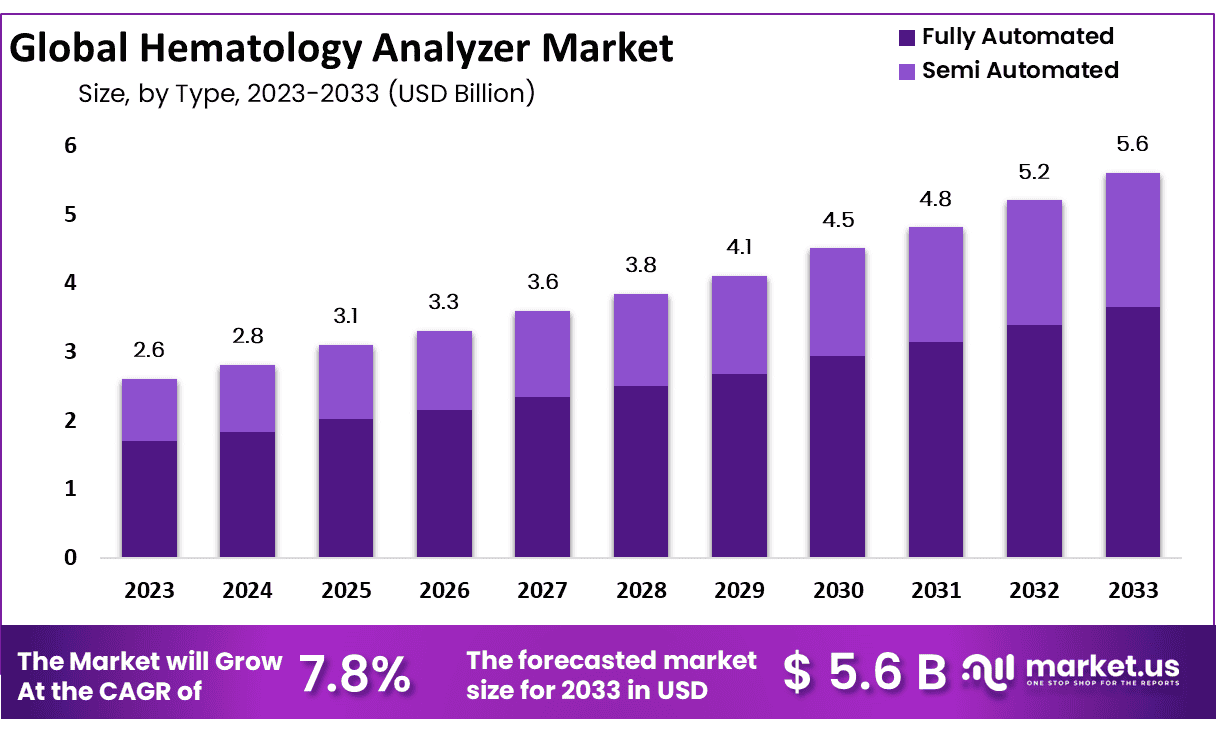
Key Takeaways
- Market Size & Growth: The hematology analyzer market is projected to reach approximately USD 5.6 billion by 2033, rising from USD 2.6 billion in 2023, registering a CAGR of 7.8% during the forecast period.
- Component Analysis: In 2023, the reagents and consumables segment accounted for the largest share, contributing 41.6% of total market revenue.
- Type Analysis: Fully automated hematology analyzers led the market in 2023, representing 65.2% of the overall market share.
- End-Use Analysis: Clinical laboratories remained the dominant end-use segment, capturing 63.2% of the market share in 2023.
- Regional Analysis: North America held a leading position in 2023, accounting for 41.5% of the global market share and generating approximately USD 1.07 billion in revenue.
Regional Analysis
North America accounted for a dominant market position, capturing 41.5% of the global market share and generating approximately USD 1.07 billion in revenue in 2023. This leadership position was primarily supported by high disposable income levels and the widespread adoption of automated hematology analyzers across diagnostic laboratories in the region. Well-established healthcare infrastructure and early integration of advanced diagnostic technologies further contributed to strong regional demand.
In contrast, the Asia Pacific region is projected to witness notable expansion over the forecast period, supported by substantial untapped opportunities in developing economies such as China and India. The region’s growth trajectory is expected to remain strong as healthcare systems continue to evolve and access to diagnostic services improves.
The anticipated growth in Asia Pacific is being driven by several interrelated factors. Increasing awareness of advanced healthcare services, a rising prevalence of chronic and infectious diseases, and rapid population growth are collectively contributing to a higher demand for efficient and accurate blood diagnostic solutions. Additionally, ongoing investments in healthcare infrastructure and the gradual shift toward automated laboratory systems are expected to further accelerate the adoption of hematology analyzers across the region.
Emerging Trends in Hematology Analyzers
- Miniaturization and Portability: Technological progress is driving the development of smaller and more compact hematology analyzers. These systems are increasingly portable, allowing deployment across hospitals, diagnostic centers, and remote or resource-limited settings, thereby improving accessibility and flexibility of blood testing services.
- Integration with Artificial Intelligence and Robotics: The integration of artificial intelligence and robotic automation is enhancing the performance of hematology analyzers. AI-driven algorithms support faster data processing, improved result accuracy, and reduced dependency on manual intervention, contributing to lower error rates and optimized laboratory workflows.
- Advanced Imaging and Flow Cytometry Technologies: Modern hematology analyzers are incorporating advanced imaging systems and flow cytometry capabilities. These technologies enable detailed cellular analysis, supporting precise identification of complex blood disorders and strengthening diagnostic confidence in both routine and specialized hematological assessments.
- Growth of Point-of-Care Testing Solutions: There is an increasing adoption of point-of-care hematology analyzers designed to deliver rapid results near the patient site. This trend supports timely clinical decision-making in emergency and critical care environments, improving treatment efficiency and overall patient management.
Use Cases of Hematology Analyzers
- Disease Diagnosis and Clinical Management: Hematology analyzers are widely used for diagnosing and managing blood-related conditions such as anemia, leukemia, and hemophilia. By detecting cellular abnormalities at an early stage, these systems support timely intervention and improved patient outcomes.
- Monitoring of Treatment Effectiveness: During therapeutic procedures, including chemotherapy and long-term disease management, hematology analyzers are used to monitor patient response. Continuous evaluation of blood parameters enables clinicians to adjust treatment protocols and optimize care delivery.
- Applications in Research and Drug Development: In research and clinical trial settings, hematology analyzers support detailed blood analysis to study disease progression and assess the effectiveness of emerging therapies. Their role is critical in advancing hematological research and accelerating drug development pipelines.
- Routine Health Screening and Preventive Care: Hematology analyzers are commonly utilized in routine health check-ups to assess overall wellness. Early identification of blood abnormalities through regular screening supports preventive healthcare strategies and reduces the risk of advanced disease progression.
Frequently Asked Questions on Hematology Analyzer
- How does a hematology analyzer work?
A hematology analyzer operates using technologies such as electrical impedance, flow cytometry, and laser scattering to count and classify blood cells, ensuring precise, rapid, and reproducible results for routine and advanced clinical testing. - What are the key applications of hematology analyzers?
Hematology analyzers are widely used in hospitals, diagnostic laboratories, and research institutions for complete blood count testing, anemia detection, infection diagnosis, cancer screening, and monitoring of chronic and infectious diseases. - What are the main types of hematology analyzers?
Hematology analyzers are commonly categorized into 3-part, 5-part, and 6-part differential systems, based on their ability to differentiate white blood cell subtypes, with higher-part systems offering improved diagnostic accuracy and automation. - What factors influence the selection of a hematology analyzer?
Selection is influenced by test volume, level of automation, accuracy requirements, maintenance costs, throughput speed, and availability of advanced features such as connectivity, data management, and integration with laboratory information systems. - Which end users dominate the hematology analyzer market?
Hospitals and diagnostic laboratories represent the largest end-user segment, supported by high patient inflow, routine blood testing requirements, and adoption of advanced analyzers, while research institutions contribute steadily through clinical and academic applications. - What technological trends are shaping the market?
Key trends include adoption of artificial intelligence, digital imaging, compact analyzers for point-of-care testing, enhanced data connectivity, and development of high-throughput systems that improve efficiency, accuracy, and workflow optimization in laboratories. - Which regions show strong market potential?
North America and Europe lead due to advanced healthcare systems, while Asia-Pacific shows strong growth potential, supported by expanding diagnostic infrastructure, rising healthcare expenditure, large patient populations, and increasing awareness of early disease detection.
Conclusion
Hematology analyzers have become indispensable tools in modern clinical and diagnostic laboratories, enabling accurate, rapid, and reproducible blood analysis. Their role in disease diagnosis, treatment monitoring, research, and preventive healthcare continues to expand with rising global disease burden and growing demand for early detection.
Market growth is being supported by automation, advanced imaging, artificial intelligence integration, and increasing adoption of point-of-care solutions. While North America remains a leading market, strong growth potential in Asia Pacific highlights future opportunities. Overall, continuous technological advancement will further strengthen the clinical value and market outlook of hematology analyzers.
Discuss your needs with our analyst
Please share your requirements with more details so our analyst can check if they can solve your problem(s)




