


Table of Contents
Overview
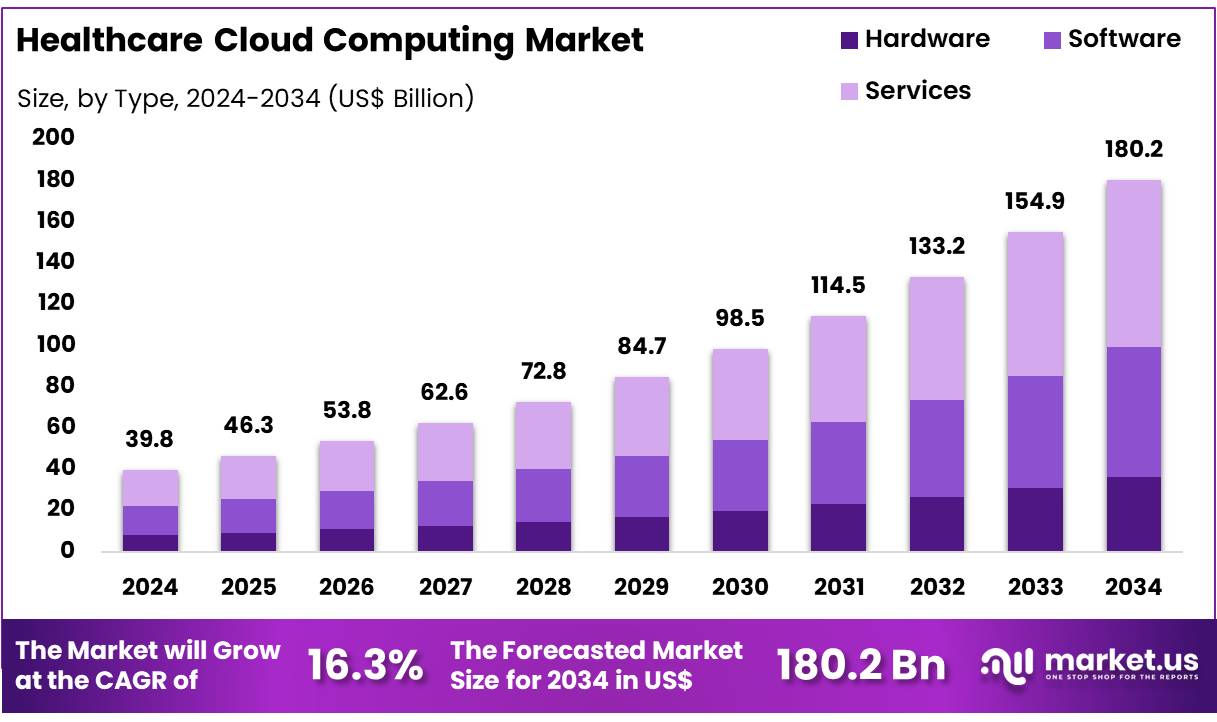
New York, NY – Dec 15, 2025 – Global Healthcare Cloud Computing Market size is forecasted to be valued at US$ 180.2 Billion by 2034 from US$ 39.8 Billion in 2024, growing at a CAGR of 16.3% during the forecast period 2025 to 2034. In 2024, North America led the market, achieving over 38.8% share with a revenue of US$ 15.4 Billion.
The adoption of cloud computing in healthcare is increasingly recognized as a critical enabler of digital transformation across the global healthcare ecosystem. Healthcare cloud computing refers to the use of cloud-based platforms and services to store, manage, process, and analyze healthcare data while ensuring security, compliance, and scalability.
Cloud-based solutions are being widely deployed to support electronic health records (EHRs), medical imaging, telehealth services, population health management, and data analytics. The transition from traditional on-premise infrastructure to cloud environments is driven by the need for improved operational efficiency, cost optimization, and real-time access to patient information.
The growth of healthcare cloud computing can be attributed to the rising volume of healthcare data, increasing demand for remote care services, and the growing emphasis on value-based care models. Cloud platforms enable healthcare providers to enhance collaboration across departments, improve clinical decision-making, and deliver personalized patient care.
In addition, advancements in data encryption, identity management, and regulatory compliance frameworks have strengthened confidence in cloud adoption across hospitals, clinics, and life sciences organizations. Public, private, and hybrid cloud deployment models are being adopted to meet diverse organizational requirements.
Looking ahead, healthcare cloud computing is expected to play a pivotal role in supporting artificial intelligence, machine learning, and advanced analytics applications. These technologies are anticipated to further improve patient outcomes, streamline workflows, and support sustainable healthcare delivery worldwide.
Key Takeaways
- In 2024, the global healthcare cloud computing market generated revenue of US$ 39.8 billion and is projected to expand at a CAGR of 16.3%, reaching US$ 180.2 billion by 2034.
- By component, the services segment dominated the market, accounting for 37.8% of the total revenue in 2024.
- Based on the service model, Software as a Service (SaaS) captured the largest revenue share of 47.4% in 2024.
- By pricing model, the pay-as-you-go model led the market with a revenue share of 58.2% in 2024.
- Based on application, non-clinical information systems represented the largest share, contributing 57.5% of market revenue in 2024.
- By deployment model, the private cloud segment held the leading position with a 39.7% revenue share in 2024.
- By end user, healthcare providers accounted for the largest market share of 62.5% in 2024.
- Regionally, North America dominated the global market, capturing a 38.8% share in 2024.
Key Statistics and Insights
- McKinsey research indicates that cloud computing adoption in healthcare could generate up to USD 140 billion in economic value by 2030, driven by operational efficiency and improved patient outcomes.
- Healthcare industry expenditure on cloud services reached USD 3.73 billion in the previous year and was projected to grow to USD 9.48 billion by 2020, reflecting accelerated digital transformation initiatives.
- Approximately 70% of health IT professionals have already implemented cloud-based solutions, while an additional 20% plan to migrate within the next two years, highlighting strong adoption momentum.
- Cloud adoption has been linked to operational improvements, including a 30% reduction in patient no-show rates and a 25% decrease in average patient wait times.
- Patient experience improvements have been enabled through cloud-supported capabilities such as contactless patient intake, online appointment scheduling, and telehealth service delivery.
- Cloud computing enables real-time data analytics, allowing healthcare providers to process millions of data requests within seconds and support time-critical clinical decisions.
- Healthcare organizations increasingly utilize artificial intelligence (AI) and machine learning (ML) on cloud platforms to strengthen preventive care by identifying at-risk patients and enabling early interventions.
- More than 83% of healthcare organizations currently leverage cloud services, primarily to enhance patient care quality, reduce operational costs, and support regulatory compliance.
- According to the US Department of Health and Human Services, 412 healthcare data breaches were investigated in 2018, reinforcing the need for advanced cybersecurity frameworks in cloud environments.
- Hybrid cloud deployment models are gaining widespread acceptance, with 95% of healthcare organizations considering them optimal for balancing scalability and mitigating cloud availability risks.
- Despite increasing adoption, cybersecurity remains a major concern, with a record 725 cyberattacks reported in 2023, emphasizing the importance of robust security investments.
- Cloud-based electronic health record (EHR) systems have enabled secure centralized storage of patient data, resulting in streamlined workflows and improved care coordination in 84% of organizations following migration.
- Healthcare providers achieve significant cost savings by utilizing cloud-based archival storage solutions, such as Amazon S3 Deep Archive, for long-term medical record retention.
- Cloud infrastructure supports the transition to value-based care models by enabling large-scale data analysis and the development of performance and outcome-based metrics.
- The shortage of skilled IT professionals continues to slow adoption, with 45.6% of respondents citing limited access to qualified personnel as a primary barrier to cloud implementation.
Regional Analysis
In 2024, North America accounted for approximately 38.8% of the global healthcare cloud computing market, supported by a well-established healthcare infrastructure, strict regulatory requirements, and widespread adoption of digital health technologies. The extensive use of electronic health records (EHRs), telemedicine platforms, and data-driven healthcare solutions has significantly increased demand for cloud-based healthcare systems. In addition, continuous innovation by leading technology providers has reinforced the region’s market leadership.
For example, in May 2025, Innovaccer Inc. introduced Innovaccer Gravity, a healthcare intelligence platform designed to integrate enterprise-wide healthcare data, enable cross-domain analytics, and accelerate AI-driven transformation while improving return on investment and lowering total cost of ownership. The strong presence of major healthcare IT vendors and the integration of artificial intelligence, cloud computing, and advanced analytics further contribute to North America’s dominance.
The Asia Pacific region is projected to register the highest CAGR during the forecast period. Rapid market expansion is being driven by rising healthcare expenditure, government-led digital health initiatives, and increasing investments in healthcare IT infrastructure. Countries such as China and India are actively adopting cloud-based healthcare solutions to address hospital overcrowding, limited rural healthcare access, and the growing prevalence of chronic diseases. Notably, China’s Greater Bay Area has initiated a cross-border medical data space aligned with international standards, supporting secure data sharing, interoperability, and innovation. Such initiatives are expected to accelerate cloud adoption and strengthen regional market growth.
Key Use Cases
- Remote Patient Monitoring: Cloud computing enables continuous remote monitoring of patient health through Internet of Medical Things (IoMT) devices, including wearable biosensors. Patient data is transmitted to cloud platforms, allowing healthcare providers to track health indicators in real time. This approach is particularly effective for chronic disease management, post-operative care, and emergency response. For example, cloud-enabled ECG monitoring systems transmit cardiac data to specialists for immediate analysis and timely clinical intervention.
- Telemedicine Application: Cloud-based telemedicine solutions support virtual consultations, remote diagnostics, and real-time patient monitoring. These platforms facilitate healthcare delivery irrespective of geographic location, reducing reliance on in-person visits and improving access to care. Cloud infrastructure enables secure video conferencing, real-time data exchange, and integration with diagnostic tools, enhancing clinical efficiency and care continuity.
- Big Data Analytics: Cloud platforms provide the computational capacity and scalable storage required to analyze large volumes of healthcare data. Advanced analytics support outcome prediction, pattern recognition, and personalized treatment planning. Leading cloud providers, such as Amazon Web Services (AWS), offer analytics services that enable healthcare organizations to extract actionable insights from complex patient datasets.
- E-Prescription Management: Cloud-hosted e-prescription systems enable electronic prescription creation, management, and fulfillment. These systems reduce medication errors, improve prescription accuracy, and enhance coordination between healthcare providers, pharmacies, and patients. Integration with EHR systems further streamlines clinical workflows and ensures timely medication delivery.
- Disaster Recovery and Business Continuity: Cloud computing delivers scalable and cost-efficient disaster recovery solutions by maintaining secure backups of critical applications and patient data. In the event of system failures or natural disasters, healthcare organizations can rapidly restore operations, minimizing service disruption and ensuring continuity of patient care.
- Collaborative Patient Care: Cloud platforms enable seamless data sharing and real-time collaboration among multidisciplinary healthcare teams. Clinicians, specialists, and care coordinators can access up-to-date patient information, supporting coordinated treatment planning and informed decision-making. This capability significantly enhances care quality, efficiency, and clinical outcomes.
Frequently Asked Questions on Healthcare Cloud Computing
- How is cloud computing used in healthcare organizations?
Cloud computing is used to support electronic health records, telemedicine platforms, medical imaging storage, population health management, and clinical decision support, improving operational efficiency, data accessibility, and collaboration among healthcare professionals. - What are the key benefits of cloud computing in healthcare?
The adoption of cloud computing provides scalability, cost efficiency, improved data security, disaster recovery capabilities, and faster deployment of healthcare applications, allowing providers to focus on patient care rather than infrastructure management. - Is healthcare cloud computing secure and compliant?
Healthcare cloud computing platforms are designed to comply with regulatory standards such as HIPAA and GDPR, offering encryption, access controls, audit trails, and continuous monitoring to protect sensitive patient information from unauthorized access. - What types of cloud deployment models are used in healthcare?
Healthcare organizations commonly use public, private, and hybrid cloud models, selected based on data sensitivity, compliance requirements, and operational needs, with hybrid models increasingly preferred for balancing flexibility and data control. - What factors are driving growth in the healthcare cloud computing market?
Market growth is driven by rising digital health adoption, increasing healthcare data volumes, demand for cost-effective IT solutions, expansion of telehealth services, and growing emphasis on data-driven decision-making across healthcare systems. - Which end users are driving market demand?
Hospitals, clinics, diagnostic laboratories, healthcare payers, and pharmaceutical companies are key end users, with hospitals accounting for a significant share due to large-scale data management needs and increasing cloud-based system adoption. - How is regulatory compliance influencing the market?
Strict healthcare data protection regulations are shaping market offerings, encouraging vendors to invest in secure, compliant cloud solutions that meet regional and international standards, thereby increasing trust and accelerating adoption among healthcare organizations. - What is the future outlook of the healthcare cloud computing market?
The market is expected to experience sustained growth, supported by advancements in artificial intelligence, interoperability solutions, and remote care technologies, alongside increasing investments in healthcare IT modernization across developed and emerging economies.
Conclusion
Healthcare cloud computing has emerged as a foundational pillar of digital transformation across the global healthcare ecosystem. Its adoption is being driven by the need for scalable data management, cost efficiency, real-time clinical insights, and enhanced patient engagement. Cloud-based platforms are enabling secure data storage, advanced analytics, telehealth expansion, and value-based care delivery while supporting regulatory compliance.
Market growth is expected to remain strong, supported by increasing healthcare data volumes, AI and machine learning integration, and rising demand for remote care. Despite cybersecurity and workforce challenges, continued technological innovation is expected to sustain long-term market expansion.
Discuss your needs with our analyst
Please share your requirements with more details so our analyst can check if they can solve your problem(s)




