


Table of Contents
Overview
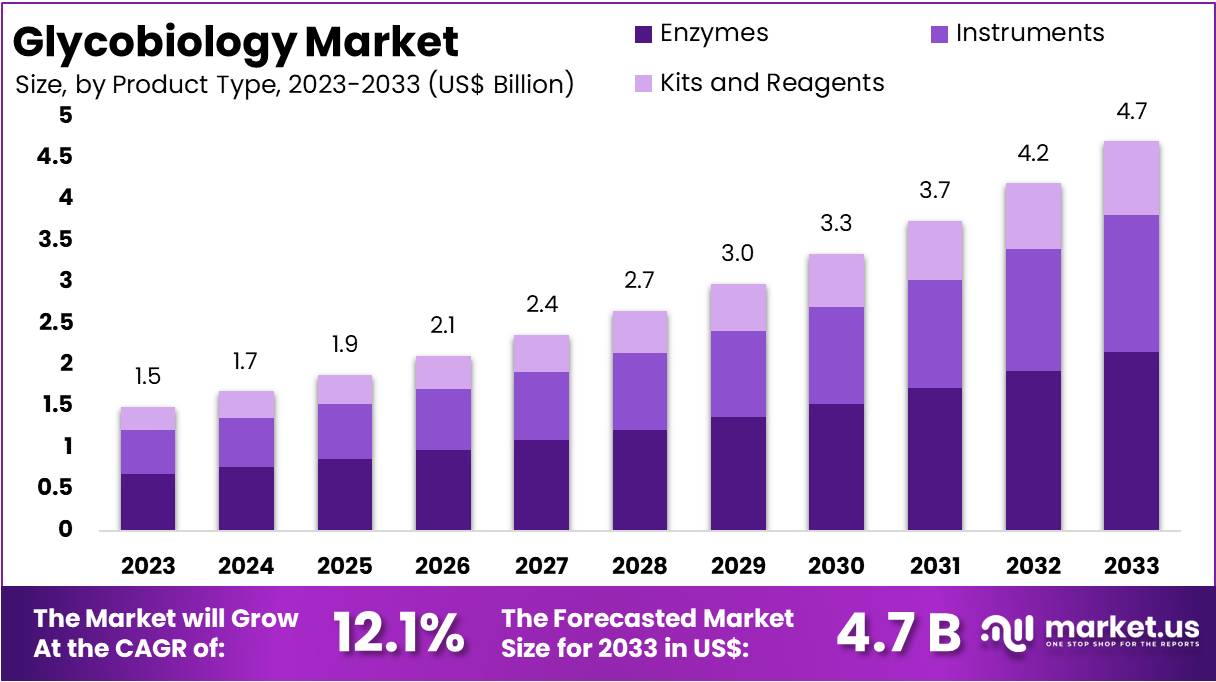
New York, NY – Feb 19, 2026 – The Global Glycobiology Market size is expected to be worth around US$ 4.7 Billion by 2033, from US$ 1.5 Billion in 2023, growing at a CAGR of 12.1% during the forecast period from 2024 to 2033.
Glycobiology is an emerging scientific discipline focused on the structure, biosynthesis, and biological functions of carbohydrates, commonly known as glycans, in living organisms. Glycans are complex sugar molecules attached to proteins and lipids on cell surfaces, playing a critical role in cellular communication, immune recognition, and molecular stability. The formation of glycans occurs through enzymatic processes within cellular compartments such as the endoplasmic reticulum and Golgi apparatus, where specific enzymes sequentially assemble sugar chains onto biomolecules.
This biological modification, referred to as glycosylation, is essential for proper protein folding, cell signaling, and host–pathogen interactions. Variations in glycan structures influence disease progression, therapeutic responses, and diagnostic outcomes, making glycobiology a key area of research across biotechnology, pharmaceutical development, and precision medicine. Advances in analytical technologies, including mass spectrometry and glycan sequencing, have significantly improved the understanding of glycan complexity and functional diversity.
The growing interest in glycobiology is driven by its applications in vaccine development, cancer research, immunotherapy, and biomarker discovery. Glycan-based innovations are enabling researchers to develop targeted treatments and improve drug efficacy through enhanced molecular design. As scientific exploration continues, glycobiology is positioned to contribute substantially to next-generation healthcare solutions by providing deeper insights into cellular mechanisms and disease pathways.
The expanding research landscape highlights glycobiology as a foundational pillar supporting modern life sciences innovation and translational medical research.
Key Takeaways
- The global glycobiology market is expected to expand from US$ 1.5 billion in 2023 to approximately US$ 4.7 billion by 2033, registering a compound annual growth rate (CAGR) of 12.1% during the forecast period.
- Within the product type category, enzymes represented the dominant segment in 2023, contributing more than 36% of the overall glycobiology market revenue.
- The opioids category emerged as the leading segment under drug class classification in 2023, accounting for around 43% of the total market share.
- Academic and research institutes constituted the primary end-user segment in 2023, capturing over 38% of the global glycobiology market demand.
- North America maintained its leadership position in 2023, securing nearly 40% of the global market share, with a market valuation of approximately US$ 0.5 million.
Regional Analysis
North America held a leading position in the glycobiology market in 2023, contributing more than 40% of the global market share, with an estimated valuation of US$ 0.5 million. The region’s dominance can be attributed to its well-established biotechnology and pharmaceutical industries, supported by substantial investments in research and development activities focused on advanced biological sciences.
The presence of prominent universities, research institutions, and innovation centers has strengthened regional capabilities in glycobiology research. Strategic collaborations between academic organizations and healthcare companies have accelerated progress in drug discovery, therapeutic development, and diagnostic innovation. These partnerships continue to enhance technological advancement and scientific outcomes across the sector.
In addition, strong government support through funding initiatives, regulatory encouragement, and favorable policy frameworks has sustained market expansion. The United States plays a central role by promoting biotechnological innovation and advancing research in biologics and precision diagnostics, reinforcing North America’s global leadership position.
Emerging Trends
- Discovery of GlycoRNAs: Researchers identified glycoRNAs, RNA molecules coated with sugar chains present on cell surfaces. These structures influence immune signaling, cellular communication, and disease mechanisms, creating new therapeutic opportunities in immunology, cancer biology, and molecular medicine research.
- AI and Computational Models Decode Sugar Patterns: Artificial intelligence and computational modeling technologies are enabling accurate prediction of glycosylation patterns on proteins. These tools improve biomarker identification, disease understanding, and therapeutic protein design, accelerating drug discovery and precision glycoscience development.
- Rise of Personalized Glycomics: Personalized glycomics focuses on analyzing individual glycan variations influenced by genetics, lifestyle, and disease conditions. This approach supports early diagnosis, customized treatments, and precision healthcare strategies through patient-specific glycan biomarker profiling and targeted therapeutic development.
- Advanced Glycan Arrays Speed Up Discovery: Advanced glycan arrays allow simultaneous testing of hundreds of carbohydrate structures, enabling rapid analysis of sugar–protein interactions. These high-throughput platforms enhance vaccine research, infectious disease studies, biomarker discovery, and immunological investigations across biomedical research applications.
Use Cases
- GlycoRNAs Act as Immune Messengers: GlycoRNAs function as signaling molecules connecting cellular RNA activity with immune receptors. They help trigger immune responses and may serve as early disease indicators, supporting development of targeted immunotherapies and precision immune modulation strategies.
- Glycan Arrays Accelerate Bio-Discovery: Glycan arrays enable rapid identification of carbohydrate binding patterns by screening multiple sugars simultaneously. This technology supports vaccine design, pathogen detection, and biomarker discovery while reducing research time, experimental costs, and laboratory resource consumption.
- Microbes Build Next-Generation Glycan Vaccines: Engineered microbes produce glycan-based vaccine components through biological synthesis processes. This microbial manufacturing approach reduces chemical complexity, improves scalability, enhances immune responses, and enables faster vaccine production during infectious disease outbreaks and global health emergencies.
- Personalized Sugar-Based Health Profiling Emerges: Personalized glycan profiling analyzes individual sugar signatures linked to inflammation, aging, and disease risk. These insights support early disease detection, treatment optimization, and personalized healthcare management through advanced analytical technologies and predictive clinical monitoring systems.
Frequently Asked Questions on Glycobiology
- Why is Glycobiology important in modern life sciences?
Glycobiology plays a critical role in understanding biological mechanisms such as cell signaling, infection pathways, and immune modulation. It supports advancements in therapeutics, diagnostics, and vaccine development, enabling researchers to better address complex diseases including cancer and autoimmune disorders. - What are glycans and how do they function in biological systems?
Glycans are complex carbohydrate chains attached to proteins or lipids, forming glycoproteins and glycolipids. They influence molecular recognition, cellular adhesion, and immune system regulation, thereby contributing significantly to physiological stability and pathological processes in living organisms. - What applications does Glycobiology have in healthcare and biotechnology?
Glycobiology supports multiple applications including drug discovery, biomarker identification, vaccine design, and regenerative medicine. The study of glycosylation patterns enables precision medicine approaches and improves therapeutic efficacy, particularly in biologics, monoclonal antibodies, and personalized treatment strategies. - Which industries are the major end users of Glycobiology solutions?
Key end users include pharmaceutical and biotechnology companies, academic research institutes, contract research organizations, and diagnostic laboratories. These stakeholders utilize glycobiology tools for therapeutic development, disease research, biomarker discovery, and advanced molecular characterization studies. - What technological advancements are influencing the Glycobiology market?
Innovations in mass spectrometry, glycan sequencing, bioinformatics platforms, and high-throughput analytical techniques are significantly enhancing glycan characterization capabilities. These technological improvements enable precise structural analysis, accelerating drug development pipelines and expanding research efficiency. - How does Glycobiology contribute to cancer research and treatment?
Glycobiology enables identification of abnormal glycosylation patterns associated with tumor progression and metastasis. These insights support early cancer detection, targeted therapy development, and immunotherapy optimization, improving treatment outcomes through more accurate disease monitoring and molecular targeting strategies. - What regional trends are observed in the Glycobiology market?
North America leads the market due to strong research funding and biotechnology infrastructure, while Europe demonstrates steady academic contributions. Asia-Pacific is experiencing rapid growth driven by expanding pharmaceutical manufacturing, government initiatives, and increasing investments in life sciences research.
Conclusion
The glycobiology field is emerging as a critical component of modern life sciences, driven by expanding research into glycan structures, biological functions, and therapeutic applications. Strong market growth is supported by technological innovation, increasing biopharmaceutical investments, and rising demand for precision medicine solutions.
Advancements such as glycoRNA discovery, AI-based glycosylation analysis, and personalized glycomics are accelerating scientific progress and clinical adoption. North America continues to lead regional development, while global research collaboration strengthens innovation capacity. Overall, glycobiology is positioned to significantly influence next-generation diagnostics, targeted therapies, and healthcare transformation through deeper understanding of cellular communication mechanisms.
Discuss your needs with our analyst
Please share your requirements with more details so our analyst can check if they can solve your problem(s)




