


Table of Contents
Overview
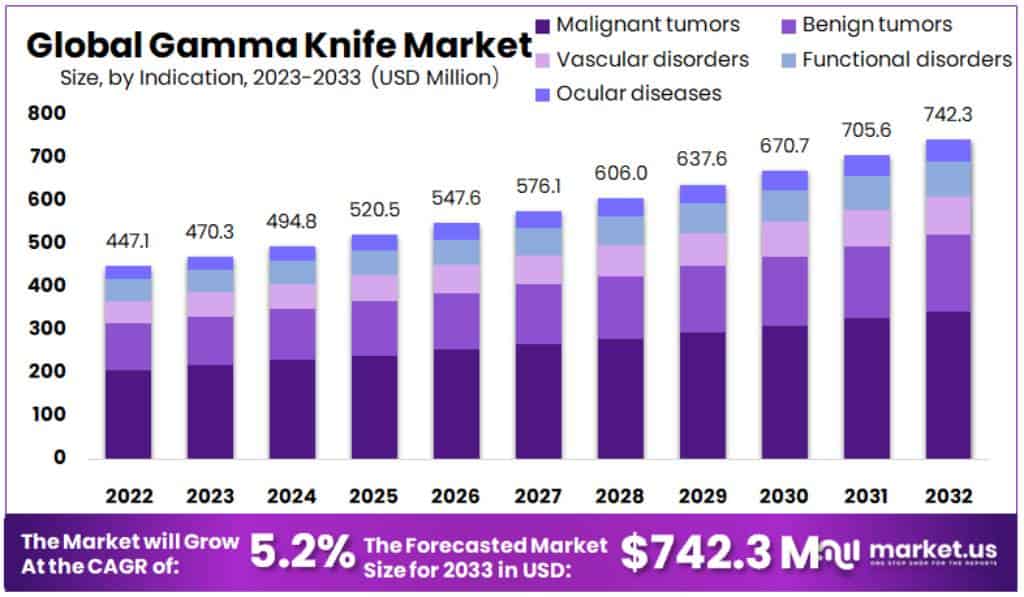
New York, NY – Jan 15, 2026 – The Global Gamma Knife Market size is expected to be worth around USD 742.3 Million by 2033 from USD 470.3 Million in 2023, growing at a CAGR of 5.2% during the forecast period from 2024 to 2033.
The Gamma Knife is a specialized form of stereotactic radiosurgery used for the treatment of a wide range of brain disorders. It is a non-invasive medical technology designed to deliver highly focused radiation beams to targeted areas of the brain with exceptional accuracy. The system is widely recognized for its role in treating both benign and malignant brain tumors, arteriovenous malformations, trigeminal neuralgia, and selected functional brain disorders.
The basic formation of Gamma Knife treatment is centered on the use of multiple cobalt-60 radiation sources. These sources are arranged in a hemispherical configuration and converge precisely at a single focal point. While each individual beam carries a low dose of radiation, the cumulative dose at the intersection point is therapeutically effective. This design allows surrounding healthy brain tissue to be largely preserved, reducing the risk of complications.
Treatment planning is performed using advanced imaging techniques such as MRI or CT scans. Based on these images, clinicians can define the exact size, shape, and location of the target area. The patient’s head is stabilized using a stereotactic frame or mask system to ensure consistent positioning throughout the procedure.
Gamma Knife procedures are typically completed in a single session and do not require surgical incisions. As a result, hospital stays are minimized, recovery times are shorter, and overall patient comfort is improved. The adoption of Gamma Knife technology continues to support the shift toward precise, outpatient-based neurological care.
Key Takeaways
- The Gamma Knife market is projected to reach USD 742.3 million by 2033.
- In 2023, the market size was estimated at USD 470.3 million.
- The market is expected to expand at a CAGR of 5.2% during 2023–2033.
- Malignant tumors accounted for the largest share, contributing over 46.2% of total revenue in 2023.
- Hospitals represented more than 43% of the market share in 2023.
- The Asia-Pacific region led the market with a 38.5% share in 2023.
- The India Gamma Knife market is forecast to grow at a CAGR of 11.2% through 2033, supported by rising medical tourism and government initiatives.
- The China market is anticipated to register a CAGR of around 10% through 2033, driven by increasing healthcare expenditure.
- Elekta AB holds a dominant position with over 50% market share, followed by Varian Medical Systems Inc., which accounts for approximately 30% of the market.
Regional Analysis
The Gamma Knife market demonstrates strong regional momentum, with Asia-Pacific (APAC) accounting for the largest share at 38.5%, valued at approximately USD 172.5 million in 2023. This leadership position is primarily supported by the increasing prevalence of neurological disorders, rising healthcare expenditure, and improving access to advanced radiosurgery procedures. These structural factors are expected to sustain market expansion across the region over the forecast period.
North America, led by the United States, is also witnessing steady adoption of Gamma Knife systems. Ongoing clinical research exploring applications in essential tremors, Parkinson’s disease, and glioblastoma is expanding the therapeutic scope of Gamma Knife radiosurgery, thereby supporting continued market growth.
At the country level, India and China are emerging as high-growth markets. India’s Gamma Knife market is projected to expand at a CAGR of 11.2% through 2033, supported by its role as a medical tourism hub and government initiatives aimed at strengthening healthcare infrastructure and promoting advanced medical technologies. China is expected to register a CAGR of 10% over the same period, driven by broader insurance coverage, increased public healthcare spending, and a rising cancer burden.
In Europe, Germany is forecast to grow at a 4.1% CAGR through 2033, reflecting its advanced healthcare system and increasing neurological disease incidence. Japan’s market, growing at approximately 7.5% CAGR, benefits from continuous technological innovation and strong industry–hospital collaborations. Overall, the Gamma Knife market is positioned for sustained growth globally.
Emerging Trends
- Shift Toward Linear Accelerator (LINAC) Systems: A gradual migration from Gamma Knife systems toward LINAC-based radiosurgery platforms is being observed. This transition is driven by LINAC’s broader clinical versatility, multi-site treatment capability, and suitability for outpatient care, improving operational efficiency and patient convenience.
- Technological Advancements in GKRS: Continuous innovations in imaging integration, dose planning software, and motion management are enhancing the precision and clinical effectiveness of Gamma Knife radiosurgery. These advancements are supporting improved patient outcomes while expanding the spectrum of neurological conditions eligible for treatment.
- Evolving Cost Dynamics: The high capital and maintenance costs associated with Gamma Knife systems, particularly due to cobalt-60 handling requirements, remain a key concern. However, increasing radioactive material production and improved supply chain efficiencies may gradually reduce overall system costs and accessibility barriers.
Use Cases
- Brain Metastases: Gamma Knife radiosurgery remains a leading treatment option for brain metastases, demonstrating tumor control rates exceeding 90% in carefully selected patients, while minimizing damage to surrounding healthy brain tissue.
- Trigeminal Neuralgia: In trigeminal neuralgia management, GKRS delivers effective pain relief in nearly 90% of patients within one year of treatment, offering a non-invasive alternative to surgical intervention with favorable safety outcomes.
- Arteriovenous Malformations (AVMs): For small arteriovenous malformations under 3 cm, Gamma Knife radiosurgery achieves success rates close to 90%, significantly reducing hemorrhage risk through targeted radiation-induced vessel obliteration.
- Meningiomas and Acoustic Neuromas: Gamma Knife radiosurgery provides high long-term tumor control for benign tumors such as meningiomas and acoustic neuromas, while preserving neurological function and reducing complication rates compared to conventional surgical approaches.
Frequently Asked Questions on Gamma Knife
- What medical conditions are treated using Gamma Knife?
Gamma Knife is commonly used for brain tumors, arteriovenous malformations, trigeminal neuralgia, acoustic neuromas, and certain functional neurological disorders, particularly when conventional surgery poses high risk or limited accessibility. - Is Gamma Knife surgery safe for patients?
Gamma Knife treatment is considered safe due to its high precision and non-invasive nature, with lower complication rates compared to open surgery, reduced hospital stays, and minimal impact on surrounding neurological structures. - How long does a Gamma Knife procedure take?
A typical Gamma Knife procedure may last between one and four hours, depending on case complexity, planning requirements, and lesion size, while most patients are discharged the same day without requiring extended recovery time. - What are the benefits of Gamma Knife over traditional surgery?
The benefits include reduced surgical risk, no incision, faster recovery, lower infection rates, and improved accuracy, making Gamma Knife an effective option for patients who are elderly or medically unfit for open surgery. - What factors are driving the growth of the Gamma Knife market?
Market growth can be attributed to aging populations, improved healthcare infrastructure, higher adoption of precision medicine, and growing awareness among clinicians and patients regarding minimally invasive neurosurgical alternatives. - Which healthcare settings are the major end users of Gamma Knife systems?
Hospitals and specialized neurosurgical centers represent the primary end users, as these facilities possess advanced imaging capabilities, skilled professionals, and sufficient patient volumes to justify the high capital investment. - How is technological innovation impacting the Gamma Knife market?
Ongoing innovations, such as enhanced imaging integration, improved treatment planning software, and reduced procedure times, are strengthening clinical outcomes and are expected to positively influence adoption rates and long-term market growth.
Conclusion
The Gamma Knife market reflects the growing clinical and economic importance of non-invasive stereotactic radiosurgery in modern neurological care. Its high precision, strong clinical outcomes, and ability to treat complex brain disorders in a single outpatient session continue to support adoption across hospitals and specialized centers.
Market expansion is being driven by rising neurological disease prevalence, technological innovation, and healthcare infrastructure development, particularly in Asia-Pacific. Despite cost and competition from LINAC systems, Gamma Knife remains a gold standard for selected brain indications, positioning the market for steady, long-term growth through 2033.
Discuss your needs with our analyst
Please share your requirements with more details so our analyst can check if they can solve your problem(s)




