


Table of Contents
Overview
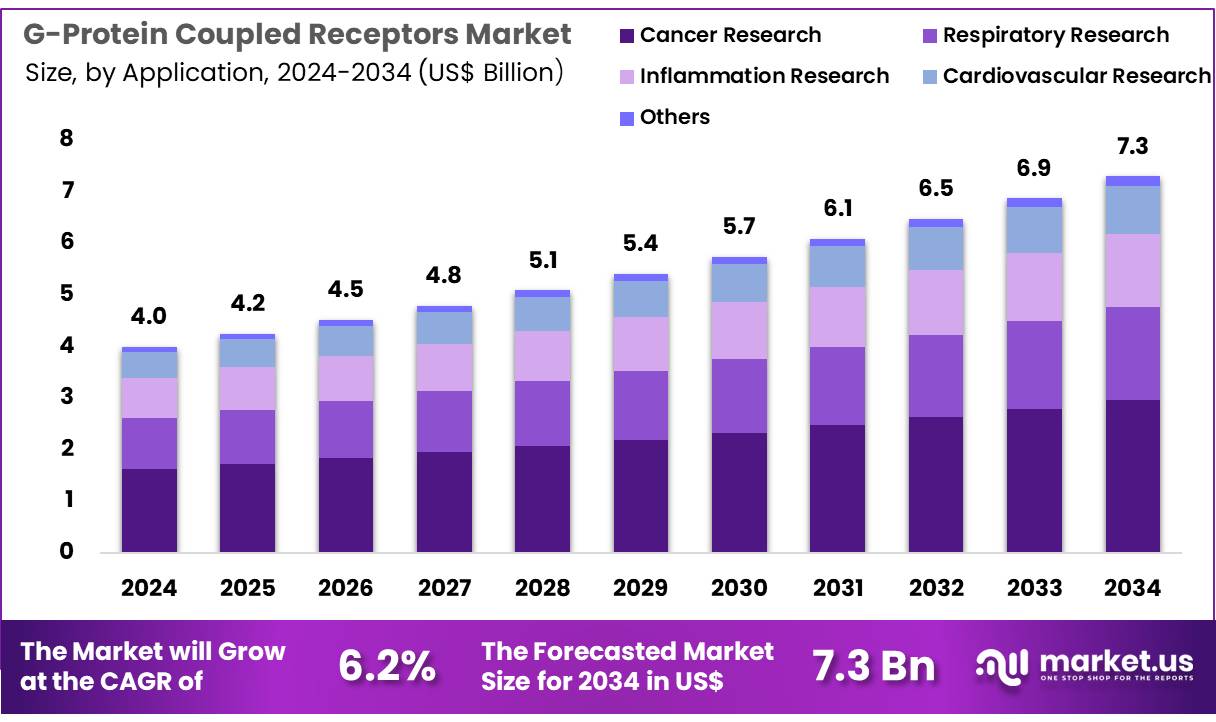
New York, NY – Dec 09, 2025 – Global G-Protein Coupled Receptors Market size is expected to be worth around US$ 7.3 Billion by 2034 from US$ 4.0 Billion in 2024, growing at a CAGR of 6.2% during the forecast period 2025 to 2034. In 2024, North America led the market, achieving over 37.9% share with a revenue of US$ 1.5 Billion.
G-Protein Coupled Receptors (GPCRs) represent one of the most significant protein families involved in cellular communication. These receptors are embedded in the cell membrane, where they facilitate the transmission of external signals into intracellular responses. The structure of a GPCR is characterized by seven transmembrane helices, an extracellular region responsible for ligand recognition, and an intracellular domain that activates G-proteins. This formation enables precise signal transduction mechanisms essential for regulating physiological processes.
The activation of GPCRs occurs when a ligand, such as a hormone, neurotransmitter, or sensory stimulus, binds to the receptor’s extracellular domain. This interaction induces a conformational change, allowing the intracellular region to engage specific G-proteins. Once activated, these proteins trigger downstream signaling pathways that influence critical functions including vision, immune response, cardiovascular regulation, and neurological activity. Due to this central role, GPCRs have been recognized as key therapeutic targets.
It has been estimated that more than one-third of all approved pharmaceuticals exert their efficacy through modulating GPCR activity. The therapeutic relevance of these receptors continues to expand, driven by advancements in structural biology, computational modeling, and high-throughput screening technologies. The growing understanding of GPCR architecture has supported the development of highly selective drug candidates, enhancing safety profiles and clinical effectiveness.
The importance of GPCRs to modern medical innovation continues to rise, and ongoing research is expected to generate new opportunities in precision therapeutics, particularly across oncology, metabolic disorders, and central nervous system diseases.
Key Takeaways
- In 2024, the G-protein coupled receptors market generated revenue of US$ 4.0 billion, and a 6.2% CAGR has been projected for the forecast period. The market is expected to reach US$ 7.3 billion by 2034.
- The product type segment comprises cell lines, ligands, detection kits, and cell culture reagents, with cell lines accounting for the largest share at 43.2% in 2024.
- Based on application, the market is categorized into cancer research, respiratory research, inflammation research, cardiovascular research, and other fields. Cancer research represented the leading segment with a 40.6% share.
- Within the assay type classification, the market includes cAMP functional assays, trafficking assays, internalization assays, calcium functional assays, and other assays. cAMP functional assays dominated the segment, contributing 38.4% of total revenue.
- From a regional perspective, North America led the market, securing a 37.9% share in 2024.
Regional Analysis
North America Leading the G-Protein Coupled Receptors Market
North America accounted for the largest share of 37.9%, supported by sustained investment in biomedical innovation, a steady flow of drug approvals targeting GPCR pathways, and the broad therapeutic relevance of these receptors. Substantial funding from the National Institutes of Health (NIH) continues to strengthen fundamental GPCR research, enabling the identification of new therapeutic candidates and advancing translational studies.
In 2023, the US Food and Drug Administration (FDA) approved several GPCR-targeting therapies, including Veozah (fezolinetant) for menopause-related vasomotor symptoms and Talvey (talquetamab-tgvs) for multiple myeloma. These advancements demonstrate the continued progress in converting receptor-based discoveries into clinical applications. Strong financial performance from major pharmaceutical companies with extensive GPCR-focused portfolios further reinforces market leadership. Eli Lilly reported US$45 billion in revenue for 2024, driven largely by cardiometabolic therapeutics, while Pfizer achieved US$63.6 billion in total revenues, supported by specialty care and oncology products that act on GPCR pathways.
Asia Pacific Expected to Record the Highest CAGR
The Asia Pacific region is projected to expand at the fastest CAGR due to increasing investment in drug discovery, rising chronic disease prevalence, and advancing healthcare infrastructure. Government funding in biotechnology continues to rise, with China’s public research spending on biotech estimated to have exceeded CNY 20 billion (US$ 2.6 billion) in 2023. Japan, through initiatives led by AMED, maintains substantial research budgets that support early-stage discovery programs involving GPCR targets.
According to the OECD/WHO Health at a Glance: Asia/Pacific 2024 report, healthcare expenditure across the region is increasing, signalling greater readiness for innovative therapies. Major pharmaceutical companies have also reported strong performance in cardiovascular and oncology portfolios within Asia Pacific markets. For instance, Novartis recorded notable growth in Q4 2024 demand from China and Japan. These developments are expected to accelerate the adoption of next-generation GPCR-targeting therapeutics across the region.
Emerging Trends
- Prevalence among approved drugs: It has been identified that 481 FDA-approved therapeutics, representing around 34% of all approved drugs, act on 107 distinct GPCR targets. This demonstrates the sustained significance of GPCRs in the management of human diseases.
- Expansion of the clinical pipeline: Approximately 320 GPCR-targeted agents are currently progressing through clinical trials. Around 36% of these candidates approximately 114 agents are directed toward 64 previously untargeted GPCRs for which no approved therapies currently exist.
- Increasing diversity of molecule types: Biotechnological advancements have supported the introduction of new therapeutic modalities, including biologics such as antibodies and peptides, as well as allosteric modulators and biased agonists. High-resolution structural data are now available for 43 unique GPCRs and 196 receptor–ligand complexes, enabling more robust structure-based drug design efforts.
- Targeting of peptide and protein receptors: Among non-olfactory GPCRs, 130 receptors about 33% of the total are peptide or protein-activated. These targets have gained prominence for next-generation biologics due to their inherent roles in protein–protein interactions and compatibility with antibody-based therapeutic strategies.
- Shifts in therapeutic focus: Central nervous system indications continue to dominate, accounting for 130 approved GPCR-targeting drugs and 137 investigational agents. However, a marked shift toward metabolic disorder treatments is being observed. Eleven GPCRs currently support approved therapies for type 2 diabetes and related metabolic conditions, and an additional 25 receptors are under clinical evaluation for these disorders.
Frequently Asked Questions on G-Protein Coupled Receptors
- What are G-Protein Coupled Receptors (GPCRs)?
GPCRs are membrane proteins responsible for transmitting signals from external stimuli into cells. Their activation regulates numerous physiological functions, and their structural diversity supports a wide range of therapeutic applications across chronic, metabolic, neurological, and rare diseases. - Why are GPCRs important in drug development?
Their central role in cell signaling makes GPCRs ideal therapeutic targets. A significant portion of approved drugs acts on GPCR pathways, and continued focus on receptor modulation supports the development of highly specific, effective, and safer treatment options. - How do GPCRs function in the human body?
GPCRs interact with extracellular ligands, triggering intracellular G-protein signaling cascades. These cascades influence biological processes such as metabolism, immune responses, neurotransmission, and cardiovascular regulation, making GPCR activity essential for maintaining physiological stability. - What diseases are linked to GPCR dysregulation?
GPCR dysfunction has been associated with cardiovascular diseases, metabolic disorders, neurological conditions, respiratory ailments, and various cancers. The prevalence of such disorders has increased interest in therapeutic strategies targeting receptor pathways and associated signaling mechanisms. - What is driving growth in the GPCR market?
Growth is being driven by rising research investments, expanding prevalence of chronic diseases, and continuous advancements in screening technologies. Increased demand for targeted therapies has strengthened the commercial value of GPCR-focused drug development initiatives. - What industries are major users of GPCR-related products?
Pharmaceutical, biotechnology, and academic research institutions constitute primary end users. Their utilization of GPCR assays, cell lines, and ligand-binding technologies supports drug discovery programs, biochemical studies, and translational research for emerging therapeutic classes. - Which factors are influencing market expansion?
Market expansion has been influenced by technological advancements, increased investment in structural biology, growing adoption of precision medicine, and higher demand for receptor-specific assays. These factors collectively support rapid development within GPCR-directed therapeutic pipelines. - What future trends are expected in the GPCR market?
Future trends include adoption of AI-driven drug design, improved structural imaging technologies, expansion of biologics targeting GPCR pathways, and growth of allosteric modulators. These innovations are expected to enhance therapeutic precision and accelerate market competitiveness.
Conclusion
The global G-protein coupled receptors market is expected to demonstrate steady expansion, supported by rising investment in drug discovery, growing demand for targeted therapeutics, and continuous advancements in structural biology. The market outlook remains positive as GPCRs retain their prominence in pharmaceutical innovation, driven by their extensive therapeutic relevance and expanding clinical pipeline.
Increasing adoption of high-throughput screening, emergence of next-generation biologics, and strong regional growth in North America and Asia Pacific are expected to strengthen overall market progression. Continuous R&D activity and diversification of molecule types will further support development of more selective, effective, and safer GPCR-targeting therapies.
Discuss your needs with our analyst
Please share your requirements with more details so our analyst can check if they can solve your problem(s)




