


Table of Contents
Overview
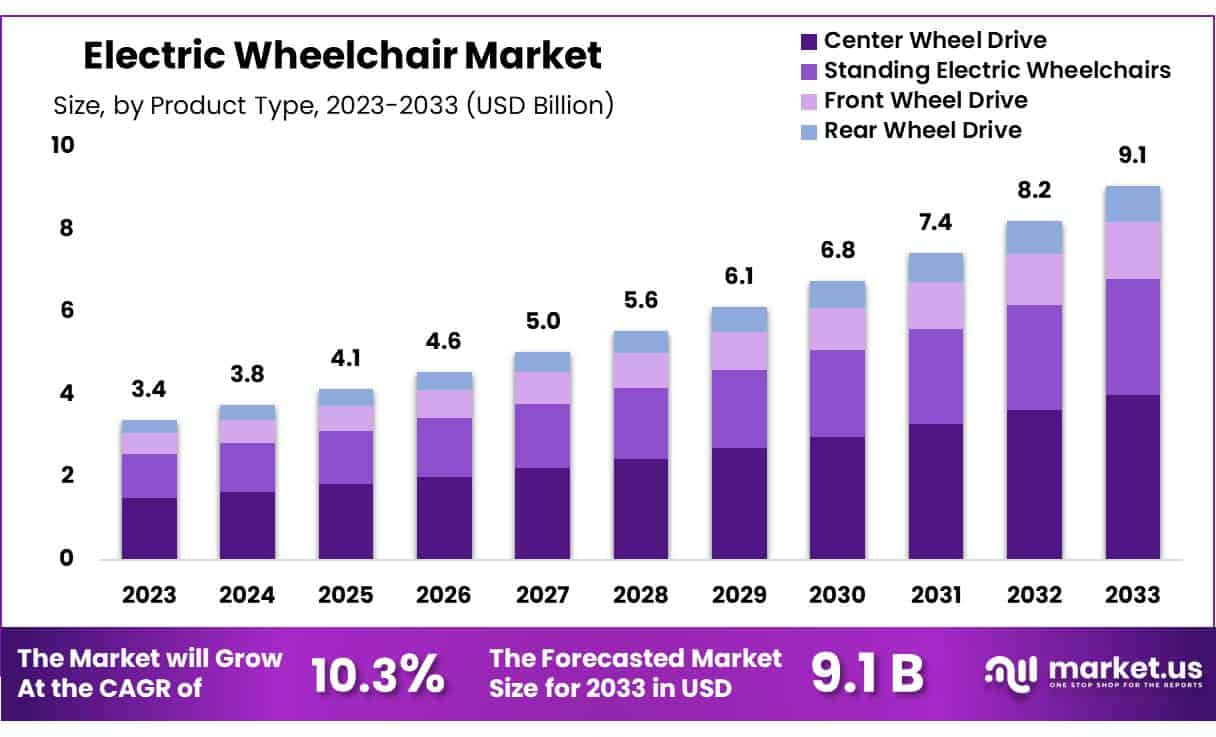
New York, NY – Jan 05, 2026 – The Electric Wheelchair Market size is expected to be worth around USD 9.1 Billion by 2033 from USD 3.4 Billion in 2023, growing at a CAGR of 10.3% during the forecast period 2024 to 2033.
The global electric wheelchair market is experiencing steady expansion, supported by increasing demand for advanced mobility solutions and a growing focus on improving quality of life for individuals with limited mobility. Electric wheelchairs, also known as power wheelchairs, are designed to provide enhanced independence, comfort, and ease of movement for elderly populations and people with physical disabilities.
Market growth is primarily attributed to the rising prevalence of age-related mobility disorders, spinal cord injuries, and chronic conditions such as arthritis and multiple sclerosis. In addition, the global increase in the geriatric population has significantly contributed to higher adoption rates of electric wheelchairs, particularly in developed and emerging healthcare markets. Technological advancements, including lightweight materials, improved battery performance, and smart control systems, have further strengthened product demand.
Healthcare infrastructure development and favorable reimbursement policies in several countries have also supported market penetration. Hospitals, rehabilitation centers, and homecare settings are increasingly adopting electric wheelchairs to enhance patient mobility and long-term care outcomes. Moreover, growing awareness regarding assistive devices and accessibility standards has positively influenced purchasing decisions among end users.
From a regional perspective, North America and Europe continue to account for a substantial share of the market due to strong healthcare systems and higher awareness levels. Meanwhile, Asia-Pacific is expected to witness notable growth, driven by improving medical facilities, rising healthcare expenditure, and expanding elderly populations.
Key Takeaways
- Market Size: The electric wheelchair market is projected to reach approximately USD 9.1 billion by 2033, rising from USD 3.4 billion in 2023.
- Market Growth: Market expansion is expected to progress at a compound annual growth rate (CAGR) of 10.3% over the forecast period from 2024 to 2033.
- Product Type Analysis: Among product categories, center wheel drive electric wheelchairs emerged as the leading segment in 2023, accounting for a 44.1% market share.
- Age Group Analysis: The 60 years and above age group represented a substantial portion of demand, capturing 54.2% of the total market share in 2023.
- End-Use Analysis: The home care segment remained the primary end-use category, generating the highest revenue share of 66.8% in the electric wheelchair market.
- Distribution Channel Analysis: Based on distribution channels, the market is divided into offline and online segments, with the offline channel maintaining dominance and securing a 66.2% revenue share.
- Regional Analysis: North America led the global electric wheelchair market in 2023, contributing the largest regional revenue share of 39.4%.
Key Global Statistics of Electric Wheelchair
- Global Demand for Wheelchairs: It is estimated that approximately 1.85% of the global population requires the use of a wheelchair, reflecting a substantial and sustained worldwide demand for mobility assistance solutions.
- Regional Distribution of Need: In developed economies, nearly 10 million individuals require wheelchairs. In contrast, developing regions account for a significantly higher demand, with an estimated 121.8 million people in need of wheelchair support.
- Access Disparities: Access to wheelchairs remains highly uneven across regions. In developed countries, over 95% of individuals who require a wheelchair have access to one. Conversely, in developing countries, less than 10% of those in need are able to obtain a wheelchair.
- Global Unmet Need: Despite ongoing initiatives, more than 110 million people worldwide remain without access to a wheelchair, underscoring a considerable gap in global mobility aid availability.
- Ongoing Demand Growth: The global requirement for wheelchairs continues to rise, with demand increasing by approximately 3,500 units per day, equivalent to nearly 145 wheelchairs per hour.
- Role of Philanthropic Organizations: Since its establishment in 2000, the Wheelchair Foundation has distributed over 1.03 million wheelchairs across more than 155 countries, contributing significantly to global mobility support efforts.
- Manufacturing and Distribution Costs: The average cost to manufacture and ship a wheelchair is estimated at USD 150 per unit, with approximately 280 wheelchairs accommodated in a single ocean freight container.
- Annual Funding Requirements: An estimated USD 42,000 per year is required to transport one container carrying 280 wheelchairs to developing regions, highlighting the ongoing financial constraints associated with large-scale distribution.
- Wheelchair Usage in the United States: In the United States, the adult wheelchair usage rate stands at 2.3%, corresponding to approximately 5.5 million users nationwide.
- Age-Related Adoption Trends: Adults aged 65 years and older are four times more likely to use a wheelchair compared to younger age groups, driven primarily by age-related mobility impairments.
- Market Stability: The prevalence of wheelchair usage has remained relatively stable over recent years, indicating consistent demand and stable market dynamics.
Regional Analysis
North America Leads the Electric Wheelchair Market
North America accounted for the largest revenue share of 39.4% in the electric wheelchair market. This dominance can be attributed to the growing awareness of advanced mobility solutions and the well-recognized benefits of powered wheelchairs. Increased acceptance among users has been supported by continuous technological advancements that enhance comfort, safety, and usability.
The high prevalence of mobility-related disabilities further supports market growth in the region. A significant number of cases arise from road accidents and physical injuries. According to the Centers for Disease Control and Prevention (CDC), nearly 26% of adults in the United States live with some form of disability, with mobility impairment being among the most common conditions. In addition, strong reimbursement frameworks, including Medicaid, Medicare, and private insurance coverage, play a critical role in improving the affordability and accessibility of electric wheelchairs.
Moreover, substantial healthcare expenditure in the United States has enabled wider adoption of advanced medical devices, including powered mobility aids, thereby reinforcing the region’s leading market position.
Asia Pacific Expected to Register the Fastest CAGR
The Asia Pacific electric wheelchair market is projected to record the highest compound annual growth rate (CAGR) during the forecast period. This growth is primarily driven by rising healthcare expenditure, rapid technological progress in medical infrastructure, and an expanding target population. Population growth across the region has been accompanied by an increase in road accidents and disability incidence, contributing to higher demand for mobility assistance devices.
In addition, the region is witnessing a significant rise in its elderly population, which has increased the need for powered mobility solutions. Governments across Asia Pacific are actively implementing initiatives aimed at improving healthcare accessibility and offering financial support to individuals with disabilities, further supporting market expansion.
For instance, according to the Office of the Commissioner for Persons with Disabilities, India, the Delhi Social Welfare Department administers a disability pension program known as the Subsistence Allowance/Financial Assistance for Persons with Special Needs . Under this scheme, eligible individuals receive a monthly grant of INR 2,500 (approximately US$ 29.8), which helps improve access to essential assistive devices, including electric wheelchairs.
Emerging Trends
- Integration of Smart Technologies: The evolution of electric wheelchairs is increasingly defined by the integration of smart technologies, including embedded sensors, cloud computing, and mobile connectivity. Advanced safety features such as collision avoidance, drop-off detection, and real-time cloud communication are being incorporated to enhance operational safety and user confidence. These innovations are designed to support greater independence and improve overall quality of life for individuals with mobility impairments.
- Rising Demand for Customization and Adaptability: Electric wheelchairs are being developed with a strong focus on user-specific customization. Adjustable back supports, headrests, wheel locks, and advanced seating functions such as tilt-in-space, recline, and standing capabilities are becoming standard options. This adaptability enables manufacturers to address a wide range of clinical requirements and personal preferences, resulting in improved comfort, posture, and functional mobility.
- Shift Toward Rehabilitation-Integrated Designs: There is a growing emphasis on wheelchairs that combine mobility assistance with physical rehabilitation. Designs such as the Lever-Actuated Rehabilitation and Ambulation (LARA) chair reflect this trend by encouraging active engagement of weakened limbs, particularly among stroke survivors. By embedding rehabilitation into daily mobility, these solutions support muscle strengthening, motor recovery, and long-term functional improvement.
- Expansion of Global Research Collaboration: Smart wheelchair innovation has increasingly become a globally collaborative effort. Since the mid-2000s, academic institutions and research centers across North America, Europe, and Asia have contributed to advancements in intelligent mobility systems. These collaborative research initiatives are accelerating technological progress and are expected to drive the development of more advanced and capable mobility aids.
- Focus on Sustainability and Cost Optimization: Sustainability and affordability have emerged as key industry priorities. Manufacturers are leveraging advancements in materials, manufacturing processes, and global supply chain efficiencies to reduce production costs while maintaining high standards of performance and comfort. This approach is critical for expanding access to advanced electric wheelchairs across diverse economic and geographic markets.
- Adoption of Artificial Intelligence and Robotics: The application of artificial intelligence and robotic systems represents a significant emerging trend in electric wheelchair development. AI-enabled features such as autonomous path planning, obstacle recognition, and adaptive navigation are being introduced to enhance user autonomy. These capabilities reduce cognitive effort during navigation and enable smoother, more intuitive mobility across complex environments.
- Integration of Therapeutic and Diagnostic Capabilities: Future electric wheelchairs are expected to incorporate health monitoring and diagnostic functionalities. Features such as posture assessment, pressure monitoring, and vital-sign tracking are being explored to provide real-time insights into user health. This integration positions electric wheelchairs not only as mobility devices but also as tools for ongoing health management and preventive care.
Use Cases
- Home Accessibility and Mobility Enhancement: Effective use of electric wheelchairs within residential settings often requires targeted home modifications. Common recommendations include installing ramps with a 1:12 slope ratio, expanding doorways to a minimum width of 32 inches, and using threshold ramps or beveled transitions. Strategically positioned switches and electrical outlets, typically at 40 inches from the floor, further improve accessibility and ease of use.
- Stroke Rehabilitation and Motor Recovery: Electric wheelchairs such as the LARA chair are increasingly used in post-stroke rehabilitation. Lever-based propulsion systems encourage active use of weakened limbs, integrating therapeutic exercise into daily mobility. This approach has demonstrated effectiveness in improving upper-limb strength, coordination, and overall functional recovery.
- Enhanced Safety Through Smart Systems: Advanced electric wheelchairs equipped with sensor-based safety systems provide enhanced protection for users. Technologies such as collision avoidance, tip-over prevention, and cloud-based monitoring enable safer navigation and allow caregivers to receive alerts during emergencies. These features significantly reduce accident risks in both indoor and outdoor environments.
- Mobility in Workplace and Public Environments: Electric wheelchairs are widely used in professional, educational, and public settings due to their adaptability and terrain-handling capabilities. Adjustable seating systems, programmable controls, and terrain-specific configurations support seamless movement across diverse environments, enabling users to remain productive and socially engaged.
- Assistive Mobility for the Elderly Population: For older adults with limited strength or endurance, electric wheelchairs provide a critical mobility solution. These devices reduce physical strain while supporting independence in daily activities and access to community services. As the global aging population increases, demand for user-friendly and reliable electric wheelchairs is expected to grow steadily.
- Therapeutic Applications in Clinical Settings: In healthcare and rehabilitation facilities, electric wheelchairs serve both mobility and therapeutic functions. Configurable supports, adaptive control interfaces, and specialized seating systems allow clinicians to tailor wheelchairs to individual treatment plans in physical and occupational therapy.
- Personalized Solutions for Medical and Comfort Needs: Electric wheelchairs offer extensive customization to address specific medical conditions and comfort requirements. Features such as tilt-in-space, recline mechanisms, elevating leg rests, and pressure-relief systems help optimize posture, prevent secondary complications, and enhance long-term user well-being.
Frequently Asked Questions on Electric Wheelchair
- Who typically uses electric wheelchairs?
Electric wheelchairs are primarily used by elderly individuals, patients with mobility impairments, spinal cord injuries, neurological disorders, or chronic disabilities. They are also adopted by users requiring long-term mobility assistance due to reduced upper-body strength. - What are the key benefits of electric wheelchairs?
Electric wheelchairs provide enhanced independence, reduced caregiver dependency, and improved quality of life. Advanced models offer customizable seating, improved battery life, and smart navigation features, making them suitable for both indoor and outdoor mobility needs. - What factors are driving the electric wheelchair market growth?
Market growth is driven by rising disability prevalence, increasing geriatric population, technological advancements in mobility devices, and favorable reimbursement policies. Expanding healthcare infrastructure and growing awareness of assistive technologies further support global market expansion. - Which region leads the electric wheelchair market?
North America leads the electric wheelchair market due to high healthcare expenditure, strong insurance coverage, and widespread adoption of advanced medical devices. Increased awareness of mobility solutions and supportive government policies further contribute to regional market dominance. - Why is Asia Pacific expected to grow rapidly in this market?
Asia Pacific is expected to register the fastest growth due to rising healthcare investments, expanding elderly population, and increasing disability incidence. Government initiatives, improving medical infrastructure, and growing affordability of powered wheelchairs support strong market momentum. - How does insurance coverage impact electric wheelchair adoption?
Insurance coverage significantly improves accessibility by reducing out-of-pocket costs for patients. Public programs and private insurers often reimburse powered wheelchairs, particularly for medically necessary cases, thereby increasing adoption rates across developed healthcare systems. - What technological trends are shaping the electric wheelchair market?
The market is witnessing advancements such as lightweight materials, smart controls, AI-based navigation, and enhanced battery efficiency. These innovations improve safety, usability, and durability, making electric wheelchairs more appealing to a broader patient population.
Conclusion
The global electric wheelchair market is positioned for sustained growth, supported by demographic shifts, rising disability prevalence, and continuous technological advancement. Increasing adoption across homecare, rehabilitation, and clinical settings reflects the growing emphasis on independence, safety, and quality of life for mobility-impaired individuals.
Strong reimbursement frameworks and healthcare infrastructure continue to support demand in developed regions, while rapid expansion in Asia Pacific highlights untapped growth potential. Innovations in smart technologies, customization, and rehabilitation-focused designs are expected to further enhance product value. Overall, the market outlook remains stable and cautiously optimistic, underpinned by consistent global demand and expanding accessibility initiatives.
Discuss your needs with our analyst
Please share your requirements with more details so our analyst can check if they can solve your problem(s)




