


Table of Contents
Overview
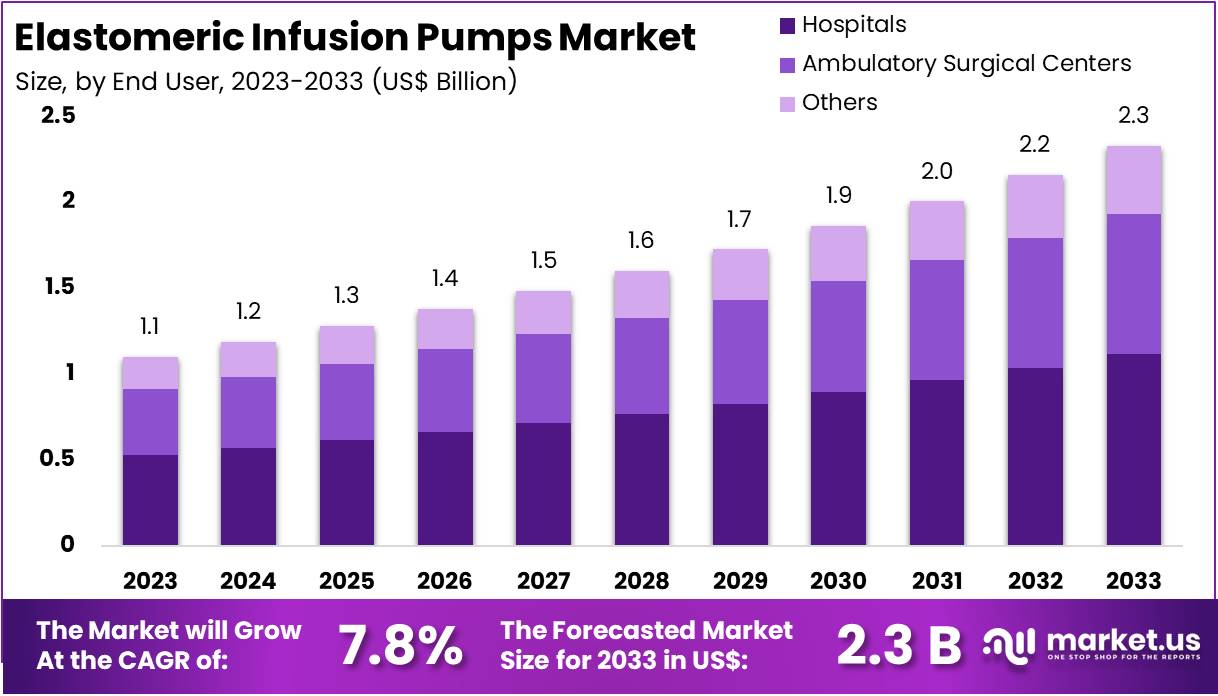
New York, NY – Feb 18, 2026 – The Global Elastomeric Infusion Pumps Market size is expected to be worth around US$ 2.3 Billion by 2033, from US$ 1.1 Billion in 2023, growing at a CAGR of 7.8% during the forecast period from 2024 to 2033.
The global elastomeric infusion pumps market is witnessing stable growth, supported by increasing demand for efficient drug delivery systems across hospitals, ambulatory surgical centers, and home healthcare settings. Elastomeric infusion pumps are lightweight, disposable medical devices designed to deliver controlled doses of medication over a specified period without the need for electronic programming. These pumps utilize an elastomeric balloon reservoir that generates consistent pressure to administer drugs accurately.
Market expansion is being driven by the rising prevalence of chronic diseases, including cancer and cardiovascular disorders, which require long-term intravenous therapies. The growing preference for outpatient care and home-based treatment solutions has further strengthened product adoption. Elastomeric infusion pumps offer advantages such as portability, ease of use, reduced risk of programming errors, and lower maintenance costs compared to electronic infusion systems.
Technological advancements in material design and flow rate accuracy have enhanced product reliability and patient safety. Increasing healthcare expenditure, expanding geriatric population, and improved access to medical infrastructure in emerging economies are contributing to market growth.
North America maintains a significant share of the market, supported by advanced healthcare systems and high adoption of innovative medical technologies. Meanwhile, Asia-Pacific is projected to witness accelerated growth due to expanding healthcare facilities and rising awareness regarding advanced infusion therapies. Overall, sustained demand for convenient and cost-effective drug delivery solutions is expected to support long-term market development.
Key Takeaways
- The elastomeric infusion pumps market is projected to expand from US$ 1.1 billion in 2023 to approximately US$ 2.3 billion by 2033, reflecting a 7.8% compound annual growth rate over the forecast period.
- Continuous rate elastomeric infusion pumps emerged as the leading product category in 2023, capturing over 64% of total market revenue.
- Pain management applications represented the largest application segment in 2023, contributing around 38% of the overall market share.
- Hospitals remained the dominant end-user segment, accounting for more than 48% of total demand in 2023.
- North America held the top regional position in 2023, securing 48% of global market share, with a market valuation of approximately US$ 0.5 billion.
Regional Analysis
In 2023, North America maintained a leading position in the elastomeric infusion pumps market, accounting for over 48% of global revenue, valued at approximately US$ 0.5 billion. Market leadership has been supported by a well-established healthcare infrastructure that encourages the adoption of advanced medical technologies. Increasing utilization of elastomeric infusion pumps in home healthcare settings has aligned with the region’s emphasis on cost-efficient, outpatient treatment models.
A supportive regulatory framework has further strengthened regional growth. Streamlined medical device approval pathways have facilitated faster commercialization of innovative infusion systems, ensuring timely market access while maintaining safety standards. The presence of major healthcare technology companies has also reinforced competitive strength, with significant investments directed toward research and development.
Product innovations focused on dosing accuracy, portability, and patient comfort continue to enhance adoption rates. Rising healthcare expenditure, favorable reimbursement policies, and a growing preference for patient-centric treatment solutions are expected to sustain strong demand for elastomeric infusion pumps across North America.
Emerging Trends
- Shift Toward Home-Based Care: Healthcare delivery is increasingly transitioning to home settings, driving demand for portable elastomeric infusion pumps. Their lightweight, non-electric design supports cost-effective outpatient therapies, reduces hospital burden, and enhances patient comfort and treatment accessibility.
- Broader Range of Therapies: Elastomeric infusion pumps are being adopted for complex therapies, including monoclonal antibodies and chemotherapy agents. Improved drug compatibility and material innovation enable broader therapeutic applications, supporting personalized treatment strategies across diverse medical conditions.
- Growing Use in Cancer Treatment: In oncology care, elastomeric pumps enable continuous chemotherapy infusion with enhanced patient convenience. Their portability reduces hospital visits, improves adherence, and supports patient-centered cancer treatment approaches in both outpatient and home environments.
- Increased Focus on Sustainability: Environmental considerations are influencing elastomeric pump design, with manufacturers exploring recyclable materials and reusable models. Healthcare providers are prioritizing sustainable solutions to reduce medical waste and align with broader environmental responsibility initiatives.
Use Cases
- Outpatient Infection Management: Elastomeric pumps facilitate continuous antibiotic administration in home settings, minimizing hospital stays and associated costs. This approach enhances patient comfort, supports long-term infection management, and reduces healthcare system burden during high-capacity periods.
- Pain Management After Surgery: These pumps provide consistent postoperative analgesia through controlled medication delivery. Continuous infusion improves patient comfort, reduces injection frequency, supports faster recovery, and enhances overall pain management efficiency in surgical care settings.
- Pediatric and Geriatric Care: Elastomeric pumps are well-suited for pediatric and elderly patients due to their simple, non-electric operation. Their lightweight design ensures safe, accurate dosing and convenient home-based administration under caregiver supervision.
- Support for Antimicrobial Stewardship: By delivering steady antibiotic levels, elastomeric pumps enhance therapeutic effectiveness and reduce resistance risks. Their controlled infusion supports optimized antimicrobial usage and strengthens infection management programs across healthcare systems.
Frequently Asked Questions on Elastomeric Infusion Pumps
- How do elastomeric infusion pumps work?
These pumps use an elastomeric reservoir that stretches when filled with medication. As the balloon naturally contracts, it generates steady pressure that pushes the drug through tubing into the patient at a predetermined flow rate. - What are the key advantages of elastomeric infusion pumps?
Elastomeric infusion pumps offer portability, ease of use, and reduced risk of programming errors compared to electronic systems. They support outpatient and home-based care, improve patient mobility, and lower equipment maintenance requirements for healthcare providers. - What are the primary applications of elastomeric infusion pumps?
These devices are widely used in pain management, chemotherapy, antibiotic therapy, and palliative care. Their controlled drug delivery capability makes them suitable for post-operative recovery and long-term treatment of chronic conditions. - What factors are driving the elastomeric infusion pumps market growth?
Market expansion is driven by increasing chronic disease prevalence, growing demand for home healthcare, and rising surgical procedures. Technological improvements in flow rate accuracy and patient convenience further support adoption across hospitals and ambulatory care centers. - Which region dominates the elastomeric infusion pumps market?
North America holds a leading market share, supported by advanced healthcare infrastructure, strong reimbursement systems, and high adoption of innovative medical devices. The presence of major manufacturers also strengthens regional competitiveness and product availability. - Which product segment leads the elastomeric infusion pumps market?
Continuous rate elastomeric infusion pumps represent the largest product category. Their consistent drug delivery performance and ease of use have contributed to widespread preference among healthcare professionals across various therapeutic applications. - What is the future outlook for the elastomeric infusion pumps market?
The market is projected to expand steadily over the forecast period, supported by increasing outpatient care models and patient-centric treatment approaches. Rising healthcare expenditure and technological innovation are expected to sustain long-term growth opportunities globally.
Conclusion
The elastomeric infusion pumps market is positioned for sustained expansion, driven by rising chronic disease incidence, growing preference for home-based care, and advancements in drug delivery technologies. Strong demand across pain management, oncology, and infection control applications continues to support revenue growth.
Continuous rate pumps remain the leading product segment, while hospitals represent the primary end-users. North America maintains market leadership, supported by advanced healthcare infrastructure and favorable reimbursement frameworks. With the market projected to reach US$ 2.3 billion by 2033 at a CAGR of 7.8%, long-term growth prospects remain firmly supported by innovation and expanding outpatient care models.
Discuss your needs with our analyst
Please share your requirements with more details so our analyst can check if they can solve your problem(s)




