


Table of Contents
Overview
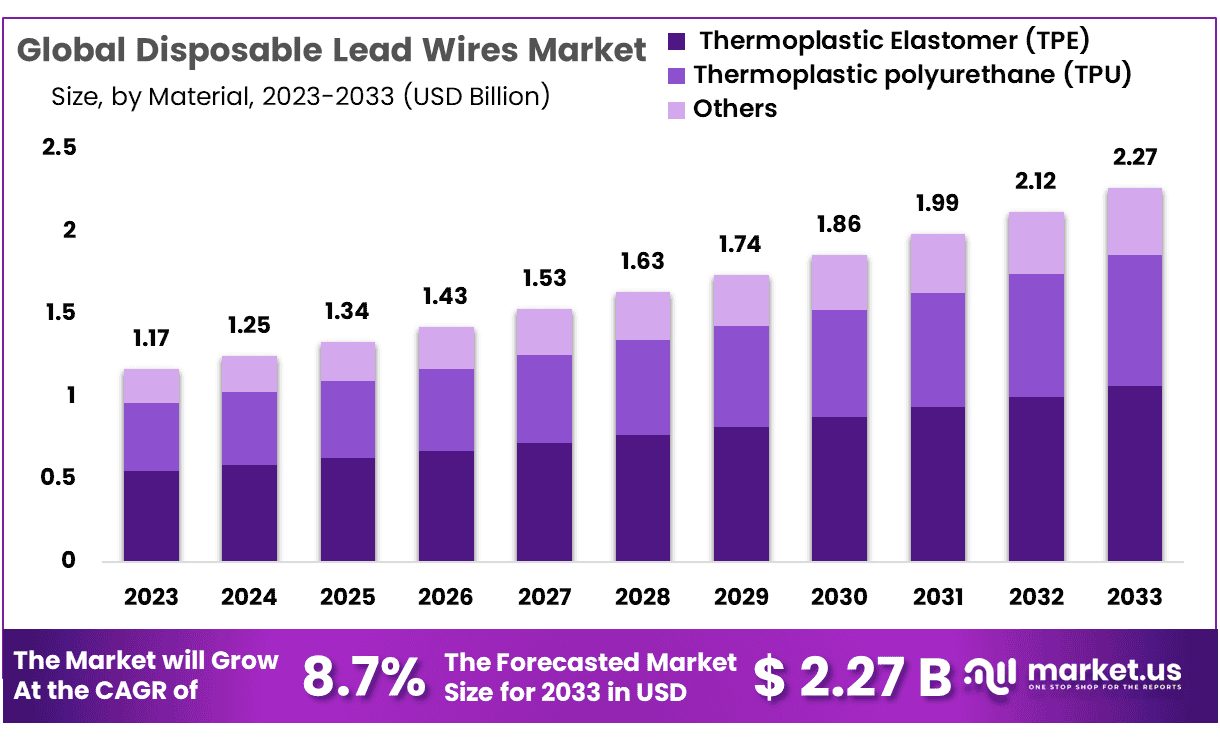
New York, NY – Jan 22, 2026 – The Global Disposable Lead Wires Market size is expected to be worth around USD 2.27 Billion by 2033 from USD 1.17 Billion in 2023, growing at a CAGR of 8.7% during the forecast period from 2024 to 2033.
Disposable lead wires are increasingly being adopted across hospitals and diagnostic centers due to their role in improving patient safety, infection control, and operational efficiency in cardiac monitoring procedures. These single-use medical accessories are designed to connect electrodes to monitoring systems such as electrocardiograms (ECG), telemetry units, and bedside monitors.
Disposable lead wires are manufactured using medical-grade materials that ensure reliable signal transmission while maintaining patient comfort. The use of single-use lead wires is associated with a reduced risk of cross-contamination, as the need for reprocessing and repeated handling is eliminated. This feature supports hospital infection prevention protocols, particularly in high-risk environments such as intensive care units and emergency departments.
From an operational perspective, disposable lead wires simplify workflow by reducing cleaning time and minimizing equipment downtime. Healthcare facilities benefit from improved efficiency, as staff time previously spent on sterilization and inspection can be redirected toward patient care. In addition, consistent performance is achieved since each patient uses a new, standardized product.
The growing focus on patient safety standards, along with increased awareness of hospital-acquired infections, is supporting the adoption of disposable lead wires globally. Demand is further driven by rising hospitalization rates and the expanding use of continuous cardiac monitoring.
As healthcare systems continue to prioritize quality of care and cost-effective solutions, disposable lead wires are positioned as a practical and reliable component of modern patient monitoring infrastructure.
Key Takeaways
- Market Size: The disposable lead wires market is projected to reach approximately USD 2.27 billion by 2033, rising from USD 1.17 billion in 2023.
- Market Growth: Market expansion is anticipated at a compound annual growth rate (CAGR) of 8.7% over the forecast period from 2024 to 2033.
- Material Analysis: Thermoplastic Elastomer (TPE) emerged as the leading material, accounting for 47.1% of the total market share in 2023.
- Machine Type Analysis: Market research indicates that the Others segment represented the largest share, contributing 45.6% of overall market revenue.
- End-Use Analysis: The hospital segment remained the dominant end user, capturing 37.0% of the market share in 2023.
- Regional Analysis: North America led the global market with a 40.3% share, generating approximately USD 0.47 billion in revenue in 2023.
Regional Analysis
North America held a dominant position in the disposable lead wires market, accounting for 40.3% of total market share and generating approximately USD 0.47 billion in revenue in 2023. This leadership position was supported by the high prevalence of cardiovascular diseases, increasing mortality rates associated with heart conditions, and rising healthcare expenditure in countries such as the United States. Market growth in the region is further reinforced by the strong presence of established medical device manufacturers and advanced healthcare infrastructure.
Currently, North America represents the largest market for disposable wire adapters. However, increasing global emphasis on infection prevention, reduction of cross-contamination, and improved patient safety is expected to accelerate adoption across Europe, Asia Pacific, and other emerging regions over the coming years.
Carlisle Medical Technologies is a key industry participant, manufacturing high-performance lead wires, ECG/EKG cables, and related components for medical and healthcare applications. The company’s portfolio includes subassemblies, finished devices, and pre-engineered solutions designed to accurately measure cardiac electrical activity. Its disposable lead wires are produced using fully automated assembly processes and standardized cable and connector components to ensure consistent quality and performance.
The Asia Pacific region is forecast to register the highest compound annual growth rate (CAGR) of 7.8% during the forecast period. Growth in this region is attributed to the rising incidence of cardiovascular diseases, increasing healthcare awareness, growing hospital-acquired infections, expanding hospital infrastructure, and improving disposable income levels across developing economies.
Emerging Trends
- Enhanced Infection Control Measures: The growing adoption of single-use ECG lead wires is primarily driven by the need to minimize hospital-acquired infections (HAIs). Evidence indicates that reusable ECG leads can retain pathogenic microorganisms, including antibiotic-resistant bacteria, even after standard cleaning and disinfection processes. As a result, disposable alternatives are increasingly preferred to reduce cross-contamination risks and improve patient safety.
- Material Advancements: Thermoplastic elastomers (TPE) and thermoplastic polyurethanes (TPU) are widely being adopted in the production of disposable ECG lead wires. These materials offer high flexibility, mechanical strength, and resistance to chemicals and temperature fluctuations, making them suitable for reliable short-term clinical use.
- Integration with Advanced Monitoring Systems: Disposable ECG lead wires are being engineered to ensure compatibility with a wide range of patient monitoring platforms. This interoperability supports uninterrupted patient monitoring across multiple hospital departments, thereby improving clinical workflow efficiency.
- Cost-Effectiveness and Operational Efficiency: Although disposable lead wires generally involve a higher upfront cost compared to reusable options, they remove the need for cleaning, sterilization, and reprocessing. This results in lower labor expenses, reduced equipment downtime, and improved operational efficiency over time.
- Regulatory Support and Guidelines: Healthcare authorities and regulatory organizations are increasingly recommending the use of single-use medical devices. These guidelines are aimed at strengthening infection control practices, enhancing patient safety, and lowering the risk of device-related cross-contamination.
Use Cases
- Hospitals: In hospital environments, disposable ECG lead wires are extensively used for continuous cardiac monitoring in intensive care units (ICUs) and during surgical procedures. Their single-use design helps prevent patient-to-patient contamination and supports stringent infection control protocols.
- Clinics and Outpatient Facilities: Outpatient clinics rely on disposable lead wires for routine ECG examinations. Using a new set for each patient ensures high hygiene standards and significantly reduces the risk of infection transmission.
- Emergency Medical Services (EMS): Ambulance and emergency response teams use disposable ECG lead wires for rapid cardiac assessment in pre-hospital settings. Their ease of use and immediate disposability are critical advantages in time-sensitive emergency situations.
- Home Healthcare: The expansion of home-based healthcare has increased the use of disposable lead wires for remote and continuous patient monitoring. These products offer convenience for caregivers and patients while eliminating the need for sterilization.
- Research and Clinical Trials: In clinical research and trials, disposable ECG lead wires are used to ensure sterile conditions for each participant. This practice supports compliance with strict hygiene standards and helps maintain data integrity throughout the study period.
Frequently Asked Questions on Disposable Lead Wires
- Why are disposable lead wires preferred over reusable ones?
Disposable lead wires are preferred due to improved infection control, reduced hospital-acquired infection risk, and lower labor costs associated with cleaning. Their use supports compliance with strict hygiene protocols in critical and acute care settings. - Where are disposable lead wires commonly used?
Disposable lead wires are widely used in hospitals, ambulatory surgical centers, emergency departments, and intensive care units. Their adoption is particularly high in environments where rapid patient turnover and infection prevention are operational priorities. - Are disposable lead wires compatible with standard monitoring systems?
Disposable lead wires are designed to be compatible with most standard ECG and patient monitoring systems. Manufacturers offer multiple connector types to ensure seamless integration with widely used monitoring equipment across healthcare facilities. - What materials are used in disposable lead wires?
Disposable lead wires are typically manufactured using medical-grade plastics and conductive metals. These materials are selected to ensure signal accuracy, patient safety, flexibility, and cost efficiency while meeting regulatory and clinical performance standards. - What factors are driving the disposable lead wires market growth?
The disposable lead wires market growth is driven by rising awareness of infection control, increasing hospital admissions, and stricter healthcare regulations. The shift toward single-use medical devices further supports sustained market expansion globally. - How does infection control influence market demand?
Infection control requirements significantly influence demand, as disposable lead wires help reduce cross-contamination and hospital-acquired infections. Healthcare providers increasingly prefer single-use solutions to improve patient safety and comply with hygiene standards. - Which end users dominate the disposable lead wires market?
Hospitals represent the largest end-user segment in the disposable lead wires market. High patient volumes, frequent monitoring needs, and strong emphasis on infection prevention drive consistent demand across public and private healthcare institutions. - What regional trends are observed in the disposable lead wires market?
North America leads the disposable lead wires market due to advanced healthcare infrastructure and strict regulatory frameworks. Meanwhile, Asia-Pacific is experiencing rapid growth, supported by expanding hospital networks and increasing healthcare expenditure.
Conclusion
The disposable lead wires market is witnessing steady growth, driven by rising emphasis on patient safety, infection control, and operational efficiency in cardiac monitoring. Single-use lead wires effectively reduce cross-contamination risks while supporting compliance with stringent healthcare regulations.
Advancements in medical-grade materials and compatibility with modern monitoring systems further enhance product reliability and clinical adoption. Strong demand from hospitals, supported by increasing cardiovascular disease prevalence and hospitalization rates, continues to anchor market expansion.
While North America maintains market leadership, rapid growth in Asia Pacific reflects improving healthcare infrastructure and awareness, positioning disposable lead wires as a critical component of modern healthcare delivery.
Discuss your needs with our analyst
Please share your requirements with more details so our analyst can check if they can solve your problem(s)




