


Table of Contents
Overview
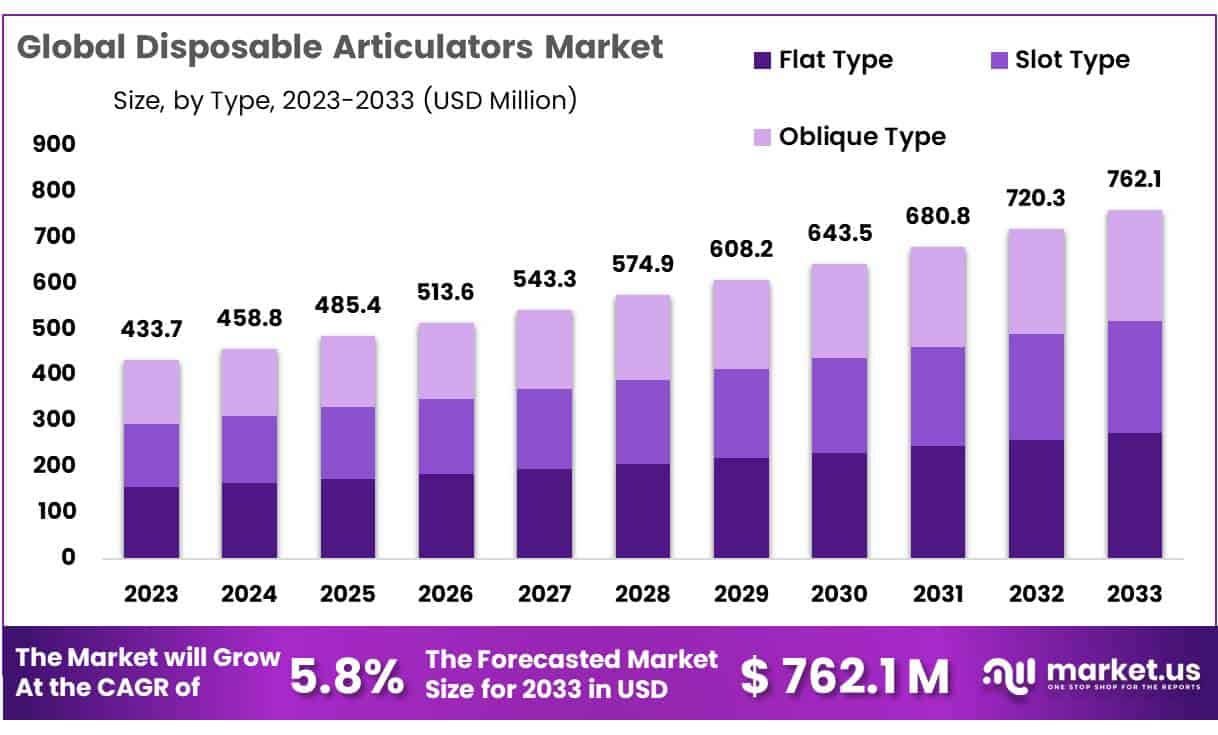
New York, NY – Jan 30, 2026 – The Global Disposable Articulators Market size is expected to be worth around USD 762.1 Million by 2033 from USD 433.7 Million in 2023, growing at a CAGR of 5.8% during the forecast period from 2024 to 2033.
The basic formation of disposable articulators has been designed to meet the growing demand for hygienic, efficient, and cost-effective solutions in dental laboratories and clinics. Disposable articulators are primarily used to simulate jaw movements during dental restoration, prosthodontic, and orthodontic procedures. Their single-use nature supports strict infection control protocols and reduces the risk of cross-contamination.
Disposable articulators are typically manufactured using lightweight medical-grade plastic materials. This material selection ensures adequate strength, dimensional stability, and ease of handling while maintaining affordability. The formation includes upper and lower frames connected through a hinge mechanism that allows controlled opening and closing movements. The design is standardized to accommodate common dental models and mounting plates, ensuring compatibility across routine laboratory workflows.
The simplified structure of disposable articulators enables quick model mounting and removal, reducing chairside and laboratory processing time. Calibration features are pre-set during manufacturing, eliminating the need for complex adjustments. As a result, consistent occlusal positioning can be achieved with minimal technical effort. The compact and lightweight construction also supports easy storage and disposal after use.
The increasing focus on infection prevention, coupled with rising procedural volumes in restorative and cosmetic dentistry, has supported the adoption of disposable articulators. Their basic formation aligns with operational efficiency and regulatory compliance requirements. As dental practices continue to prioritize safety, standardization, and workflow optimization, disposable articulators are positioned as a practical and reliable solution within modern dental care environments.
Key Takeaways
- Market Size: The global disposable articulators market is projected to reach approximately USD 762.1 million by 2033, increasing from USD 433.7 million in 2023.
- Market Growth: The market is anticipated to expand at a compound annual growth rate (CAGR) of 5.8% over the forecast period from 2024 to 2033.
- Type Analysis: Within the disposable articulators market, the flat type segment remains the leading category, accounting for nearly 36% of the total market share.
- Application Analysis: The dentistry application segment holds a dominant position, representing approximately 42% of the overall market, reflecting its strong industry relevance.
- Regional Analysis: North America emerged as the leading regional market, capturing around 39% of the global market share in 2023.
Regional Analysis
North America accounted for the largest share of the disposable articulators market, representing approximately 39% in 2023. The regional market is expected to expand at a steady rate over the forecast period, thereby sustaining its leading position. The strong focus on oral healthcare, combined with the growing adoption of digital dentistry, is contributing to increased demand for disposable articulators.
In addition, the presence of well-established manufacturing infrastructure across the region supports consistent product availability. Market growth is further reinforced by the presence of key industry participants, including Dentsply Sirona, Align Technology, and Amann Girrbach, which continue to strengthen regional market penetration.
Europe is projected to experience rapid market expansion during the forecast period, registering the fastest compound annual growth rate. The region benefits from a robust dental industry with high revenue generation, driven largely by the rising prevalence of oral health disorders. Growing awareness of advanced dental treatments has increased demand for innovative dental articulation solutions.
Furthermore, technological advancements in manufacturing processes, along with rising investments in research and development, are supporting market growth. Notably, research and development expenditure across European countries reached approximately €331 billion in 2021, highlighting the region’s strong commitment to innovation.
Emerging Trends
- Strengthened Infection Control Measures: The importance of infection prevention in dental practices is increasingly being emphasized by regulatory bodies such as the Centers for Disease Control and Prevention (CDC). The use of disposable items is being encouraged to reduce the risk of cross-contamination. Disposable articulators remove the need for sterilization processes, thereby lowering the potential exposure to pathogens and supporting safer clinical and laboratory environments.
- Alignment with Digital Dentistry Workflows: The growing adoption of Computer-Aided Design and Computer-Aided Manufacturing (CAD/CAM) technologies is reshaping dental prosthetics production. Disposable articulators are being integrated into these digital workflows as a convenient and hygienic solution for mounting models, supporting faster turnaround times and more streamlined restorative procedures.
- Improved Cost Efficiency and Operational Productivity: Disposable articulators are being recognized as a cost-effective alternative to reusable systems, as expenses related to cleaning, maintenance, and sterilization are eliminated. Their single-use design also contributes to reduced chairside handling time, enabling higher patient throughput and enhanced overall practice efficiency.
Key Use Cases
- Dental Laboratories: In dental laboratories, disposable articulators are widely used for mounting casts during the fabrication of crowns, bridges, and dentures. Their single-use nature ensures that each case is processed using a clean, uncontaminated device, supporting strict infection control standards and consistent production quality.
- Clinical Applications: Within clinical settings, disposable articulators are utilized for occlusal assessment, treatment planning, and restorative diagnostics. Their simplicity, hygiene benefits, and ease of disposal make them well suited for chairside use, contributing to smoother clinical workflows.
- Educational and Training Institutions: Dental schools and training centers commonly adopt disposable articulators for preclinical instruction in occlusion analysis and prosthetic fabrication. Their affordability and hygienic design allow repeated use across multiple training sessions, making them a practical tool for educational environments.
Frequently Asked Questions on Disposable Articulators
- What materials are commonly used in disposable articulators?
Disposable articulators are typically manufactured from lightweight medical-grade plastics. These materials provide sufficient rigidity for short-term dental applications while ensuring affordability, ease of disposal, and compliance with infection control and hygiene standards. - What are the advantages of disposable articulators over reusable ones?
The key advantages include reduced cross-contamination risk, elimination of sterilization costs, and improved operational efficiency. Disposable articulators are especially preferred in high-volume dental laboratories where time savings and hygiene compliance are critical considerations. - Are disposable articulators suitable for complex dental restorations?
Disposable articulators are generally designed for basic to moderately complex restorations. For highly complex occlusal cases, fully adjustable reusable articulators are often preferred due to their superior precision and customization capabilities. - What factors are driving growth in the disposable articulators market?
Market growth is driven by rising dental procedure volumes, increasing emphasis on infection control, and demand for cost-efficient dental consumables. The expansion of dental laboratories and clinics globally further supports sustained market development. - Which end users dominate the disposable articulators market?
Dental laboratories represent the dominant end-user segment, followed by dental clinics and academic institutions. High procedural throughput and the need for standardized, hygienic tools contribute significantly to adoption across these end-user categories. - How does regulation impact the disposable articulators market?
The market is influenced by medical device regulations related to material safety and quality standards. Compliance requirements may increase manufacturing costs but also enhance product credibility, supporting wider adoption in regulated healthcare environments. - What is the future outlook for the disposable articulators market?
The market is expected to grow steadily, supported by preventive dentistry trends and expanding dental care access. Incremental innovation in materials and design is likely to enhance functionality while maintaining affordability and disposability advantages.
Conclusion
The disposable articulators market is positioned for steady growth, supported by increasing emphasis on infection control, workflow efficiency, and cost containment across dental laboratories, clinics, and educational institutions. Their simple yet functional design, compatibility with routine dental procedures, and alignment with regulatory hygiene standards continue to drive adoption.
Market expansion is further reinforced by rising dental procedure volumes and the integration of digital dentistry workflows. While reusable articulators remain essential for complex cases, disposable articulators offer a practical solution for high-volume, standardized applications. Overall, sustained demand and incremental design improvements are expected to support long-term market stability and growth.
Discuss your needs with our analyst
Please share your requirements with more details so our analyst can check if they can solve your problem(s)




