


Table of Contents
Overview
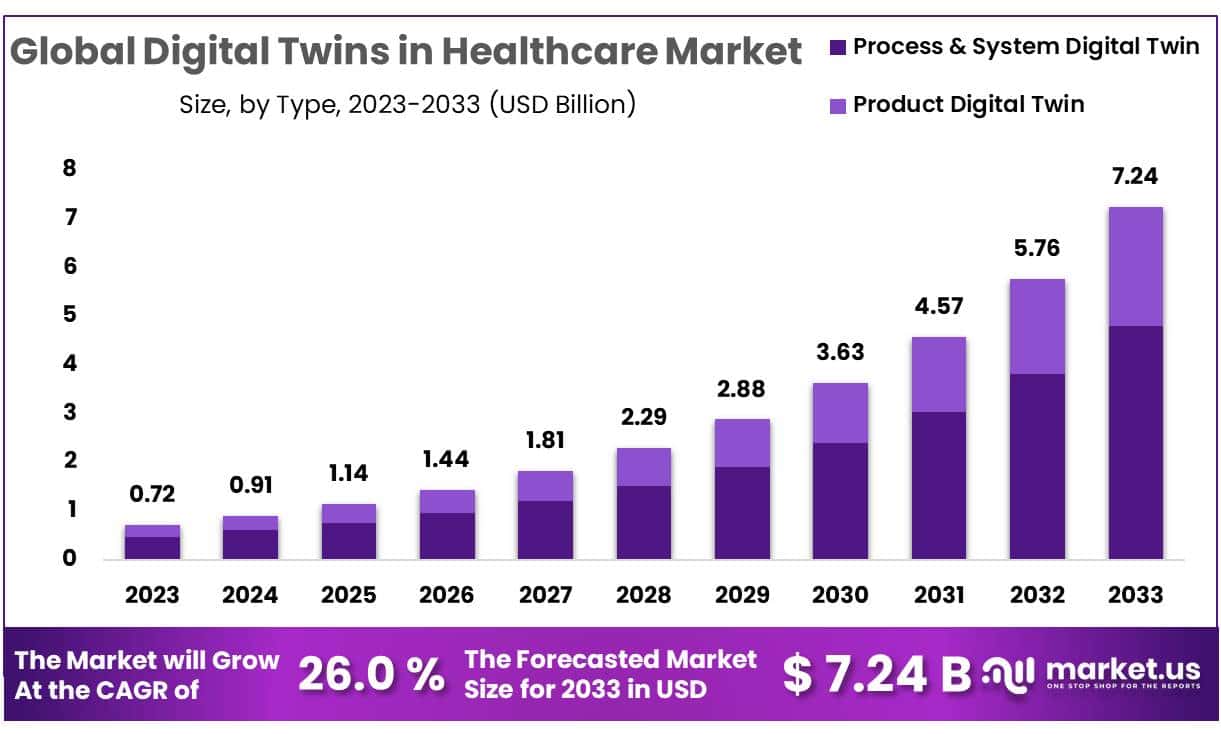
New York, NY – Dec 24, 2025 – The Global Digital Twins in Healthcare Market size is expected to be worth around USD 7.24 Billion by 2033 from USD 0.72 Billion in 2023, growing at a CAGR of 26.0% during the forecast period from 2024 to 2033.
The adoption of digital twin technology in healthcare is emerging as a transformative development in the delivery of medical services and clinical decision-making. A digital twin is a virtual representation of a physical system, process, or patient, created using real-time data, advanced analytics, and simulation models. In healthcare, this technology is increasingly being applied to model organs, treatment pathways, medical devices, and entire hospital systems.
The growth of digital twins in healthcare is being driven by the rising demand for personalized medicine, improved patient outcomes, and cost-efficient care delivery. By creating a virtual replica of a patient or clinical process, healthcare providers are able to simulate disease progression, predict treatment responses, and optimize therapeutic strategies before real-world implementation. This approach supports evidence-based decision-making while reducing clinical risks.
Digital twins are also being used to enhance operational efficiency within healthcare facilities. Virtual models of hospitals and medical equipment allow administrators to optimize resource allocation, streamline workflows, and improve maintenance planning. As a result, operational downtime can be reduced and service quality can be enhanced.
The integration of artificial intelligence, Internet of Things (IoT) devices, and advanced data analytics has further strengthened the capabilities of digital twin solutions. Continuous data inputs enable real-time monitoring and adaptive modeling, supporting proactive care management and early intervention.
Looking ahead, digital twins are expected to play a critical role in shaping the future of healthcare systems. As data interoperability and regulatory frameworks continue to improve, the technology is anticipated to support more precise, predictive, and patient-centric healthcare delivery worldwide.
Key Takeaways
- The global Digital Twins in Healthcare Market was valued at USD 0.72 billion in 2023 and is projected to expand significantly, reaching USD 7.24 billion by the end of the forecast period, registering a strong compound annual growth rate (CAGR) of 26.0%.
- In 2023, process and system digital twins represented the leading market segment by type, accounting for the largest share due to their extensive use in clinical and operational optimization.
- The asset and process management application segment generated the highest revenue, contributing 37.5% of the overall Digital Twins in Healthcare Market in 2023.
- Among end-use segments, hospitals and clinics emerged as the largest contributors, holding a dominant revenue share of 34.1% during the same year.
- From a regional perspective, North America maintained its leadership position, capturing 47.3% of the total market revenue in the Digital Twins in Healthcare Market in 2023.
Key Statistics on Digital Twins in Healthcare
- Healthcare Adoption Trends: It is estimated that nearly 66% of healthcare professionals expect increased investment in digital twin technologies, reflecting their rising strategic importance across healthcare systems.
- Core Healthcare Applications: Digital twins are increasingly applied to personalized medicine, predictive maintenance of medical equipment, and real-time clinical analytics, resulting in measurable improvements in patient outcomes and operational efficiency.
- Technology Integration Landscape: Approximately 75% of healthcare facilities have integrated IoT-enabled sensors, cloud platforms, and advanced analytics to support real-time simulation of physical and biological systems.
- Regulatory Recognition: The U.S. Food and Drug Administration has acknowledged that digital twins can reduce clinical trial costs by up to 50%, particularly in medical device testing and validation.
- Impact on Personalized Medicine: Patient-specific simulations enabled by digital twins can improve treatment effectiveness by 20–30%, supporting more precise therapeutic decision-making.
- Clinical Trial Optimization: Digital twin models are shown to shorten clinical trial timelines by 30–40%, improve safety profiling, and accelerate drug development cycles.
- Hospital-Level Adoption: Nearly 40% of large hospitals currently deploy digital twins for chronic disease monitoring, surgical planning, and optimization of treatment protocols.
- Environmental and Health Monitoring: The National Oceanic and Atmospheric Administration applies digital twins for environmental prediction, generating annual mitigation savings of up to USD 1 billion, with indirect public health benefits.
- Ethical and Privacy Concerns: Around 40% of stakeholders report concerns related to data privacy, ownership, and governance, which may constrain adoption rates if left unaddressed.
- AI and Machine Learning Integration: When combined with AI and machine learning, digital twins enhance diagnostic accuracy by up to 25%, supporting early intervention and preventive care models.
- Research and Standards Development: The National Institute of Standards and Technology invested more than USD 280 million in 2024 to advance digital twin standards and ecosystem development.
- Global Public Funding Initiatives: The European Union allocated over EUR 50 million in 2023 to digital twin programs targeting neurological conditions such as Alzheimer’s disease and epilepsy.
- Urban Infrastructure and Health Systems: Digital twins are used in urban simulations to manage infrastructure and climate-related risks, delivering cost savings of up to USD 1 billion annually for major cities.
- Continuous Patient Monitoring: Real-time digital twin monitoring systems can reduce hospital readmissions by 20–30% by enabling timely clinical interventions and remote care management.
Emerging Trends in Digital Twin Technology
- Personalized Treatment Planning: Advanced digital heart models are increasingly used in cardiology to predict arrhythmias and guide precision-based interventions.
- Next-Generation Clinical Trials: Virtual patient simulations are reducing reliance on physical trials while improving safety outcomes and regulatory confidence.
- Chronic Disease Management: Digital twins are being customized for long-term conditions, such as type 2 diabetes in elderly populations, to optimize dosing strategies and reduce adverse events.
- Operational and Public Health Optimization: Healthcare systems leverage digital twins for bed utilization, workforce planning, and patient flow optimization without compromising care quality.
- Health Equity and Population Health: Institutions such as the Cleveland Clinic apply digital twins to assess environmental and socioeconomic health drivers, supporting targeted interventions to reduce disparities.
- Predictive Diagnostics: Digital twins enable early identification of disease risk, facilitating proactive and targeted clinical responses.
- Crisis and Emergency Preparedness: Simulation of pandemics and patient surges improves resource allocation, infrastructure resilience, and emergency response planning.
- Urban Health Risk Modeling: City-level digital twins are used to forecast disease outbreaks and nutritional deficiencies, enabling real-time public health alerts.
- Advanced AI Integration: AI-enhanced digital twins improve data interpretation, predictive accuracy, and healthcare system efficiency.
- Ethical and Technical Constraints: Adoption remains challenged by data bias, privacy regulations, and the need for high-performance digital infrastructure.
Key Use Cases of Digital Twin Technology
- Cardiology: At Johns Hopkins University, digital heart twins are used to model cardiac structure and electrical activity, reducing arrhythmia recurrence through targeted therapies.
- Diabetes Management: Digital twins developed for elderly type 2 diabetes patients have achieved 14–29% reductions in insulin infusion, while minimizing hypoglycemic events.
- Public Health Planning: Community-level digital twins are used to assess neighborhood health risks and guide interventions that improve population-level outcomes.
- Clinical Research and Drug Development: Virtual patient modeling enhances safety assessment, predicts therapeutic outcomes, and reduces adverse events during clinical trials.
- Hospital Operations Management: Healthcare providers deploy digital twins to optimize bed capacity, staffing, and infrastructure utilization in response to rising patient demand.
Regional Analysis
North America maintained its leading position in the Digital Twins in Healthcare Market in 2023, accounting for a dominant revenue share of 47.3%. This leadership is largely attributed to the rapid adoption of advanced digital technologies and automation across healthcare systems. Hospitals and clinics in the region are increasingly deploying digital twin solutions to improve patient outcomes, streamline workflows, and enhance operational efficiency.
Early adoption of emerging technologies has enabled healthcare providers to simulate clinical scenarios, predict disease progression, and personalize treatment pathways with greater accuracy. Continuous investment in healthcare innovation further strengthens the region’s market position.
The presence of major technology providers such as Microsoft, IBM Corporation, and IQVIA plays a critical role in driving market growth. These companies deliver advanced platforms, analytics, and data-driven solutions that support digital twin applications across clinical and operational domains. In addition, robust digital infrastructure and supportive government funding initiatives accelerate technology adoption across healthcare institutions.
In contrast, the Asia Pacific region is expected to register the highest compound annual growth rate of 29% during the forecast period. This rapid expansion is being driven by rising investments from venture capital firms, private equity players, and non-profit organizations focused on AI-enabled healthcare solutions. Increased deployment of Internet of Things (IoT) devices is further enhancing real-time data integration and simulation capabilities. Countries such as China, India, Japan, and South Korea are actively advancing digital health ecosystems, reflecting a strong shift toward smart, technology-driven healthcare delivery models.
Frequently Asked Questions on Digital Twins in Healthcare
- How are digital twins used in patient care?
Digital twins are used to simulate disease progression, test treatment responses, and predict patient outcomes. This approach supports personalized medicine by allowing healthcare providers to evaluate multiple clinical scenarios without risk to actual patients. - What technologies enable digital twins in healthcare?
Digital twins rely on technologies such as artificial intelligence, machine learning, Internet of Things sensors, cloud computing, and advanced data analytics. These technologies collectively ensure real-time data integration, accurate modeling, and continuous system updates. - What are the key benefits of digital twins in healthcare?
Key benefits include improved diagnostic accuracy, reduced treatment costs, enhanced patient outcomes, and optimized hospital operations. Digital twins also support preventive care by identifying potential health risks before clinical symptoms appear. - What is the digital twins in healthcare market?
The digital twins in healthcare market refers to the global ecosystem of solutions, platforms, and services enabling virtual healthcare models. Market growth is driven by rising demand for personalized medicine and increasing investments in digital health technologies. - What factors are driving market growth?
Market growth is driven by advancements in artificial intelligence, increasing chronic disease prevalence, demand for cost-efficient care, and the adoption of predictive analytics. Government initiatives supporting digital transformation further accelerate market expansion globally. - Which segments dominate the digital twins in healthcare market?
Patient-specific digital twins and predictive healthcare applications dominate the market. Hospitals and research institutions represent key end users, while cloud-based deployment models are gaining traction due to scalability, flexibility, and lower infrastructure requirements. - What regions show strong market potential?
North America leads the market due to advanced healthcare infrastructure and high technology adoption. Europe follows closely, while Asia-Pacific is expected to witness the fastest growth, supported by expanding healthcare digitization and rising healthcare expenditures. - How is the market expected to evolve in the coming years?
The market is expected to evolve toward real-time, fully integrated digital twin ecosystems. Increased interoperability, regulatory clarity, and AI-driven automation are anticipated to enhance scalability, improve clinical adoption, and support long-term market sustainability.
Conclusion
In conclusion, digital twin technology is emerging as a foundational pillar in the transformation of global healthcare systems. By enabling real-time, patient-specific simulations and system-level optimization, digital twins support more precise clinical decision-making, improved patient outcomes, and cost-efficient care delivery.
Strong market growth reflects increasing adoption across hospitals, research institutions, and public health systems, particularly in North America and rapidly developing Asia-Pacific markets. Continued integration of artificial intelligence, IoT, and advanced analytics is expected to enhance predictive capabilities further. As interoperability, data governance, and regulatory frameworks mature, digital twins are positioned to play a critical role in advancing personalized, predictive, and resilient healthcare delivery worldwide.
Discuss your needs with our analyst
Please share your requirements with more details so our analyst can check if they can solve your problem(s)




