


Table of Contents
Overview
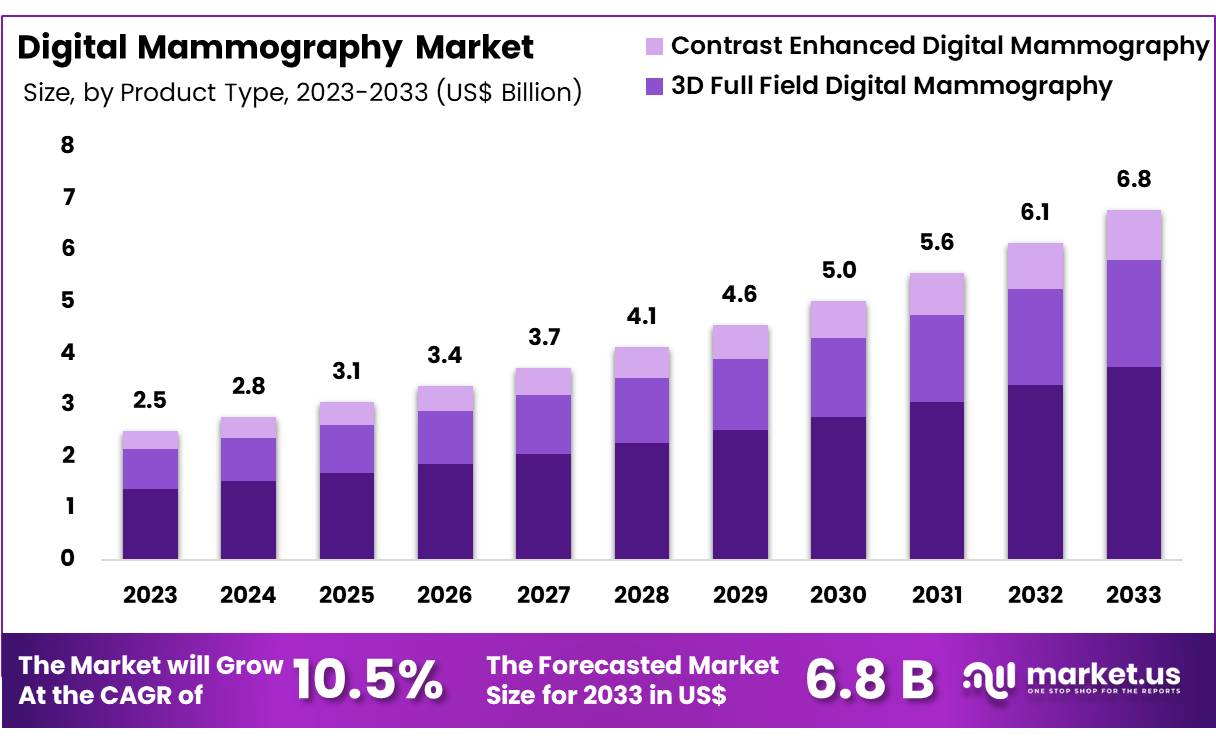
New York, NY – Dec 31, 2025 – Global Digital Mammography Market size is expected to be worth around US$ 6.8 billion by 2033 from US$ 2.5 billion in 2023, growing at a CAGR of 10.5% during the forecast period 2024 to 2033. In 2023, North America led the market, achieving over 40.3% share with a revenue of US$ 1.0 Billion.
Digital mammography is an advanced medical imaging technique used for the early detection and diagnosis of breast cancer. It is considered a significant improvement over conventional film-based mammography due to its higher image quality, improved accuracy, and efficient data management.
In digital mammography, X-ray images of the breast are captured electronically and converted into digital files. These images can be viewed instantly on computer screens, enhanced for better clarity, and securely stored for future reference. The technology allows radiologists to adjust contrast, zoom into specific areas, and compare current images with prior scans, supporting more precise clinical evaluation.
One of the key advantages of digital mammography is its effectiveness in detecting abnormalities in women with dense breast tissue. Studies have shown that digital systems provide clearer visualization, leading to earlier detection and reduced recall rates. In addition, the radiation dose used in digital mammography is generally equal to or lower than that of traditional methods, ensuring patient safety.
Digital mammography also improves workflow efficiency within healthcare facilities. Images can be transmitted electronically for remote consultation, enabling faster diagnosis and collaboration among specialists. This capability supports timely clinical decisions and enhances patient care outcomes.
The adoption of digital mammography is increasing globally, driven by rising breast cancer awareness, growing screening programs, and continuous technological advancements. As healthcare systems focus on early diagnosis and preventive care, digital mammography is expected to play a vital role in improving breast cancer screening and long-term patient survival rates.
Key Takeaways
- In 2023, the Digital Mammography market recorded a revenue of US$ 2.5 billion and is projected to expand at a CAGR of 10.5%, reaching US$ 6.8 billion by 2033.
- By product type, the market is categorized into 2D full field digital mammography, 3D full field digital mammography, and contrast-enhanced digital mammography. Among these, 2D full field digital mammography dominated in 2023, accounting for 55.2% of the total market share.
- Based on end use, the market is segmented into hospitals, diagnostic centers, and others. Hospitals emerged as the leading end-use segment, capturing 63.8% of the market share.
- North America maintained its leading position in the global market, holding a 40.3% market share in 2023.
Regional Analysis
North America Leads the Digital Mammography Market
North America accounted for the largest share of the Digital Mammography market in 2023, capturing 40.3% of total revenue. This dominance is primarily attributed to the high level of awareness regarding breast cancer and the strong emphasis on early diagnosis. The adoption of digital mammography has been supported by technological advancements that enable superior image quality, faster image processing, and improved diagnostic accuracy.
The widespread availability of advanced healthcare facilities and the strong presence of screening programs have accelerated the deployment of digital mammography systems across hospitals and diagnostic clinics. In addition, supportive healthcare policies promoting routine breast cancer screening have played a critical role in driving market growth. A rising number of women opting for regular screening procedures has further strengthened demand. Continuous research and development efforts have also enhanced system efficiency while improving affordability and accessibility, reinforcing North America’s leading position in the market.
Asia Pacific Expected to Register the Fastest CAGR
The Asia Pacific region is projected to witness the highest compound annual growth rate during the forecast period. Market expansion in this region is being driven by increasing breast cancer awareness, supported by government-led screening and awareness initiatives. Public health programs and large-scale screening efforts have highlighted a growing shift toward preventive healthcare.
Rapid investments in healthcare infrastructure across countries such as India and China are expected to support the adoption of advanced diagnostic technologies, including digital mammography. Public–private partnerships and technology-driven screening initiatives are further expanding access to early detection solutions. Rising disposable income levels, improving healthcare access, and a stronger focus on early diagnosis are expected to collectively accelerate market growth across the Asia Pacific region in the coming years.
Emerging Trends
- The adoption of digital breast tomosynthesis (DBT) is rising, as it provides layer-by-layer breast imaging that enhances invasive cancer detection and lowers patient recall rates when compared with conventional full-field digital mammography.
- Artificial intelligence–based computer-aided detection tools are increasingly being incorporated into breast screening workflows. More than 20 FDA-approved AI solutions are currently available; however, adoption levels vary significantly across healthcare facilities.
- Mobile mammography initiatives are expanding to improve access among underserved populations by delivering low-cost or free screenings in community locations. Despite broader reach, adherence rates remain limited, ranging from 12%–34% for annual screening and 40%–48% for biennial screening.
Use Cases
- Population-based screening: Digital mammography is widely utilized in organized screening programs. In 2022, mammography uptake was reported by 59.1% of U.S. women aged 40–49 and 76.5% of women aged 50–74 within the previous two years.
- Clinical decision support: Mammography continues to support diagnostic evaluation and follow-up care, with approximately 27.3 million physician office visits in 2019 involving mammography orders or related imaging services.
- Quality assurance and patient notification: Under the 2023 MQSA Final Rule, effective September 10, 2024, mammography facilities are required to notify patients about breast tissue density, increasing referrals for supplemental ultrasound or MRI in dense-breast populations.
Frequently Asked Questions on Digital Mammography
- How does digital mammography differ from conventional mammography?
Digital mammography differs from conventional film-based systems by converting X-ray signals into digital images, enabling image enhancement, easier storage, and electronic transmission, which supports higher diagnostic accuracy and improved workflow efficiency for healthcare providers. - What are the key benefits of digital mammography?
The key benefits of digital mammography include improved image clarity, lower radiation exposure, faster examination times, and better visualization of dense breast tissue, contributing to earlier breast cancer detection and improved clinical decision-making outcomes. - Is digital mammography safe for patients?
Digital mammography is considered safe, as it uses controlled low-dose radiation levels that comply with regulatory standards, while offering higher diagnostic efficiency, making the benefit-to-risk ratio favorable for routine breast cancer screening programs. - Who should undergo digital mammography screening?
Digital mammography screening is generally recommended for women aged 40 years and above, or earlier for high-risk individuals, as part of preventive healthcare strategies aimed at early detection and reduction of breast cancer mortality rates. - What factors are driving the growth of the digital mammography market?
The growth of the digital mammography market is driven by rising breast cancer prevalence, increasing awareness of early diagnosis, technological advancements in imaging systems, and expanding government-supported screening programs across developed and emerging healthcare markets. - How is technology influencing the digital mammography market?
Technological advancements, including 3D mammography, artificial intelligence integration, and enhanced detector sensitivity, are significantly improving diagnostic accuracy and workflow efficiency, thereby accelerating adoption rates and supporting sustained market expansion globally. - Which healthcare settings are the primary users of digital mammography systems?
Hospitals, diagnostic imaging centers, and specialized cancer screening facilities represent the primary users of digital mammography systems, due to their higher patient volumes, advanced infrastructure, and growing emphasis on preventive and diagnostic imaging services. - What is the future outlook of the digital mammography market?
The future outlook of the digital mammography market remains cautiously optimistic, supported by continuous innovation, expanding screening initiatives, and rising healthcare investments, which are expected to enhance accessibility and drive steady long-term market growth.
Conclusion
Digital mammography has emerged as a critical advancement in breast cancer screening, offering superior image quality, improved diagnostic accuracy, and enhanced workflow efficiency compared with conventional systems. Its proven effectiveness in detecting abnormalities, particularly in dense breast tissue, supports earlier diagnosis and better clinical outcomes.
Market growth is being driven by rising breast cancer awareness, expanding screening programs, and continuous technological innovation, including 3D imaging and artificial intelligence integration. With strong adoption in North America and rapid growth expected in Asia Pacific, digital mammography is positioned to play a central role in preventive healthcare strategies and long-term reductions in breast cancer mortality.
Discuss your needs with our analyst
Please share your requirements with more details so our analyst can check if they can solve your problem(s)




