


Table of Contents
Overview
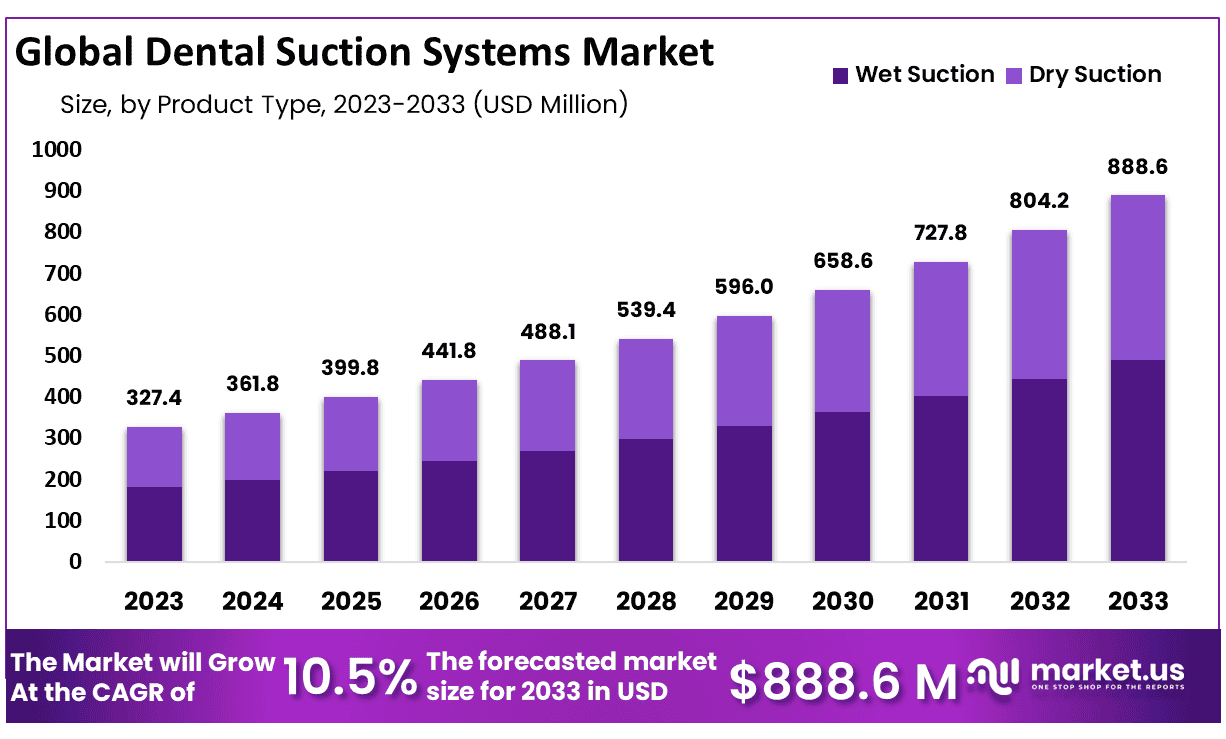
New York, NY – Jan 22, 2026 – The Global Dental Suction Systems Market size is expected to be worth around USD 888.6 Million by 2033 from USD 327.4 Million in 2023, growing at a CAGR of 10.5% during the forecast period from 2024 to 2033.
The global dental suction systems market is witnessing steady growth, supported by the rising number of dental procedures and increasing awareness of oral healthcare standards. Dental suction systems are essential equipment used in dental clinics and hospitals to remove saliva, blood, water, and debris during dental treatments, thereby improving visibility, hygiene, and patient comfort.
The growth of the market can be attributed to the expanding geriatric population, as older individuals are more prone to dental disorders such as periodontal disease and tooth loss. In addition, the increasing prevalence of cosmetic dentistry procedures, including teeth whitening and orthodontic treatments, has contributed to higher demand for advanced dental equipment, including suction systems.
Technological advancements have played a significant role in shaping the market landscape. Modern dental suction systems are designed to offer improved efficiency, low noise levels, and enhanced infection control. The integration of energy-efficient motors and compact designs has further supported adoption across small and mid-sized dental practices.
From a regional perspective, developed markets such as North America and Europe continue to hold a significant share due to well-established healthcare infrastructure and higher dental care expenditure. Meanwhile, emerging economies in Asia-Pacific are expected to witness notable growth, driven by increasing healthcare investments and growing awareness of preventive dental care.
Overall, the dental suction systems market is expected to maintain stable growth over the forecast period. Continuous innovation, combined with the rising focus on patient safety and clinical efficiency, is anticipated to support long-term market expansion.
Key Takeaways
- Market Size: The Dental Suction Systems market is projected to reach approximately USD 888.6 million by 2033, increasing from USD 327.4 million in 2023.
- Market Growth: The market is expected to expand at a compound annual growth rate (CAGR) of 10.5% over the forecast period from 2024 to 2033.
- Product Analysis: Wet suction systems generated the largest share of revenue, accounting for more than 55.1% of the total market.
- End-Use Analysis: Dental clinics represent the leading end-use segment, holding an estimated 57.2% share of the global Dental Suction Systems market.
- Regional Analysis: North America emerged as the leading regional market in 2023, capturing over 39.5% of total revenue and generating approximately USD 129.3 million in market value.
- Infection Control and Compliance: Infection prevention and regulatory compliance continue to be critical concerns within the dental industry, significantly influencing the adoption of advanced suction systems.
- Integration of Filtration Systems: The adoption of dental suction systems with integrated advanced filtration technologies is increasing, driven by the need for improved hygiene and air quality control.
- Market Consolidation: The market is experiencing moderate consolidation, with mergers and acquisitions among key players shaping the competitive landscape.
Regional Analysis
North America remained the leading regional market in 2023, accounting for more than 39.5% of global revenue and generating approximately USD 129.3 million in market value. The presence of a well-developed healthcare infrastructure, along with the rapid adoption of advanced dental technologies, has significantly supported market expansion in the region.
In addition, major regional players continue to invest substantially in research and development, as well as new product launches, which further strengthens market growth. For instance, VacStar by Air Techniques, Inc. offers enhanced procedural efficiency by reducing water usage, minimizing space requirements, and providing a compact system design for dental practices.
Asia Pacific is expected to register the fastest growth rate over the forecast period. This growth is primarily driven by the rising demand for dental care services, supported by a large and growing patient base. Increased investments by leading market participants to strengthen healthcare infrastructure in developing economies such as India and China are further contributing to regional expansion.
Moreover, strategic initiatives focused on the development and adoption of advanced dental technologies are anticipated to accelerate market growth across the Asia Pacific region.
Emerging Trends
- Enhanced Aerosol Management: The COVID-19 pandemic highlighted the critical need to limit aerosol generation during dental procedures. Evidence indicates that the combined use of high-volume evacuation (HVE) and intraoral suction devices leads to a substantial reduction in microbial aerosol levels. As a result, procedural safety for both patients and dental professionals is significantly improved.
- Integration of Advanced Technologies: Contemporary dental evacuation systems are increasingly assessed for their effectiveness in controlling aerosol exposure during procedures such as ultrasonic scaling and crown preparation. Findings from recent studies suggest that advanced intraoral evacuation solutions are capable of lowering respirable aerosol concentrations, thereby strengthening overall infection control standards.
- Regulatory Compliance and Environmental Considerations: Stricter environmental regulations have been implemented to manage the discharge of dental amalgam waste. In response, the adoption of amalgam separators has become mandatory in dental practices. These systems are engineered to capture amalgam particles from wastewater streams, contributing to reduced environmental contamination and improved regulatory compliance.
Use Cases
- Aerosol-Generating Procedures: For dental procedures associated with high aerosol production, including ultrasonic scaling and the use of high-speed handpieces, the application of HVE systems is strongly recommended. This approach effectively limits droplet spread and aerosol dispersion within the clinical environment.
- Infection Control Practices: The integration of HVE with intraoral suction devices has been shown to markedly reduce microbial aerosol presence during routine oral prophylaxis. This combined approach supports enhanced infection prevention and reinforces standard safety protocols in dental care settings.
- Compliance with Environmental Regulations: Dental clinics are required to install amalgam separators to ensure the removal of amalgam waste from wastewater. This practice supports adherence to environmental regulations and plays a vital role in minimizing mercury release into the ecosystem.
Frequently Asked Questions on Dental Suction Systems
- What are dental suction systems and why are they essential in dental clinics?
Dental suction systems are devices used to remove saliva, blood, debris, and aerosols during dental procedures. Their use is essential to maintain a clear operating field, improve treatment efficiency, and support infection control standards. - What are the main types of dental suction systems available?
Dental suction systems are commonly categorized into wet suction systems and dry suction systems. Wet systems use water for vacuum generation, while dry systems rely on air turbines, offering higher efficiency and lower water consumption. - How do dental suction systems contribute to infection control?
Dental suction systems reduce the spread of aerosols and droplets generated during procedures. By efficiently removing contaminants, these systems help minimize cross-infection risks and support compliance with strict hygiene and regulatory requirements in dental practices. - What factors influence the selection of a dental suction system?
The selection of a dental suction system is influenced by clinic size, number of dental chairs, workflow volume, energy efficiency requirements, noise levels, and maintenance costs. Regulatory compliance and long-term operational reliability are also key considerations. - What is driving the growth of the dental suction systems market?
The growth of the dental suction systems market is driven by rising dental procedure volumes, increasing awareness of infection control, expansion of dental clinics, and technological advancements focused on energy efficiency and sustainable dental equipment solutions. - How does technological innovation impact the dental suction systems market?
Technological innovation has led to compact designs, improved vacuum efficiency, reduced water usage, and smart monitoring features. These advancements enhance system performance, lower operating costs, and increase adoption across modern dental facilities globally. - Which regions show strong demand in the dental suction systems market?
Strong demand for dental suction systems is observed in North America and Europe due to advanced healthcare infrastructure. Asia-Pacific is experiencing rapid growth, supported by expanding dental tourism, urbanization, and increasing investment in oral healthcare services. - What is the future outlook for the dental suction systems market?
The dental suction systems market is expected to grow steadily, supported by preventive dental care trends and stricter hygiene regulations. Demand for eco-friendly and digitally integrated systems is anticipated to shape future product development strategies.
Conclusion
In conclusion, the global dental suction systems market is positioned for sustained growth, supported by increasing dental procedure volumes, rising awareness of oral hygiene, and stringent infection control requirements. Advancements in technology, including energy-efficient designs and enhanced aerosol management, continue to improve clinical efficiency and patient safety.
Strong demand from dental clinics, particularly in developed regions, reinforces market stability, while rapid expansion in Asia-Pacific highlights emerging opportunities. Moreover, regulatory compliance related to infection prevention and environmental protection is accelerating the adoption of advanced suction systems. Overall, continuous innovation and expanding dental care infrastructure are expected to support long-term market expansion.



