


Table of Contents
Overview
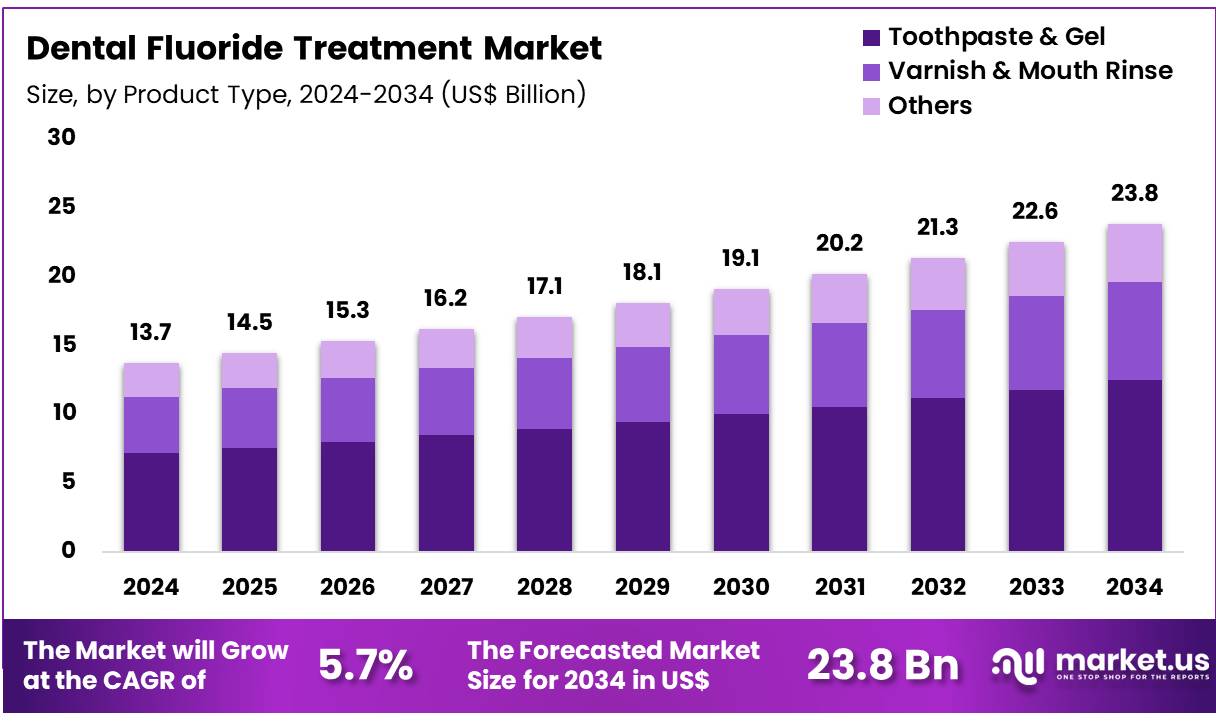
New York, NY – Dec 22, 2025 – Global Dental Fluoride Treatment Market size is expected to be worth around US$ 23.8 Billion by 2034 from US$ 13.7 Billion in 2024, growing at a CAGR of 5.7% during the forecast period 2025 to 2034. In 2024, North America led the market, achieving over 36.9% share with a revenue of US$ 4.1 Billion.
Dental fluoride treatment continues to be recognized as a fundamental preventive solution in modern oral healthcare, supporting long-term dental health across all age groups. The treatment is widely applied in clinical settings to strengthen tooth enamel and reduce the risk of dental caries, which remains one of the most prevalent oral health conditions globally.
Fluoride treatment works by remineralizing weakened enamel and increasing resistance to acid attacks caused by plaque bacteria and sugars. Regular professional application has been shown to significantly lower the incidence of tooth decay, particularly among children, adolescents, and individuals with a higher risk of cavities. The treatment is typically delivered in the form of gels, foams, varnishes, or rinses, allowing for safe and efficient absorption.
The growing emphasis on preventive dentistry has contributed to increased adoption of fluoride-based treatments in dental clinics and community oral health programs. Public health initiatives have also highlighted fluoride treatment as a cost-effective approach to reducing long-term dental treatment expenses and improving overall oral hygiene outcomes. Rising awareness regarding oral health, combined with supportive recommendations from dental associations, has further strengthened market demand.
Advancements in formulation technologies have led to the development of fluoride treatments with improved taste, faster application time, and enhanced patient compliance. These innovations are expected to support continued growth in the preventive dental care segment.
Overall, dental fluoride treatment remains a clinically proven, widely accepted solution that plays a vital role in preventive oral healthcare strategies, supporting healthier smiles and improved quality of life.
Key Takeaways
- In 2024, the dental fluoride treatment market generated revenue of US$ 13.7 billion and is projected to expand at a CAGR of 5.7%, reaching US$ 23.8 billion by 2034.
- By product type, the market is categorized into toothpaste & gel, varnish & mouth rinse, and others, with toothpaste & gel dominating the segment and accounting for 52.3% of the market share in 2023.
- Based on end user, the market is segmented into children & adolescents, adults, and pregnant women, with adults representing the largest share at 47.3%.
- North America emerged as the leading regional market, capturing a 36.9% share in 2024.
Regional Analysis
North America held a dominant position in the global dental fluoride treatment market, accounting for 36.9% of total revenue in 2024. This leadership is largely driven by a strong emphasis on preventive oral healthcare and sustained government support. Programs supported by the Centers for Medicare & Medicaid Services have focused on improving access to preventive dental services for children enrolled in Medicaid and CHIP, including fluoride applications.
In parallel, the American Dental Hygienists’ Association reported more than 214,000 dental hygienists in the U.S. in 2023, reinforcing patient education and routine use of fluoride-based preventive care. Market growth is further supported by an aging population and a high burden of dental caries. According to the Centers for Disease Control and Prevention, about 21% of adults aged 20–64 and 18% of children aged 6–8 had untreated dental decay in 2024, underscoring continued demand for preventive treatments.
Asia Pacific is projected to register the fastest CAGR over the forecast period. Rapid population aging, particularly in Japan, and rising awareness of oral hygiene are key contributors. Government-led oral health initiatives, increasing middle-income populations, and a high prevalence of periodontal disease are expected to accelerate adoption of both professional and consumer fluoride treatments, positioning the region as a major growth engine for the market.
Emerging Trends
Nanotechnology-Enabled Fluoride Formulations: Fluoride products are increasingly being enhanced with nano-hydroxyapatite and nano-silver particles to improve enamel remineralization performance and extend fluoride retention on tooth surfaces.
Fluoride Varnishes with Bioactive Additives: Modern formulations are incorporating fluoride in combination with bioactive agents such as calcium phosphate, xylitol, and casein phosphopeptide–amorphous calcium phosphate (CPP-ACP), delivering synergistic remineralization and enhanced enamel protection.
Shift Toward Minimally Invasive Preventive Dentistry: Preventive dentistry strategies are placing greater emphasis on early-stage fluoride interventions, supporting disease prevention and reducing the long-term need for restorative dental procedures.
Personalized Fluoride Treatment Protocols: Digital caries risk assessment tools are being adopted to customize fluoride concentration, application frequency, and delivery methods based on individual patient risk profiles.
Expansion of At-Home Fluoride-Based Preventive Care: Prescription-strength fluoride gels, mouth rinses, and custom-fitted trays are increasingly utilized, particularly for high-risk individuals, to support continuous preventive care between professional dental visits.
Key Use Cases
- Caries Prevention in High-Risk Groups: Regular fluoride varnish applications are widely used to reduce caries incidence among children, older adults, and individuals experiencing reduced salivary flow.
- Management of Early-Stage Carious Lesions: Professional fluoride treatments are applied to arrest or reverse early enamel demineralization, minimizing the need for invasive restorative interventions.
- Control of Post-Orthodontic Demineralization: Following orthodontic appliance removal, fluoride therapy is employed to remineralize white spot lesions commonly observed around former bracket sites.
- Protection Against Dental Erosion: Patients affected by acid reflux, eating disorders, or frequent consumption of acidic beverages benefit from fluoride treatments that strengthen enamel and reduce hypersensitivity.
- Preventive Support for Special Needs Populations: Fluoride therapy forms an integral component of preventive oral care programs for individuals with physical or cognitive challenges that limit effective daily oral hygiene practices.
Frequently Asked Questions on Dental Fluoride Treatment
- How does fluoride treatment help prevent tooth decay?
Fluoride treatment helps prevent tooth decay by enhancing enamel remineralization, inhibiting bacterial acid production, and increasing tooth resistance to demineralization, thereby reducing cavity formation and slowing the progression of early-stage dental caries. - Who should receive dental fluoride treatment?
Dental fluoride treatment is recommended for children, adolescents, adults with high caries risk, orthodontic patients, and individuals with dry mouth conditions, as these groups are more susceptible to enamel erosion and tooth decay. - How often is dental fluoride treatment required?
The frequency of dental fluoride treatment depends on individual caries risk, oral hygiene habits, and dietary patterns, but it is generally administered every three to six months as part of routine preventive dental care. - What factors are driving the dental fluoride treatment market?
The dental fluoride treatment market is driven by rising dental caries prevalence, increasing preventive dental care awareness, growing pediatric populations, and expanded access to dental services, particularly in emerging economies and urban healthcare settings. - Which products dominate the dental fluoride treatment market?
The market is primarily dominated by fluoride varnishes, followed by gels and foams, due to their ease of application, high patient compliance, and proven clinical effectiveness in reducing tooth decay across different age groups. - How does government policy influence the dental fluoride treatment market?
Government initiatives supporting oral health programs, school-based fluoride applications, and public awareness campaigns significantly influence market growth by increasing treatment adoption and encouraging preventive dental care at population levels. - What is the future outlook for the dental fluoride treatment market?
The dental fluoride treatment market is expected to experience steady growth, supported by technological advancements, rising healthcare expenditure, and increasing emphasis on preventive dentistry within both public and private healthcare systems globally.
Conclusion
Dental fluoride treatment continues to play a central role in preventive oral healthcare, supported by strong clinical evidence and growing global adoption. Its proven ability to strengthen enamel, prevent dental caries, and reduce long-term treatment costs has reinforced its value across all age groups.
Market growth is being driven by rising awareness of oral hygiene, supportive public health initiatives, and ongoing formulation advancements that enhance patient compliance. Regional expansion, particularly in Asia Pacific, further strengthens future prospects. Overall, dental fluoride treatment remains a cost-effective, clinically validated solution that will continue to support improved oral health outcomes and sustained market growth worldwide.
Discuss your needs with our analyst
Please share your requirements with more details so our analyst can check if they can solve your problem(s)




