


Table of Contents
Overview
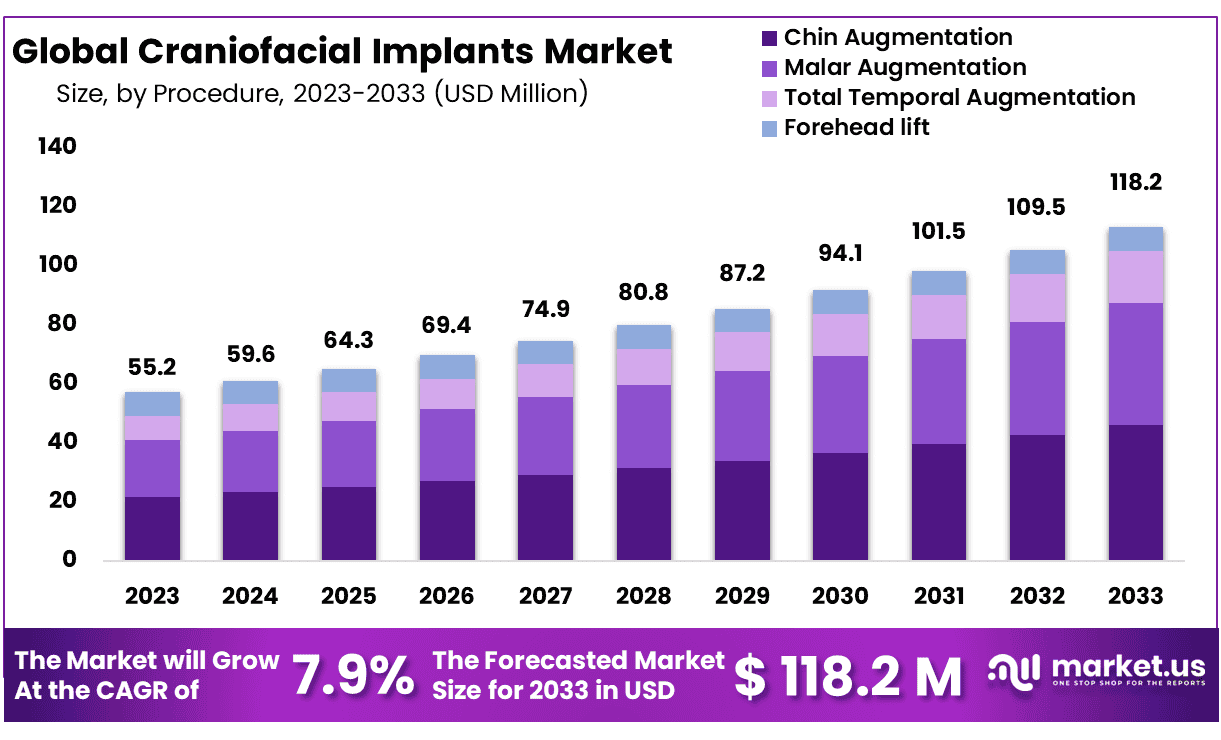
New York, NY – Jan 23, 2026 – The Global Craniofacial Implants Market size is expected to be worth around USD 118.2 Million by 2033 from USD 55.2 Million in 2023, growing at a CAGR of 7.9% during the forecast period from 2024 to 2033.
Craniofacial implants are specialized medical devices designed to restore, support, or replace facial and cranial structures affected by trauma, congenital disorders, tumors, or surgical interventions. These implants play a critical role in reconstructive and maxillofacial surgery, enabling both functional rehabilitation and aesthetic restoration.
Craniofacial implants are typically manufactured from biocompatible materials such as titanium, polyetheretherketone (PEEK), and advanced ceramics. Titanium remains the most widely used material due to its high strength, corrosion resistance, and excellent compatibility with human bone. The selection of material is determined by anatomical requirements, patient-specific conditions, and long-term durability considerations.
The formation and placement of craniofacial implants involve precise preoperative planning supported by advanced imaging technologies, including computed tomography (CT) and three-dimensional modeling. These tools allow for accurate customization of implant shape and size, ensuring optimal fit and stability. In recent years, the integration of computer-aided design and manufacturing (CAD/CAM) and 3D printing technologies has significantly improved surgical accuracy and patient outcomes.
Clinically, craniofacial implants are used in applications such as orbital reconstruction, mandibular and maxillary repair, dental anchoring systems, and fixation of facial prosthetics. The growing demand for craniofacial implants is being driven by an increase in road accidents, rising incidence of craniofacial abnormalities, and advancements in reconstructive surgical techniques.
Overall, craniofacial implants represent a vital component of modern reconstructive medicine. Continuous innovation in materials science and surgical technologies is expected to further enhance their safety, effectiveness, and adoption across global healthcare systems.
Key Takeaways
- Market Size: The craniofacial implants market is projected to reach approximately USD 118.2 million by 2033, increasing from USD 55.2 million recorded in 2023.
- Market Growth: Market expansion is anticipated at a compound annual growth rate (CAGR) of 7.9% throughout the forecast period spanning 2024 to 2033.
- Procedure Analysis: Chin augmentation represents the leading procedure segment within the craniofacial implants market, contributing 39.0% of the total market share.
- Shape Analysis: Anatomically designed implants emerged as the dominant category, accounting for a 30.1% share of overall market revenues.
- End-Use Analysis: Cosmetic and plastic surgery clinics constitute the primary end-use segment, capturing 53.8% of the craniofacial implants market share.
- Regional Analysis: North America maintained its leading position in 2023, representing 49.8% of total revenue and generating approximately USD 27.4 million in market value.
Regional Analysis
North America dominated the craniofacial implants market in 2023, accounting for a 49.8% share of total revenue and generating approximately USD 27.4 million in industry earnings. This strong market position is primarily supported by the region’s continued focus on technological advancement, particularly the development and widespread adoption of innovative implant solutions.
The rising number of craniofacial implant procedures performed across the region has further strengthened its leadership. Growth is also being supported by increasing public awareness of cosmetic and reconstructive surgical options, alongside the availability of well-established, high-quality healthcare infrastructure.
Collectively, these factors have created a favorable environment for sustained market expansion in North America. The combination of advanced medical technologies, growing procedural volumes, and strong institutional capabilities has positioned the region as the leading market for craniofacial implants globally, reflecting both robust healthcare systems and a heightened acceptance of aesthetic and reconstructive treatments.
Emerging Trends
- Personalized Implants Enabled by 3D Printing and AI: The combination of 3D printing and artificial intelligence is transforming craniofacial implant development. AI-driven analysis of imaging data supports the creation of patient-specific implants, improving anatomical fit, enhancing surgical accuracy, and reducing overall operative time.
- Progress in Implant Material Innovation: Ongoing advancements in biomaterials, including bioresorbable polymers and advanced biocompatible metals, are improving implant performance. These materials support better bone integration, lower complication risks, and contribute to improved long-term clinical outcomes.
- Growing Adoption of Minimally Invasive Techniques: Minimally invasive surgical approaches, such as endoscopic procedures and computer-assisted navigation, are increasingly adopted. These methods reduce tissue trauma, shorten recovery periods, and deliver superior cosmetic results, benefiting both patients and surgeons.
- Developments in Regenerative Medicine and Stem Cell Research: Research in regenerative medicine is focusing on stem cells and tissue engineering for craniofacial repair. These innovations aim to encourage natural tissue regeneration and may reduce reliance on synthetic implants over the long term.
Use Cases
- Reconstruction Following Trauma or Surgical Procedures: Craniofacial implants are widely used to restore facial structures after trauma or tumor-related surgeries. Materials such as titanium have shown high durability and survival rates across multiple craniofacial applications.
- Prosthetic Rehabilitation of Facial Defects: For patients unsuitable for surgical reconstruction, craniofacial prostheses such as artificial ears or noses are used. Osseointegrated implants provide secure anchorage, improving prosthetic stability and aesthetic outcomes.
- Management of Congenital Craniofacial Disorders: Customized craniofacial implants are essential in treating congenital anomalies, including microtia and craniosynostosis. Patient-specific solutions enhance functional restoration and facial symmetry in affected individuals.
- Anchoring of Craniofacial Prosthetic Devices: Implants are utilized to support and stabilize facial prosthetics, such as ocular or auricular devices. This application is critical for patients affected by trauma, disease, or congenital facial defects.
- Enhanced Surgical Planning and Precision: The application of CAD/CAM technologies enables accurate preoperative planning and customized implant fabrication. This approach improves surgical efficiency, reduces operative time, and enhances overall treatment outcomes.
Frequently Asked Questions on Craniofacial Implants
- Which materials are commonly used in craniofacial implants?
Craniofacial implants are primarily manufactured using biocompatible materials such as titanium, PEEK, and ceramics, selected for their durability, bone compatibility, corrosion resistance, and ability to integrate effectively with surrounding tissues. - What conditions require craniofacial implants?
These implants are commonly used to treat facial trauma, cranial defects, congenital deformities, tumor-related bone loss, and aesthetic enhancements, supporting reconstruction of the jaw, orbit, skull, and facial contours. - Are craniofacial implants safe for long-term use?
Craniofacial implants are considered safe for long-term use when properly designed and implanted, as they undergo rigorous testing and are developed using materials proven to be compatible with human bone and soft tissues. - What is driving the growth of the craniofacial implants market?
Market growth is driven by rising demand for cosmetic and reconstructive surgeries, increasing road accidents and trauma cases, technological advancements in implant design, and greater public awareness of aesthetic treatment options. - Which end users dominate the craniofacial implants market?
Cosmetic and plastic surgery clinics dominate the market due to higher procedural volumes, patient preference for specialized centers, and the growing popularity of aesthetic facial correction and enhancement procedures. - Which region leads the craniofacial implants market?
North America leads the global craniofacial implants market, supported by advanced healthcare infrastructure, high adoption of innovative implant technologies, increased procedural volumes, and strong awareness of reconstructive and cosmetic treatments. - How is technology influencing the craniofacial implants market?
Technological advancements such as 3D printing, CAD/CAM systems, and patient-specific implant designs are improving surgical accuracy, reducing recovery time, and enhancing outcomes, thereby accelerating market adoption and innovation.
Conclusion
Craniofacial implants have become an essential element of modern reconstructive and aesthetic medicine, supporting the restoration of facial structure, function, and appearance. Market growth is being sustained by technological advancements, rising procedural volumes, and increasing acceptance of cosmetic and reconstructive solutions.
Innovations in personalized implant design, biomaterials, and minimally invasive techniques are further strengthening clinical outcomes and patient safety. With strong regional leadership from North America and expanding applications across trauma, congenital conditions, and prosthetic rehabilitation, the craniofacial implants market is positioned for steady, long-term expansion globally.
Discuss your needs with our analyst
Please share your requirements with more details so our analyst can check if they can solve your problem(s)




