


Table of Contents
Overview
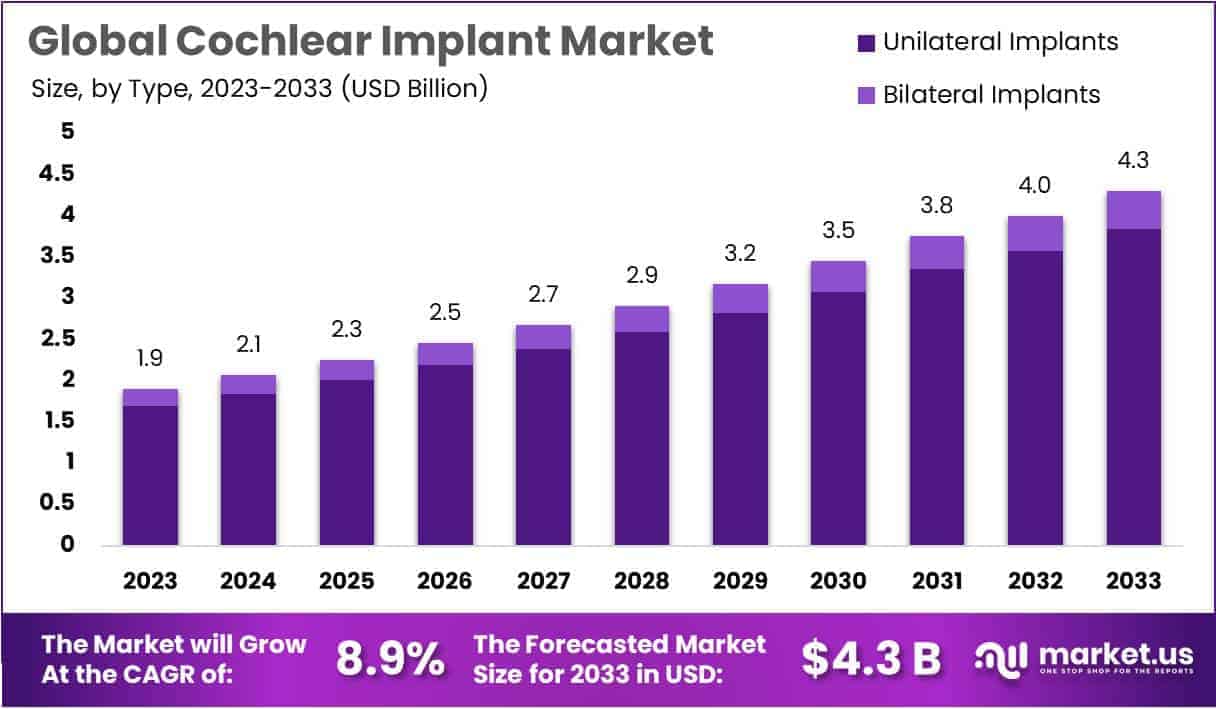
New York, NY – Jan 01, 2026 – The Global Cochlear Implant Market size is expected to be worth around USD 4.3 Billion by 2033, from USD 1.9 Billion in 2023, growing at a CAGR of 8.9% during the forecast period from 2024 to 2033.
A cochlear implant is an advanced medical device designed to provide a sense of sound to individuals with severe to profound sensorineural hearing loss. Unlike conventional hearing aids, which amplify sound, a cochlear implant directly stimulates the auditory nerve, enabling sound perception even when the inner ear is significantly damaged.
The cochlear implant system consists of two primary components: an external sound processor and an internal implanted device. The external sound processor captures sound from the environment, converts it into digital signals, and transmits these signals to the internal implant through a radio-frequency link. The internal component, surgically placed under the skin behind the ear, converts the signals into electrical impulses. These impulses are delivered to an electrode array positioned within the cochlea, where the auditory nerve fibers are stimulated and sound signals are sent to the brain for interpretation.
Cochlear implants are commonly recommended for individuals who receive limited or no benefit from hearing aids, including both children and adults. Early implantation, particularly in pediatric patients, has been associated with improved speech perception, language development, and educational outcomes. In adults, cochlear implantation has been shown to enhance speech understanding, social interaction, and overall quality of life.
Advancements in implant technology, signal processing algorithms, and surgical techniques continue to improve hearing outcomes and expand patient eligibility. As awareness and access increase globally, cochlear implants are increasingly recognized as a reliable and effective intervention for managing severe hearing impairment.
Key Takeaways
- The global cochlear implant market is projected to reach USD 4.3 billion by 2033, expanding at a compound annual growth rate (CAGR) of 8.9% from 2024 to 2033.
- Unilateral cochlear implants account for 89.2% of the total market share, largely due to wider reimbursement coverage, established clinical adoption, and comparatively lower procedural and device costs.
- The bilateral cochlear implants segment is expected to register a CAGR of 9.9%, supported by growing clinical evidence highlighting improved sound localization and enhanced social communication outcomes.
- The adult patient segment dominates the market with a 61.8% share, while the pediatric segment is anticipated to grow at a 9.4% CAGR, driven by early diagnosis and favorable long-term developmental outcomes.
- Hospitals represent the leading end-user category, capturing 47.7% of the market share, supported by their role in surgical implantation, post-operative care, and rehabilitation services.
- Market growth is primarily driven by continuous technological advancements in implant design and sound processing, alongside the rising prevalence of hearing loss worldwide.
- However, high device costs and ongoing maintenance requirements remain key restraints, limiting adoption in cost-sensitive regions.
- Government-supported initiatives, such as India’s ADIP program, are creating significant growth opportunities by improving access to cochlear implantation.
- Global awareness levels are increasing, with more than 60,000 individuals benefiting from cochlear implants, reflecting broader acceptance of the technology.
- Europe leads the global market with a 37.2% share, while Asia Pacific is expected to record the fastest growth, with a projected CAGR of 9.7% over the forecast period.
Cochlear Implantation Surgery: Key Statistics
- Infection Risk: The postoperative infection rate remains below 3%, classifying cochlear implantation as a low-risk and clean surgical procedure.
- Overall Complication Profile: Minor complications are reported in approximately 12% of cases, while major complications account for around 3%, reflecting a generally favorable safety profile.
- Post-Implantation Bacterial Meningitis: Globally, up to 20 new cases are reported annually. However, the incidence has shown a consistent downward trend due to improved surgical protocols and vaccination strategies.
- Facial Nerve Outcomes: Transient facial nerve palsy occurs in nearly 1% of procedures. The overall risk of facial nerve injury has declined to below 1%, with permanent paralysis estimated at approximately 1 per 1,000 surgeries, and even lower rates observed in high-volume, experienced centers.
- Device Reliability and Reimplantation: Device failure and the need for reimplantation are estimated to occur in 2.5% to 6% of cases, depending on device type, duration of use, and patient factors.
- Postoperative Vestibular Symptoms: Up to one-third of recipients experience postoperative symptoms such as vertigo, disequilibrium, or vestibular weakness lasting longer than one week. These symptoms are more persistent among patients aged over 70 years.
- Advancements in Surgical Techniques: Technological improvements and refined surgical approaches have reduced the global complication rate from over 35% in 1991 to less than 10% in current clinical practice.
- Revision Surgery Rates: Revision procedures are reported in 3.8% to 8% of patients, primarily due to device malfunction, infection, or implant migration.
Public Health Impact and Utilization
- Prevalence in the United States: By the end of 2019, approximately 217,000 individuals in the United States had received a cochlear implant.
- Global Adoption: As of 2016, an estimated 600,000 people worldwide had undergone cochlear implantation, indicating steady global uptake.
- Burden of Hearing Loss: Approximately 6.1% of the global population lives with hearing loss. This figure is projected to exceed 900 million individuals by 2050, underscoring the growing demand for auditory rehabilitation solutions.
Economic Considerations
- Cost-Effectiveness: Cochlear implants are widely recognized as a cost-effective intervention, particularly in low- and middle-income countries. Reported returns on investment range from US$1.46 to US$4.09 for every dollar spent.
- Lifetime Economic Value: In Colombia, the estimated lifetime cost of cochlear implantation per child is approximately US$99,000, yielding an average return of US$2.07 per dollar invested.
Insurance Coverage and Eligibility Criteria
- Age and Hearing Threshold Requirements: Eligibility criteria vary by age group and typically include defined thresholds for hearing loss severity and limited benefit from conventional hearing aids.
- Special Clinical Considerations: Additional criteria apply to patients with asymmetric hearing loss, single-sided deafness, or those requiring hybrid cochlear implant systems.
Effectiveness in Tinnitus Management
- Clinical Outcome Variability: A systematic review published in 2015 reported total tinnitus suppression rates ranging from 8% to 45% following cochlear implantation. Outcomes remain variable, with some patients experiencing no change or a worsening of tinnitus symptoms post-surgery.
Regional Analysis
Europe Dominates the Global Cochlear Implant Market
Europe accounted for the largest share of the global cochlear implant market in 2023, capturing 37.2% of total revenue, which represented a market value of approximately USD 0.70 billion. Market expansion in the region has been supported by the growing recognition of advanced hearing solutions, widespread availability of speech therapy and rehabilitation centers, and the presence of favorable reimbursement frameworks across several European countries.
Ongoing technological innovation and the establishment of advanced healthcare facilities within the European Union have further strengthened market growth. Regulatory advancements have also played a critical role in supporting adoption. For instance, in March 2020, MED-EL Medical Electronics became the first cochlear implant manufacturer to receive certification under the European Medical Device Regulation (MDR), reinforcing confidence in product safety and quality standards across the region.
In contrast, the Asia Pacific region is expected to witness the fastest growth, registering a projected CAGR of 9.7% during the forecast period. This accelerated growth is primarily attributed to the rapidly expanding elderly population, rising prevalence of hearing impairment, and increasing patient awareness regarding cochlear implantation. Government-backed support programs are also contributing to regional growth. For example, the Government of India, through its Ministry of Social Justice and Empowerment, provides financial assistance of up to INR 6 lakh per child for cochlear implant procedures, significantly improving access to advanced hearing care solutions.
Use Cases of Cochlear Implants
- Management of Severe to Profound Hearing Loss: Cochlear implants are primarily indicated for individuals with severe to profound sensorineural hearing loss in one or both ears, particularly when conventional hearing aids provide limited or no functional benefit.
- Enhancement of Speech Perception: The devices significantly improve the ability to perceive and understand speech, including in complex listening environments such as background noise, thereby strengthening everyday communication.
- Recognition of Environmental Sounds: Cochlear implants enable users to detect and interpret common environmental sounds, including doorbells, alarms, and telephones, contributing to improved situational awareness and safety.
- Quality of Life Improvement in the Elderly: Among older adults, cochlear implantation has been associated with reduced social isolation, improved emotional well-being, and a lower risk of depression linked to untreated hearing loss.
- Support for Pediatric Language Development: In children, particularly those implanted at an early age, cochlear implants facilitate improved speech and language development outcomes compared to reliance on hearing aids alone.
- Educational Advancement in Children: For pediatric patients with severe hearing impairment, cochlear implants improve access to spoken language, supporting better classroom participation, learning outcomes, and long-term academic performance.
- Facilitation of Telephonic Communication: Cochlear implants enhance the clarity of telephone conversations, addressing a common limitation experienced by individuals using traditional hearing aids.
- Improved Music Perception: The technology supports better perception of musical elements such as rhythm and pitch, allowing users to engage more fully with music and other complex auditory experiences.
- Rehabilitation for Post-Lingually Deaf Adults: Adults who experience hearing loss after language acquisition often benefit substantially from cochlear implants, as prior auditory memory supports faster adaptation and improved sound recognition.
- Potential Mitigation of Cognitive Decline: By restoring auditory stimulation, cochlear implants may contribute to the prevention or slowing of cognitive decline associated with prolonged hearing deprivation in older populations.
Frequently Asked Questions on Cochlear Implant
- Who is eligible for a cochlear implant?
Cochlear implants are recommended for children and adults with severe to profound sensorineural hearing loss who receive limited benefit from hearing aids and meet defined medical, audiological, and speech perception criteria. - How does a cochlear implant work?
The device converts sound into digital signals, which are transmitted to electrodes implanted in the cochlea. These electrodes stimulate the auditory nerve, allowing the brain to interpret the signals as sound. - Is cochlear implant surgery safe?
Cochlear implant surgery is considered a safe and well-established procedure with high success rates. Risks are relatively low and typically include infection, dizziness, or device malfunction, which are clinically manageable. - What benefits do cochlear implants provide?
Cochlear implants significantly improve speech perception, communication ability, and quality of life. Benefits are enhanced with early implantation, consistent device use, and structured post-implant auditory rehabilitation programs. - What factors are driving market growth?
Market growth is driven by rising prevalence of hearing loss, increasing geriatric population, technological advancements, favorable reimbursement policies in developed regions, and growing awareness regarding early hearing intervention solutions. - Which regions dominate the cochlear implant market?
North America and Europe dominate the market due to advanced healthcare infrastructure and reimbursement coverage, while Asia-Pacific is experiencing rapid growth driven by large patient populations and improving access to healthcare services. - What technological trends are shaping the market?
Key trends include miniaturization of devices, wireless connectivity, AI-enabled sound processing, MRI-compatible implants, and improved battery technologies, all contributing to better patient outcomes and higher device adoption rates.
Conclusion
Cochlear implants represent a clinically proven and economically viable solution for managing severe to profound sensorineural hearing loss across pediatric and adult populations. The technology has demonstrated strong safety, reliability, and long-term benefits in speech perception, social integration, and quality of life.
Market growth is being supported by technological innovation, expanding eligibility criteria, and government-backed access programs, particularly in emerging economies. While high device and maintenance costs remain a constraint, improving reimbursement frameworks and rising awareness are mitigating these barriers. Overall, cochlear implants are positioned as a critical intervention within global hearing healthcare systems, with sustained demand expected over the forecast period.
Discuss your needs with our analyst
Please share your requirements with more details so our analyst can check if they can solve your problem(s)




