


Table of Contents
Overview
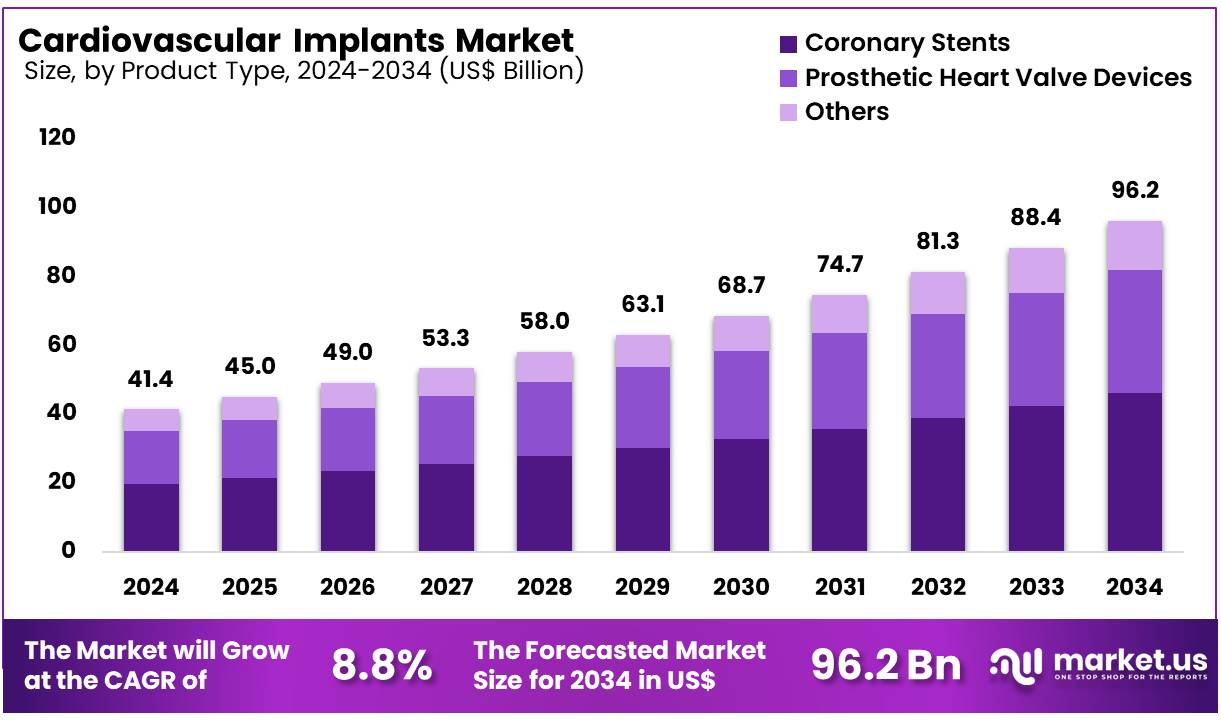
New York, NY – Dec 18, 2025 – Global Cardiovascular Implants Market size is expected to be worth around US$ 96.2 Billion by 2034 from US$ 41.4 Billion in 2024, growing at a CAGR of 8.8% during the forecast period 2025 to 2034. In 2024, North America led the market, achieving over 39.7% share with a revenue of US$ 16.4 Billion.
The cardiovascular implants segment represents a critical component of modern healthcare, supporting the diagnosis, treatment, and long-term management of heart-related disorders. These implants are designed to restore normal blood flow, regulate heart rhythm, and improve overall cardiac function in patients affected by cardiovascular diseases.
Cardiovascular implants include products such as stents, pacemakers, implantable cardioverter defibrillators (ICDs), heart valves, and vascular grafts. These devices are developed using advanced biomaterials and precision engineering to ensure durability, biocompatibility, and long-term performance. Their adoption has increased steadily due to rising incidences of coronary artery disease, heart failure, and arrhythmias across both developed and emerging economies.
The growth of the cardiovascular implants market is primarily driven by an aging global population, increasing prevalence of lifestyle-related risk factors, and continuous advancements in medical technology. Minimally invasive surgical procedures and improved implant designs have further enhanced patient outcomes and reduced recovery times. Additionally, growing awareness of early diagnosis and preventive cardiac care has contributed to higher implantation rates.
Healthcare providers continue to prioritize cardiovascular implants due to their proven clinical effectiveness and role in reducing mortality associated with cardiac conditions. Ongoing research and development activities are focused on improving device longevity, enhancing patient comfort, and integrating digital monitoring capabilities.
Overall, the cardiovascular implants sector is expected to maintain stable growth, supported by technological innovation, expanding healthcare infrastructure, and increasing demand for effective cardiac treatment solutions worldwide.
Key Takeaways
- In 2024, the global cardiovascular implants market generated revenue of US$ 41.4 billion and is projected to expand at a CAGR of 8.8%, reaching US$ 96.2 billion by 2034.
- By product type, the market is segmented into prosthetic heart valve devices, coronary stents, and others, with coronary stents emerging as the leading category, accounting for 47.9% of the market share in 2024.
- Based on application, the market is classified into arrhythmias, heart failure, and others, where the arrhythmias segment held a substantial share of 45.3%.
- In terms of end users, the market is divided into cardiac care centers, hospitals, and others, with hospitals dominating the segment and capturing 58.7% of total revenue.
- North America remained the leading regional market, securing a 39.7% share of the global cardiovascular implants market in 2024.
Regional Analysis
The cardiovascular implants market in North America accounted for a substantial 39.7% share in 2024, reflecting strong market expansion. This growth was driven by the sustained burden of cardiovascular diseases, an aging population requiring advanced interventional care, and continuous technological progress that improved the safety, durability, and clinical effectiveness of implantable devices.
Although age-adjusted mortality from ischemic heart disease in the United States declined significantly between 1970 and 2022, mortality linked to other cardiac conditions such as heart failure and arrhythmias increased sharply, highlighting a structural shift in clinical demand toward implantable therapies. Technological advancements in transcatheter heart valves, pacemakers, and implantable cardioverter-defibrillators have supported improved patient outcomes and broadened treatment pathways.
Leading manufacturers reported solid financial performance, with Medtronic’s cardiovascular portfolio generating US$11.8 billion in fiscal 2024, while Edwards Lifesciences and Abbott recorded double-digit growth driven by strong demand for structural heart and rhythm management solutions.
Asia Pacific is projected to register the highest compound annual growth rate during the forecast period. Market expansion is expected to be supported by a rapidly rising cardiovascular disease burden, demographic aging, increasing healthcare investments, and improving access to advanced cardiac care. Growing disposable incomes, government-led healthcare modernization, and strategic regional expansion by global device manufacturers are expected to collectively sustain strong demand for cardiovascular implants across the region.
Emerging Trends
- Miniaturization of Devices: Cardiovascular implants such as pacemakers and stents are becoming smaller while maintaining full functionality. Miniaturization supports minimally invasive procedures, reduces surgical risk, shortens hospital stays, and enables faster recovery. This advancement improves patient outcomes and procedural efficiency.
- Smart and Connected Implants: Smart cardiovascular implants integrate sensors and wireless connectivity to enable continuous heart monitoring. Real-time data transmission allows clinicians to detect abnormalities early and personalize treatment. This connectivity enhances clinical decision-making, reduces complications, and supports proactive patient management across care settings.
- Biodegradable and Resorbable Implants: Biodegradable cardiovascular implants are designed to dissolve after completing their function. These devices reduce long-term risks associated with permanent implants and minimize repeat interventions. Temporary structural support followed by natural resorption improves safety, healing, and overall patient outcomes.
- Patient-Specific Customization: Advanced imaging and 3D printing enable cardiovascular implants tailored to individual anatomy. Customized devices improve fit, performance, and comfort while reducing complications. This shift toward personalized solutions enhances surgical precision and is expected to become standard practice in cardiovascular treatment.
- Integration of Artificial Intelligence: Artificial intelligence supports implant design, surgical planning, and patient monitoring by analyzing complex datasets. AI-driven insights improve accuracy, predict complications, and enable early intervention. This integration enhances clinical efficiency, reduces human error, and supports more precise cardiovascular care.
- Focus on Minimally Invasive Procedures: Minimally invasive delivery of cardiovascular implants using catheter-based and robotic techniques reduces trauma and recovery time. These procedures lower complication risks, expand treatment eligibility for high-risk patients, and improve overall patient experience while maintaining clinical effectiveness.
Use Cases
- Treating Blocked Arteries: Coronary stents restore blood flow in narrowed arteries, reducing heart attack risk. Placed through minimally invasive procedures, modern stents improve heart function, reduce symptoms, and often release medication to prevent re-blockage, supporting long-term management of coronary artery disease.
- Managing Heart Rhythm Disorders: Pacemakers and implantable cardioverter defibrillators regulate abnormal heart rhythms and prevent sudden cardiac events. These devices continuously monitor heart activity, deliver corrective signals when needed, and significantly improve survival rates and quality of life for patients with arrhythmias.
- Replacing Damaged Heart Valves: Prosthetic heart valves replace malfunctioning valves to restore efficient blood circulation. Available in mechanical or tissue forms, these implants reduce symptoms and improve cardiac performance. Advances in valve design have increased durability and reduced complication rates.
- Supporting Weak Heart Muscles: Left ventricular assist devices support blood circulation in patients with severe heart failure. These implants reduce symptoms, improve daily functioning, and extend life expectancy. Modern LVADs are more compact, durable, and manageable, providing critical long-term cardiac support.
- Preventing Stroke in High-Risk Patients: Left atrial appendage occluders reduce stroke risk in atrial fibrillation patients unable to use blood thinners. Implanted through minimally invasive procedures, these devices prevent clot formation, improve safety, and significantly lower long-term stroke-related complications.
- Post-Surgery Recovery Monitoring: Smart cardiovascular implants enable continuous monitoring after surgery by transmitting real-time data to clinicians. Early detection of complications reduces hospital readmissions and improves recovery outcomes. These devices enhance patient confidence and support efficient, data-driven post-operative care.
Frequently Asked Questions on Cardiovascular Implants
- What types of cardiovascular implants are commonly used?
Common cardiovascular implants include stents, pacemakers, implantable cardioverter defibrillators, heart valves, and ventricular assist devices. Each implant is designed for specific cardiac conditions and varies in material composition, function, and implantation technique. - Who requires cardiovascular implants?
Cardiovascular implants are typically required by patients suffering from chronic heart diseases, blocked arteries, abnormal heart rhythms, or valve dysfunction. Aging populations and patients with lifestyle-related cardiovascular conditions represent a major patient base. - What materials are used in cardiovascular implants?
Cardiovascular implants are manufactured using biocompatible materials such as titanium, cobalt-chromium alloys, stainless steel, polymers, and biological tissues. Material selection is critical to ensure durability, compatibility, and reduced risk of immune reactions. - What are the benefits of cardiovascular implants?
Cardiovascular implants significantly improve patient survival, restore normal cardiac function, and enhance quality of life. These devices reduce symptoms, lower hospitalization rates, and enable long-term management of cardiovascular diseases with minimal invasiveness. - What factors are driving the cardiovascular implants market?
The cardiovascular implants market is driven by the rising prevalence of heart diseases, increasing geriatric population, technological advancements in implant design, and growing adoption of minimally invasive cardiac procedures across developed and emerging healthcare systems. - How is technological innovation impacting the market?
Technological advancements such as bioresorbable stents, leadless pacemakers, and smart implants with remote monitoring capabilities are enhancing treatment outcomes. These innovations are improving device performance, safety, and patient compliance, thereby supporting market growth. - Which regions dominate the cardiovascular implants market?
North America and Europe dominate the cardiovascular implants market due to advanced healthcare infrastructure, high adoption of innovative devices, and strong reimbursement frameworks. Asia-Pacific is witnessing rapid growth due to expanding healthcare access and rising disease burden. - What is the future outlook for the cardiovascular implants market?
The cardiovascular implants market is expected to grow steadily, supported by continuous innovation, increasing healthcare expenditure, and early disease diagnosis. Expanding patient awareness and improving reimbursement policies are likely to further enhance long-term market potential.
Conclusion
The cardiovascular implants market represents a vital pillar of modern cardiac care, addressing the growing global burden of heart-related disorders through clinically proven and technologically advanced solutions. Market expansion is being supported by demographic aging, rising lifestyle-related risk factors, and continuous innovation in implant design and minimally invasive procedures.
Strong adoption across hospitals and cardiac care centers, combined with increasing use of smart, customized, and bioresorbable devices, is improving patient outcomes and long-term disease management. With North America leading and Asia Pacific emerging as a high-growth region, the sector is expected to sustain steady, innovation-driven growth over the coming decade.
Discuss your needs with our analyst
Please share your requirements with more details so our analyst can check if they can solve your problem(s)




