


Table of Contents
Overview
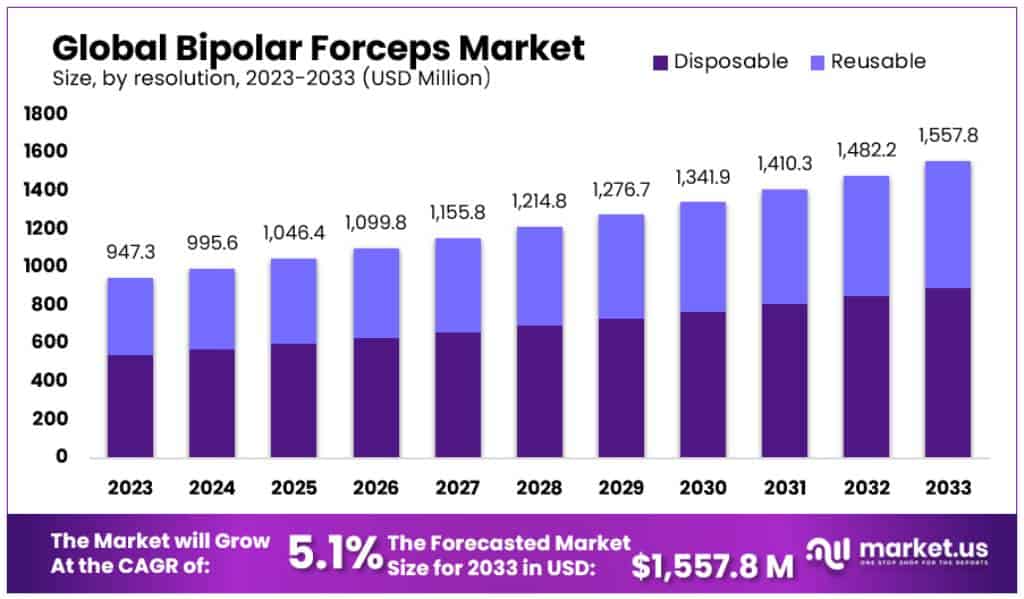
New York, NY – Jan 20, 2026 – The Global Bipolar Forceps Market size is expected to be worth around USD 1557.8 Million by 2033, from USD 947.3 Million in 2023, growing at a CAGR of 5.1% during the forecast period from 2024 to 2033.
Bipolar forceps are widely used surgical instruments designed to deliver controlled bipolar electrical energy for precise tissue coagulation. These instruments are primarily utilized in electrosurgical procedures where accuracy, safety, and reduced thermal spread are critical. The growing adoption of minimally invasive and advanced surgical techniques has supported the consistent demand for bipolar forceps across hospitals, ambulatory surgical centers, and specialty clinics.
Bipolar forceps consist of two conductive tips that function as both the active and return electrodes. Unlike monopolar instruments, the electrical current passes only through the tissue held between the tips, which allows for localized coagulation and minimizes damage to surrounding tissues. This feature makes bipolar forceps particularly suitable for neurosurgery, ophthalmology, ENT procedures, gynecology, and cardiovascular surgeries.
The effectiveness of bipolar forceps can be attributed to their ability to provide precise hemostasis, reduced risk of patient burns, and improved surgical control. Advancements in material design, insulation quality, and ergonomic handling have further enhanced their clinical performance. Disposable and reusable variants are available, offering flexibility based on procedural volume and infection control requirements.
From a market perspective, the growth of bipolar forceps is supported by increasing surgical volumes, rising prevalence of chronic diseases requiring surgical intervention, and continuous investments in healthcare infrastructure. Technological innovations focused on improving energy efficiency and surgeon comfort are expected to strengthen product adoption over the forecast period.
Key Takeaways
- The global bipolar forceps market is projected to reach USD 1,557.8 million by 2033.
- In 2023, the market size was estimated at USD 947.3 million.
- A compound annual growth rate (CAGR) of 5.1% is expected during the forecast period from 2024 to 2033.
- Disposable bipolar forceps dominate the market, accounting for over 57.3% of total revenue share.
- The general surgery application represents more than 31.2% of overall market demand.
- Hospitals remain the leading end-user segment, contributing over 39.9% of the market share.
- North America holds a leading position with a 39.5% share and a market value of USD 374.2 million in 2023.
Regional Analysis
In 2023, North America maintained its leading position in the global bipolar forceps market, accounting for a substantial 39.5% share, equivalent to USD 374.2 million. This strong market presence is supported by a well-developed healthcare system, widespread adoption of advanced surgical technologies, and the presence of major medical device manufacturers. Rising disposable incomes and a high burden of chronic diseases further contribute to market strength in the region.
The prevalence of cardiovascular and neurological disorders remains a key demand driver. According to the American Heart Association, more than 92.1 million Americans were affected by cardiovascular disease, resulting in a steady increase in surgical procedures that require reliable electrosurgical instruments such as bipolar forceps. Additionally, the Centers for Disease Control and Prevention reported that six in ten adults in the United States live with at least one chronic condition, including heart disease, cancer, or diabetes. These conditions continue to drive surgical volumes and healthcare expenditures, which reached approximately USD 4.1 trillion annually.
North America also benefits from strong research and development activity and clinical validation of bipolar technologies. Studies have demonstrated improved surgical outcomes with bipolar forceps, supporting their increased clinical adoption.
In contrast, the Asia Pacific region is expected to witness rapid market growth, driven by an expanding elderly population and rising incidence of chronic diseases in countries such as Japan, China, and India, leading to increased demand for surgical interventions.
Emerging Trends in Bipolar Forceps
- Adoption of Non-Stick Technology: The accumulation of tissue on forceps tips due to thermal effects has historically disrupted surgical workflows. To overcome this limitation, manufacturers are introducing non-stick coatings that reduce tissue adhesion, thereby improving coagulation efficiency and minimizing procedural interruptions during surgery.
- Growing Preference for Single-Use Instruments: There is an increasing shift toward single-use bipolar forceps to address concerns related to cross-contamination and sterilization costs. Disposable instruments ensure consistent sterility for each procedure, supporting infection control protocols and improving operational efficiency in high-volume surgical settings.
- Integration of Irrigation Systems: Modern bipolar forceps are being designed with integrated irrigation channels that allow simultaneous coagulation and cooling. This advancement helps maintain a clear surgical field, limits excessive heat generation, and reduces the risk of thermal injury to adjacent tissues.
- Improvements in Ergonomics and Instrument Design: Recent product innovations emphasize surgeon comfort and procedural precision. Lightweight construction, balanced weight distribution, and ergonomically designed handles are being incorporated to reduce hand fatigue and enhance control, particularly during prolonged or complex surgical procedures.
Key Use Cases of Bipolar Forceps
- Neurosurgical Applications: In neurosurgery, bipolar forceps are essential for achieving precise coagulation while protecting delicate neural structures. Their controlled energy delivery minimizes collateral damage, making them highly suitable for complex brain and spinal procedures requiring exceptional accuracy.
- Otolaryngology (ENT) Procedures: ENT surgeries often involve confined anatomical spaces where precision is critical. Bipolar forceps are widely used due to their reduced lateral thermal spread and effective hemostasis, enabling safe tissue removal and bleeding control in sensitive ear, nose, and throat procedures.
- Gynecological Surgeries: Bipolar forceps play a vital role in gynecological procedures such as hysterectomies and myomectomies. Their ability to achieve reliable hemostasis in highly vascular tissues supports efficient dissection and reduces intraoperative blood loss.
- General Surgical Procedures: In general and minimally invasive surgeries, bipolar forceps assist in tissue manipulation and bleeding control across abdominal and thoracic interventions. Their precision contributes to shorter operative times, improved surgical outcomes, and enhanced procedural safety.
Frequently Asked Questions on Bipolar Forceps
- How do bipolar forceps differ from monopolar instruments?
Bipolar forceps differ by confining electrical current between two tips of the instrument. This design enhances safety and precision, reduces unintended burns, and is especially preferred in neurosurgery and delicate microsurgical applications. - Which medical specialties commonly use bipolar forceps?
Bipolar forceps are widely used in neurosurgery, gynecology, general surgery, ENT procedures, and ophthalmology. Their precision and reduced lateral thermal spread make them suitable for surgeries involving sensitive or confined anatomical areas. - What materials are commonly used in bipolar forceps?
Bipolar forceps are typically manufactured using high-grade stainless steel, titanium, or insulated alloys. These materials ensure durability, corrosion resistance, electrical insulation, and consistent performance during repeated sterilization and surgical use. - Are bipolar forceps reusable or disposable?
Bipolar forceps are available in both reusable and disposable formats. Reusable variants are commonly used in hospitals to reduce long-term costs, while disposable forceps are preferred for infection control and single-use clinical environments. - What factors are driving the growth of the bipolar forceps market?
The growth of the bipolar forceps market is driven by rising surgical volumes, increasing adoption of minimally invasive procedures, and growing demand for precision-based electrosurgical instruments across multiple medical specialties worldwide. - Which end users contribute most to market demand?
Hospitals represent the largest end-user segment due to high surgical throughput and advanced infrastructure. Ambulatory surgical centers are also contributing steadily, supported by the shift toward outpatient and same-day surgical procedures. - How does technological advancement influence the market?
Technological advancements, including improved insulation, ergonomic designs, and compatibility with advanced electrosurgical generators, are enhancing product efficiency. These innovations support surgeon preference and contribute positively to market expansion and product differentiation. - Which regions dominate the bipolar forceps market?
North America dominates the market due to strong healthcare infrastructure, high surgical adoption rates, and early technology uptake. Europe follows closely, while Asia-Pacific is experiencing faster growth driven by expanding healthcare access.
Conclusion
In conclusion, bipolar forceps represent a critical component of modern electrosurgical practice, offering precise coagulation, enhanced safety, and reduced thermal spread across a wide range of surgical applications. Their growing use in minimally invasive and specialty procedures continues to support steady market expansion.
Advancements in non-stick technology, ergonomic design, and disposable formats have further strengthened clinical efficiency and infection control. Supported by rising surgical volumes, increasing prevalence of chronic diseases, and ongoing healthcare investments, the bipolar forceps market is expected to maintain consistent growth, with strong demand from hospitals and rapid expansion across emerging healthcare markets.
Discuss your needs with our analyst
Please share your requirements with more details so our analyst can check if they can solve your problem(s)




