


Table of Contents
Overview
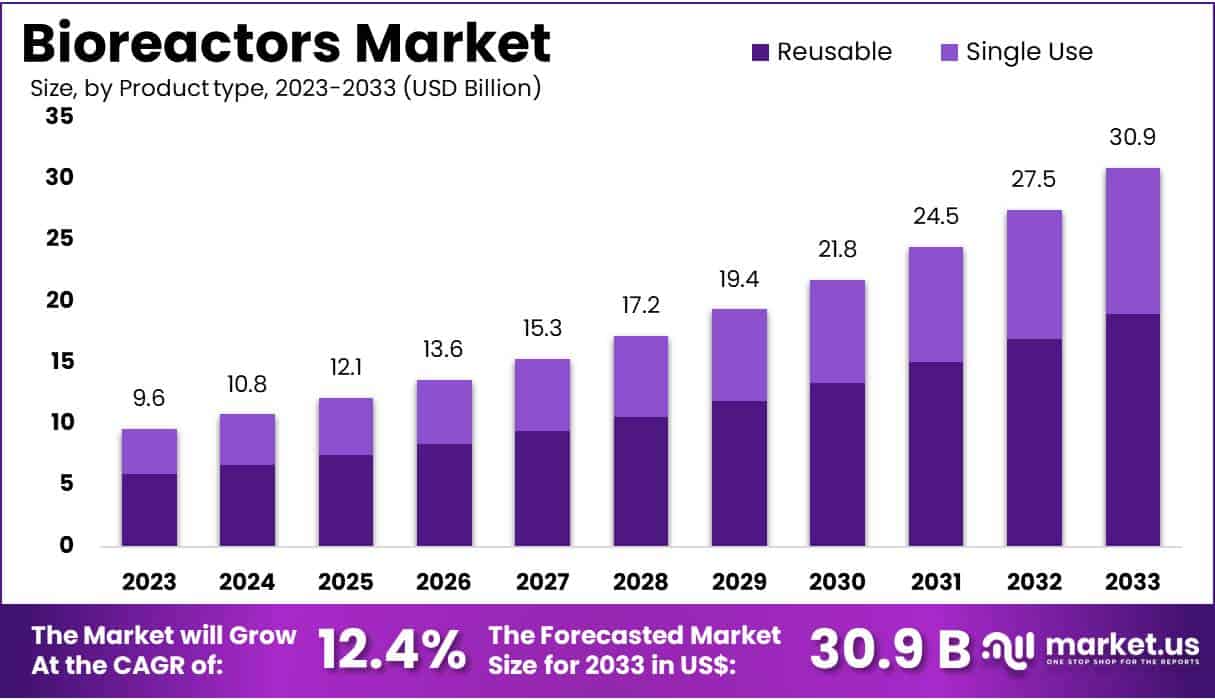
New York, NY – Feb 24, 2026 –The Global Bioreactors Market size is expected to be worth around US$ 30.9 Billion by 2033 from US$ 9.6 Billion in 2023, growing at a CAGR of 12.4% during the forecast period 2024 to 2033.
Bioreactors are specialized systems designed to support biological processes under controlled conditions, enabling the cultivation of microorganisms, plant cells, or animal cells for research and industrial applications. The basic formation of a bioreactor includes a vessel, agitation mechanism, aeration system, sensors, and control units that collectively maintain optimal temperature, pH, dissolved oxygen, and nutrient levels. These components are integrated to ensure consistent process performance and product quality.
The vessel is typically constructed from stainless steel or glass, allowing sterility and durability. Agitation is provided through mechanical stirrers or air-driven systems to ensure uniform mixing and efficient mass transfer. Aeration systems supply oxygen or other gases essential for cellular metabolism. Sensors continuously monitor critical parameters, while automated control systems adjust operating conditions in real time.
Bioreactors are widely utilized in pharmaceuticals, biotechnology, food processing, and environmental applications, supporting the production of vaccines, enzymes, biofuels, and therapeutic proteins. Their design can range from small laboratory-scale units to large industrial systems, depending on production requirements.
Advancements in bioreactor technology have enabled improved scalability, higher yields, and enhanced process efficiency. As demand for biologics and sustainable manufacturing continues to grow, the role of well-designed bioreactor systems is expected to remain central to innovation and commercial production across multiple industries.
Key Takeaways
- In 2023, the global bioreactors market recorded revenue of approximately US$ 6 billion and is projected to expand at a CAGR of 12.4%, reaching an estimated value of US$ 30.9 billion by 2033.
- By product type, the market is categorized into single-use and reusable systems, with reusable bioreactors accounting for the leading share of 61.5% in 2023.
- Based on cell type, the market is segmented into mammalian, yeast, bacterial, and other cells, with mammalian cells representing the largest portion at 47.9%.
- In terms of molecule type, the vaccines segment emerged as the leading category, contributing the highest revenue share of 42.6%.
- By usage, the market is divided into preclinical & clinical, developmental, and commercial production applications, with preclinical & clinical usage holding the dominant share of 50.3%.
- Regarding end use, segments include research and development organizations, biopharmaceutical manufacturers, and contract manufacturing organizations, with biopharmaceutical manufacturers leading at 53.1%.
- Regionally, North America accounted for the largest market share of 38.4% in 2023.
Regional Analysis
North America leads the bioreactors market, accounting for a 38.4% revenue share, supported by strong demand for biotechnological applications, increasing chronic disease burden, and growing adoption of personalized medicine. The expansion of cell and gene therapies has strengthened the need for advanced bioreactor systems.
Continuous progress in bioprocessing has improved scalability and efficiency; for example, researchers at Washington State University introduced a compact bioreactor in October 2023 capable of producing T cells at significantly faster growth rates. Robust investment in research and development has further reinforced regional market growth.
Asia Pacific is projected to register the fastest growth, driven by rising biopharmaceutical production and expanding healthcare access. Increasing investments in countries such as China and India are supporting innovation. In April 2023, Cytiva launched new X-platform bioreactors, enhancing process efficiency. Growing vaccine demand and improving infrastructure are expected to sustain regional expansion.
Emerging Trends
- Wider Use of Single-Use Bioreactors: Single-use bioreactors are gaining widespread adoption in biopharmaceutical manufacturing due to reduced cleaning requirements, lower contamination risks, faster setup times, improved operational flexibility, and enhanced resource efficiency, supporting cost control and agile production strategies.
- Rise of Continuous Bioprocessing: Continuous bioprocessing is increasingly implemented to improve production consistency, optimize equipment utilization, minimize waste generation, reduce downtime, and support higher output levels, enabling manufacturers to meet growing demand for biologics efficiently.
- Smart Bioreactors Powered by Automation and AI: Automation and artificial intelligence are being integrated into bioreactors to enable real-time monitoring, predictive maintenance, precise parameter control, improved process stability, reduced operational risks, and enhanced productivity across modern biomanufacturing environments.
- Push for Sustainable Bioreactor Technologies: Sustainability initiatives are driving development of energy-efficient bioreactors, reduced water consumption systems, eco-friendly materials, and improved resource monitoring, helping organizations lower environmental impact while maintaining operational performance and regulatory compliance.
Use Cases
- Vaccine and Antibody Production: Bioreactors are widely used for vaccine and monoclonal antibody production by supporting controlled cell growth, ensuring sterile conditions, enabling scalable manufacturing, and helping pharmaceutical companies respond effectively to global healthcare demand.
- Cell and Gene Therapy Manufacturing: Bioreactors support cell and gene therapy production by maintaining precise environmental conditions, enabling reliable cell expansion, ensuring product quality, and facilitating scalable manufacturing for advanced therapeutic applications such as personalized treatments.
- Cultivated (Lab-Grown) Meat: Bioreactors are used in cultivated meat production to replicate biological conditions for cell growth, enabling sustainable protein manufacturing, reducing environmental impact, and supporting development of alternative food solutions for future demand.
- Industrial Enzyme Production: Bioreactors enable large-scale enzyme production by supporting microbial growth under controlled conditions, improving yield efficiency, ensuring consistent product quality, and meeting demand across industries including food processing, detergents, and textiles.
Frequently Asked Questions on Bioreactors
- What is a bioreactor and how does it work?
A bioreactor is a controlled system designed to support biological processes such as cell culture or fermentation by regulating temperature, pH, oxygen, and nutrients. It enables efficient production of biologics, vaccines, enzymes, and other bioproducts at laboratory or industrial scale. - What are the main types of bioreactors used in industry?
Common bioreactor types include stirred tank, airlift, packed bed, fluidized bed, and single-use systems. Selection is based on process requirements, product type, scalability, and cost considerations, with single-use systems gaining popularity due to flexibility and reduced contamination risks. - What factors are driving growth in the bioreactors market?
Market growth is being driven by increasing demand for biologics, expansion of biopharmaceutical manufacturing, rising investments in biotechnology research, and growing adoption of single-use technologies. Supportive regulatory frameworks and advancements in process automation are also contributing to expansion. - What industries are the major end users of bioreactors?
Bioreactors are widely used across biopharmaceutical, biotechnology, food and beverage, environmental, and academic research sectors. Their application ranges from vaccine production and monoclonal antibody manufacturing to fermentation processes and wastewater treatment, supporting diverse industrial needs. - What are single-use bioreactors and why are they important?
Single-use bioreactors are disposable systems made from polymer materials that eliminate the need for cleaning and sterilization. They reduce turnaround time, lower operational costs, and enhance process flexibility, making them increasingly preferred in clinical and small-batch production environments. - How is technological innovation shaping bioreactor development?
Advancements such as automation, real-time monitoring sensors, digital twins, and improved control software are enhancing process efficiency and product consistency. Continuous bioprocessing and modular designs are enabling faster development cycles and supporting more flexible manufacturing strategies across facilities. - What is the future outlook for the global bioreactors market?
The market outlook remains positive, supported by increasing biologics pipelines, growth in cell and gene therapies, and expansion of contract manufacturing organizations. Continued innovation and rising healthcare demand are expected to sustain steady growth over the coming years.
Conclusion
The global bioreactors market is positioned for sustained expansion, supported by rising demand for biologics, vaccines, and advanced therapies. Continuous technological advancements, including automation, single-use systems, and smart monitoring, are enhancing process efficiency, scalability, and product quality.
Strong investments in biopharmaceutical manufacturing and research activities, particularly in North America and rapidly developing Asia Pacific markets, are reinforcing growth momentum. Increasing adoption across healthcare, food, and environmental sectors highlights the versatility of bioreactor systems. As innovation progresses and production requirements evolve, bioreactors are expected to remain critical infrastructure enabling efficient, scalable, and sustainable biomanufacturing worldwide.
Discuss your needs with our analyst
Please share your requirements with more details so our analyst can check if they can solve your problem(s)




