


Table of Contents
Overview
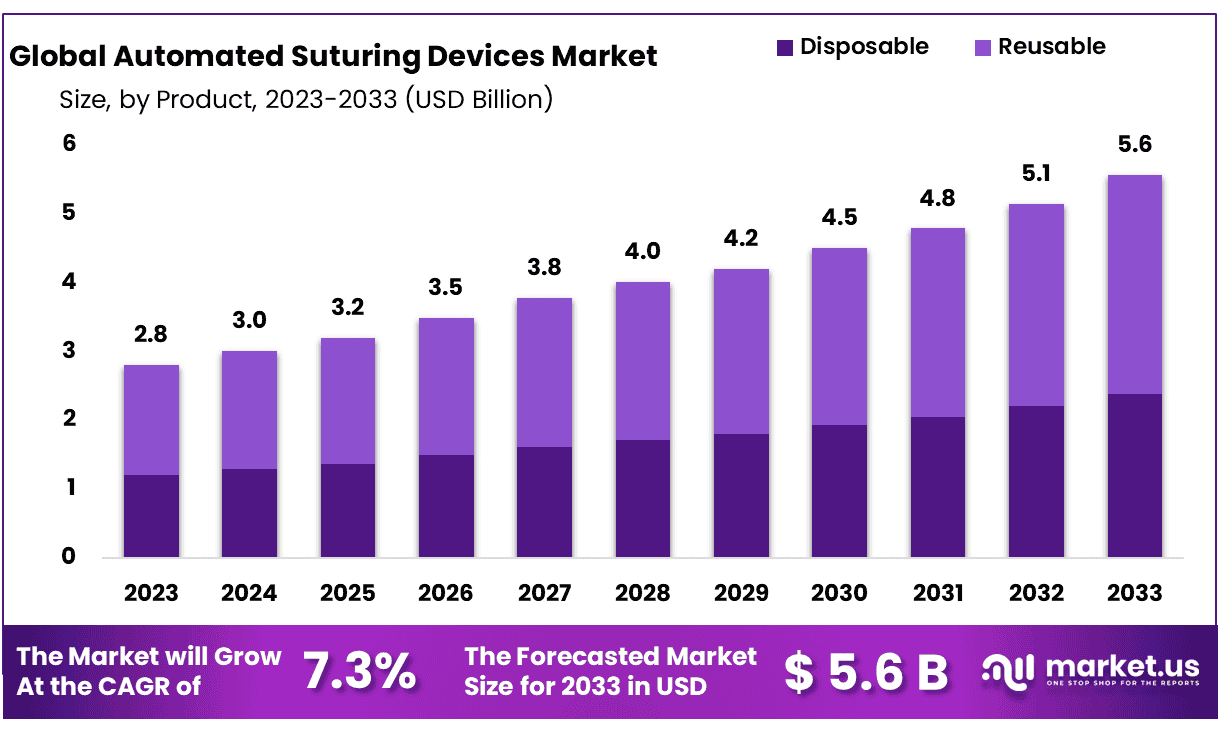
New York, NY – Jan 23, 2026 – The Global Automated Suturing Devices Market size is expected to be worth around USD 5.6 Billion by 2033 from USD 2.8 Billion in 2023, growing at a CAGR of 7.3% during the forecast period from 2024 to 2033.
The global healthcare sector is witnessing steady progress in surgical technologies, with automated suturing devices gaining increasing attention across hospitals and ambulatory surgical centers. These devices are designed to automate the suturing process, supporting surgeons in achieving consistent wound closure while reducing manual effort and procedure time.
Automated suturing devices are engineered to enhance surgical precision, minimize tissue trauma, and improve overall procedural efficiency. Their adoption is being supported by the growing volume of surgical procedures, rising demand for minimally invasive surgeries, and an increased focus on patient safety and post-operative outcomes. The integration of automation in suturing is contributing to reduced variability in surgical performance and improved reproducibility of results.
The market growth can be attributed to ongoing technological advancements, including improved device ergonomics, enhanced control mechanisms, and compatibility with a wide range of surgical applications. In addition, the increasing burden of chronic diseases and age-related conditions is leading to higher surgical intervention rates, further supporting market expansion.
Healthcare providers are increasingly recognizing the value of automated suturing devices in reducing operation time and lowering the risk of complications, which can result in shorter hospital stays and optimized resource utilization. Regulatory approvals and growing clinical evidence are also strengthening confidence in these solutions.
As healthcare systems continue to prioritize efficiency, accuracy, and patient-centric care, automated suturing devices are expected to play a critical role in shaping the future of surgical practice.
Key Takeaways
- Market Size: The automated suturing devices market is projected to reach approximately USD 5.6 billion by 2032, increasing from USD 2.8 billion in 2023.
- Market Growth: The market is expected to expand at a compound annual growth rate (CAGR) of 7.3% during the forecast period from 2024 to 2033.
- Product Analysis: Reusable automated suturing devices represented the largest share, accounting for 57.2% of total market revenue in 2023.
- Application Analysis: The cardiac surgery segment held a significant position, contributing nearly 29% of the total revenue in 2023.
- End-Use Analysis: Hospitals remained the primary end users, capturing approximately 48% of overall market revenue in 2023.
- Regional Analysis: North America led the global market in 2023 with a 36% share, generating close to USD 1.0 billion in revenue.
- Global Expansion: Market players are increasingly focusing on emerging economies with expanding healthcare infrastructure to unlock new growth opportunities.
- Sustainability: The adoption of environmentally friendly materials and sustainable manufacturing practices is gaining importance among manufacturers.
- AI Integration: The integration of artificial intelligence with robotic systems is emerging as a key trend, enhancing suturing accuracy, efficiency, and ease of use.
Regional Analysis
North America emerged as the leading market for automated suturing devices in 2023, accounting for approximately 36% of the global market share and generating nearly USD 1 billion in revenue. Market leadership is supported by a growing geriatric population and a rising number of surgical procedures. In addition, the increasing adoption of robot-assisted and minimally invasive surgeries is strengthening demand for technologically advanced automated suturing solutions across the region.
The growing incidence of road accidents is also contributing to higher demand for automated suturing devices. According to the World Health Organization, more than 20 million non-fatal injuries occur globally each year, resulting in a significant rise in wound-related surgical procedures. This trend is expected to positively influence market growth. Other injury types, including burn injuries, sports-related trauma, and accidental injuries, further support demand. Data from the American Burn Association indicate that burn injuries account for approximately 44% of hospital admissions, highlighting the need for surgical intervention in severe cases.
The Asia Pacific region is projected to register the fastest growth rate during the forecast period. Market expansion in this region is being driven by increasing disease awareness, a rising burden of chronic conditions, and improving healthcare infrastructure. Furthermore, strategic initiatives by local companies to develop and commercialize advanced treatment solutions are expected to accelerate regional market growth.
Emerging Trends
- Integration of Artificial Intelligence and Robotics: The incorporation of artificial intelligence and robotic technologies is enhancing the performance of automated suturing devices by improving precision, control, and procedural efficiency. These advancements allow devices to adapt to varying surgical conditions, supporting better clinical outcomes and reduced operation times.
- Development of Smart Sutures: Ongoing innovations in smart sutures, including designs based on soft hydraulic artificial muscles, enable self-tightening mechanisms and uniform tension distribution. Such technologies automatically adjust to wound characteristics, supporting improved healing outcomes while minimizing manual intervention by surgeons.
- Advancements in Minimally Invasive Surgery: Automated suturing devices are increasingly integrated into minimally invasive surgical procedures, where precision in confined spaces is critical. Systems such as RAM® have demonstrated safety and effectiveness in endoscopic valve surgeries, reducing technical complexity and supporting faster patient recovery.
Use Cases
- Cardiac Surgery: In cardiac procedures, including aortic and mitral valve replacements, automated suturing devices enhance suturing accuracy and help reduce operative time. Clinical evaluations indicate favorable safety profiles and consistent surgical outcomes.
- Mitral Valve Repair: Advanced automated solutions such as Mi-Stitch™ and Mi-Knot™ are being adopted for mitral valve repair. These devices streamline suturing processes, potentially lowering procedural complexity and shortening surgery duration.
- Abdominal Wall Closure: Automated suturing devices are used in abdominal surgeries to support efficient subcuticular closure. Benefits include improved wound consistency, reduced infection risk, and enhanced cosmetic results.
- Robotic-Assisted Procedures: Robotic surgical platforms, including systems like da Vinci, are integrating automated suturing functions to perform complex surgical tasks. This integration enables higher accuracy in multi-throw suturing and is reshaping modern surgical workflows.
Frequently Asked Questions on Automated Suturing Devices
- What are the key benefits of automated suturing devices?
The primary benefits include reduced operating time, improved suturing consistency, minimized tissue trauma, and lower risk of post-operative complications. These advantages contribute to faster patient recovery and optimized utilization of healthcare resources. - Which surgical applications commonly use automated suturing devices?
Automated suturing devices are widely used in cardiac, general, orthopedic, and minimally invasive surgeries. Their ability to provide precise and reliable suturing makes them suitable for complex procedures requiring high accuracy and reproducibility. - What factors are driving the growth of the automated suturing devices market?
Market growth is driven by rising surgical volumes, increasing adoption of minimally invasive and robotic-assisted surgeries, technological advancements, and a growing geriatric population that requires frequent surgical interventions. - Which end users dominate the automated suturing devices market?
Hospitals represent the largest end-user segment due to their high procedure volumes, availability of skilled surgeons, and access to advanced surgical infrastructure, supporting widespread adoption of automated suturing technologies. - Which region leads the global automated suturing devices market?
North America leads the global market, supported by advanced healthcare infrastructure, early adoption of innovative surgical technologies, high healthcare spending, and a strong presence of key medical device manufacturers. - How is artificial intelligence influencing automated suturing devices?
Artificial intelligence integration with robotic systems is enhancing device precision, control, and usability. AI-driven features support improved surgical accuracy, reduced variability, and better real-time decision-making during suturing procedures.
Conclusion
The automated suturing devices market is positioned for sustained growth, driven by rising surgical volumes, technological advancements, and increasing adoption of minimally invasive and robotic-assisted procedures. Strong demand from hospitals, particularly in cardiac and complex surgeries, continues to support market expansion.
North America remains the leading region due to advanced healthcare infrastructure, while Asia Pacific is expected to register the fastest growth owing to improving medical access and awareness. Emerging trends such as artificial intelligence integration, smart sutures, and sustainable device development are further enhancing clinical outcomes, efficiency, and long-term market potential.
Discuss your needs with our analyst
Please share your requirements with more details so our analyst can check if they can solve your problem(s)




