


Table of Contents
Overview
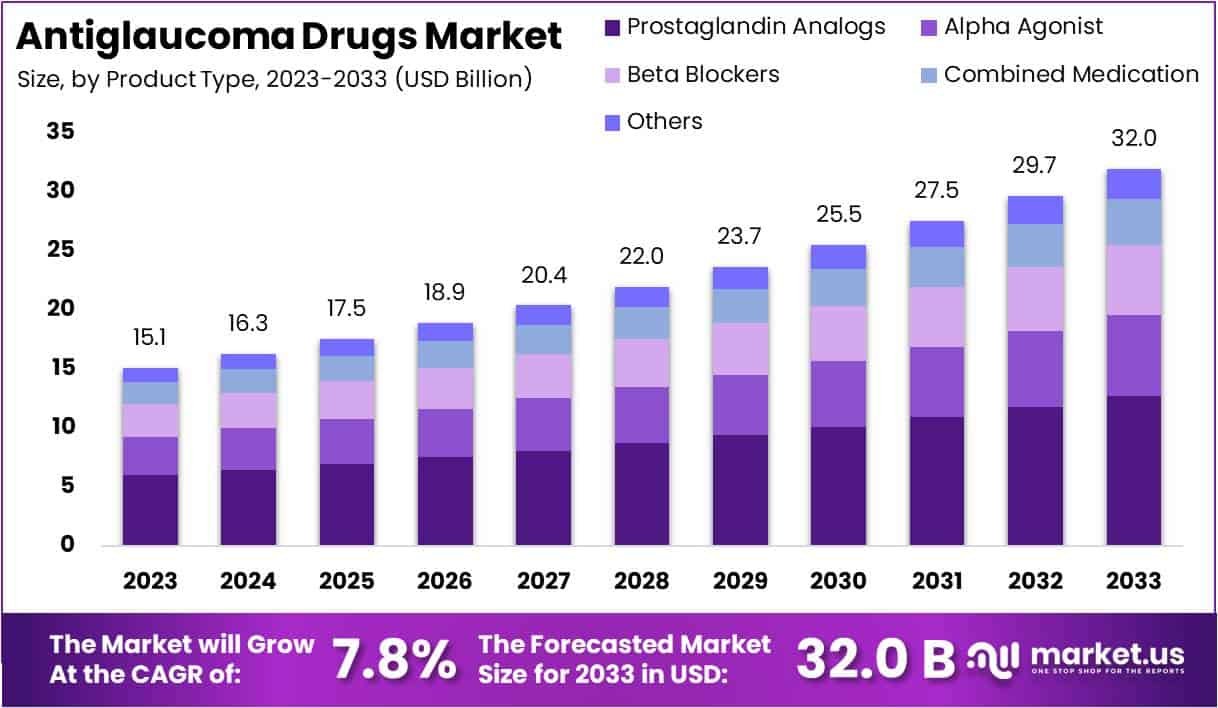
New York, NY – Feb 27, 2026 – The Global Antiglaucoma Drugs Market size is expected to be worth around US$ 32 Billion by 2033, from US$ 15.1 Billion in 2023, growing at a CAGR of 7.8% during the forecast period from 2024 to 2033.
The global market for antiglaucoma drugs has experienced significant evolution, driven by rising prevalence of glaucoma, an eye condition characterized by increased intraocular pressure that can lead to irreversible vision loss if untreated. Antiglaucoma medications remain the cornerstone of disease management, with formulations designed to reduce intraocular pressure effectively and prevent optic nerve damage.
Current antiglaucoma therapies include prostaglandin analogs, beta-blockers, carbonic anhydrase inhibitors, alpha-adrenergic agonists, and combination therapies. Prostaglandin analogs have become the first-line treatment due to their potent efficacy in lowering intraocular pressure and convenient once-daily dosing. Beta-blockers and carbonic anhydrase inhibitors offer alternative mechanisms for pressure reduction, while alpha-adrenergic agonists provide adjunctive therapy in complex cases.
Innovations in drug delivery systems, such as sustained-release implants, ocular inserts, and fixed-dose combinations, have improved patient adherence and therapeutic outcomes. Recent research focuses on neuroprotective agents and novel molecules targeting the trabecular meshwork to provide long-term control and minimize systemic side effects.
The antiglaucoma drug market is projected to maintain steady growth, underpinned by increasing awareness, aging populations, and technological advancements in ophthalmology. Stakeholders, including pharmaceutical companies, healthcare providers, and research institutions, continue to prioritize development of safer, more effective, and patient-friendly therapies to address the global burden of glaucoma.
Key Takeaways
- In 2023, the antiglaucoma drugs market generated revenue of US$ 15.1 billion, exhibiting a CAGR of 7.8%, and is projected to reach US$ 32.0 billion by 2033.
- By product type, the market is categorized into alpha agonists, prostaglandin analogs, beta blockers, combination medications, and others, with prostaglandin analogs leading at 39.6% market share in 2023.
- Based on application, the market includes open-angle glaucoma, normal-tension glaucoma, angle-closure glaucoma, congenital glaucoma, and others, with open-angle glaucoma accounting for 47.8% of the market.
- In terms of distribution channels, the market is divided into hospitals, pharmacies, and others, with hospitals holding the largest revenue share of 51.5%.
- North America led the market in 2023, capturing 40.3% of the global market share.
Regional Analysis
North America dominated the antiglaucoma drugs market in 2023, accounting for 40.3% of global revenue, driven by a high prevalence of glaucoma among aging populations and advanced treatment options. Open-angle glaucoma, the most common form, affected approximately 2.7 million Americans aged 40 and older in 2022, highlighting the urgent need for effective therapies.
Increasing awareness of early screening, availability of prostaglandin analogs and combination therapies, and innovations in sustained-release drug delivery have improved treatment adherence and patient outcomes. Government programs and expanded insurance coverage further support market growth by enhancing access to essential therapies.
Asia Pacific is projected to register the fastest CAGR during the forecast period, fueled by rising glaucoma diagnoses and an aging population. Launches such as OMLONTI (Omidenepag Isopropyl) in Japan, coupled with expanding healthcare infrastructure in China and India, growing awareness initiatives, and increased healthcare expenditure, are expected to drive accessibility and adoption of antiglaucoma treatments, positioning the region for significant growth.
Emerging Trends
- Shift Toward Sustained-Release Formulations: Development is increasingly focused on sustained-release formulations that gradually deliver medication, reducing frequent dosing requirements. These systems improve adherence, particularly among elderly patients, enhance intraocular pressure control, minimize side effects, and support long-term disease management efficiency.
- Rise of Combination Therapies: Combination therapies integrating two or more agents in a single formulation are gaining adoption. These fixed-dose options reduce dosing frequency, improve compliance, simplify treatment regimens, and provide effective intraocular pressure reduction for moderate to severe glaucoma patients.
- Focus on Personalized Treatment: Personalized treatment approaches are expanding, with therapies tailored to patient-specific factors such as genetics, age, and disease severity. Improved diagnostics enable targeted drug selection, enhancing clinical outcomes, reducing adverse effects, and optimizing glaucoma management strategies.
- Digital Tools Supporting Treatment: Digital health solutions, including reminder applications and smart monitoring devices, are supporting medication adherence. These technologies track dosing patterns, facilitate physician oversight, reduce missed applications, and strengthen long-term treatment outcomes in glaucoma care.
Use Cases
- Managing Open-Angle Glaucoma in Elderly Patients: Antiglaucoma drugs remain first-line therapy for open-angle glaucoma, particularly in elderly populations. Regular administration reduces intraocular pressure, slows optic nerve damage, and preserves vision, playing a critical role in maintaining long-term visual function.
- Preventing Blindness in High-Risk Groups: High-risk individuals, including patients with diabetes or family history, benefit from early antiglaucoma therapy. Timely treatment lowers intraocular pressure, slows disease progression, and significantly reduces the probability of irreversible vision impairment.
- Post-Surgery Eye Pressure Control: Following glaucoma surgery, adjunctive drug therapy is often required to maintain optimal intraocular pressure. Continued medication use supports surgical outcomes, prevents further optic nerve damage, and enhances long-term visual stability.
- Treating Ocular Hypertension: In ocular hypertension cases, antiglaucoma drugs are prescribed to lower elevated intraocular pressure. Early intervention reduces the likelihood of progression to glaucoma, protects optic nerve integrity, and supports preventive eye care strategies.
Frequently Asked Questions on Antiglaucoma Drugs
- How do antiglaucoma drugs work?
These drugs reduce intraocular pressure either by increasing the outflow of aqueous humor or decreasing its production. Different classes work through distinct mechanisms, providing tailored treatment options for open-angle, angle-closure, or other forms of glaucoma. - What are the common types of antiglaucoma drugs?
Common types include prostaglandin analogs, beta-blockers, alpha agonists, carbonic anhydrase inhibitors, and combination medications. Prostaglandin analogs are widely preferred due to their potent efficacy and convenient once-daily dosing for sustained intraocular pressure control. - Are there side effects of antiglaucoma drugs?
Side effects vary by drug class. Prostaglandin analogs may cause eye redness or eyelash growth, while beta-blockers can affect heart rate. Alpha agonists may cause dry mouth or fatigue. Monitoring by an ophthalmologist is recommended for safety. - Can antiglaucoma drugs prevent vision loss completely?
While these drugs effectively slow glaucoma progression and reduce intraocular pressure, they cannot fully reverse existing optic nerve damage. Early diagnosis, consistent treatment, and regular monitoring are crucial to preserving vision long-term. - Which regions dominate the market?
North America leads the market due to high glaucoma prevalence, advanced treatment options, and awareness programs, while Asia Pacific is projected to grow at the fastest CAGR, driven by aging populations, rising diagnoses, and expanding healthcare infrastructure. - What are the key market segments?
The market is segmented by product type, application, and distribution channel. Prostaglandin analogs dominate the product type segment, open-angle glaucoma is the largest application, and hospitals account for the highest revenue share among distribution channels.
Conclusion
The antiglaucoma drugs market is positioned for sustained expansion, supported by rising disease prevalence, demographic aging, and continuous therapeutic innovation. With revenue projected to reach US$ 32.0 billion by 2033, growth is being driven by strong demand for effective intraocular pressure management across major regions.
Prostaglandin analogs remain the leading product segment, while open-angle glaucoma represents the primary application area.
North America maintains market leadership, and Asia Pacific is expected to witness the fastest growth. Advancements in sustained-release formulations, combination therapies, personalized treatment approaches, and digital adherence tools are collectively strengthening long-term market potential.
Discuss your needs with our analyst
Please share your requirements with more details so our analyst can check if they can solve your problem(s)




