


Table of Contents
Overview
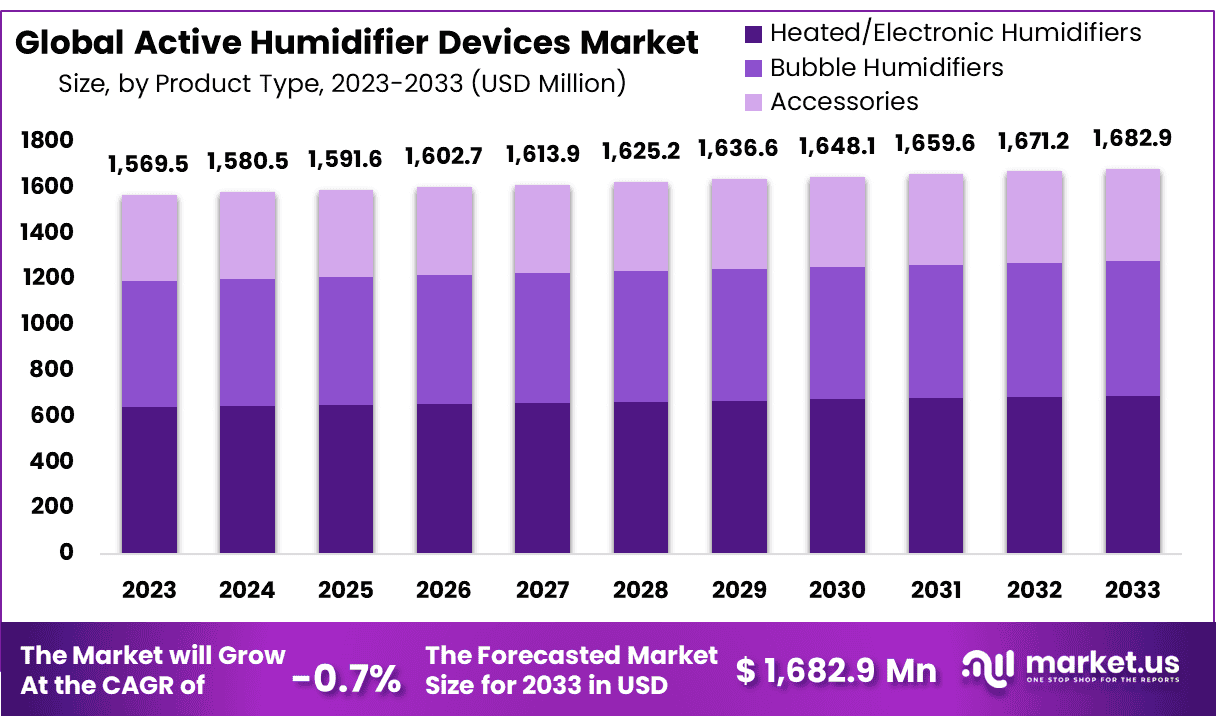
New York, NY – Jan 28, 2026 – Global Active Humidifier Market size is expected to be worth around USD 1682.9 Million by 2033 from USD 1569.5 Million in 2023, growing at a CAGR of -0.7% during the forecast period from 2024 to 2033.
The active humidifier has been developed as an advanced air treatment device designed to regulate indoor humidity levels with precision and consistency. Its basic formation integrates mechanical, electronic, and fluid-handling components to ensure controlled moisture dispersion across residential, commercial, and healthcare environments.
At the core of the active humidifier is a water reservoir, which stores and supplies water for humidification. This reservoir is connected to an active evaporation or atomization system, typically supported by ultrasonic vibration, heating elements, or high-pressure nozzles. The selected mechanism enables water to be converted into fine mist or vapor, allowing for rapid and uniform humidity distribution.
A key component of the active humidifier formation is the integrated sensor system. Humidity and temperature sensors continuously monitor ambient conditions, enabling real-time adjustments. These sensors are linked to a control unit that automatically regulates output levels based on predefined settings or environmental requirements. As a result, stable indoor humidity can be maintained without manual intervention.
The formation also includes a fan or air circulation module, which facilitates the efficient dispersion of humidified air throughout the space. Safety features, such as automatic shut-off, low-water indicators, and overheating protection, are incorporated to ensure reliable operation and extended product lifespan.
Overall, the active humidifier’s structured formation supports energy efficiency, operational accuracy, and user convenience. Its design reflects growing demand for smart indoor air quality solutions, driven by increased awareness of health, comfort, and environmental control in modern living and working spaces.
Key Takeaways
- Market Size: The active humidifier market is projected to reach approximately USD 1,682.9 million by 2033, increasing from USD 1,569.5 million in 2023.
- Market Growth: The market is anticipated to register a negative compound annual growth rate (CAGR) of 0.7% during the forecast period from 2024 to 2033.
- Product Analysis: Heated/electronic humidifiers are expected to remain the leading product category, accounting for nearly 41% of the overall market share.
- Age Group Analysis: The adult population represents the largest consumer segment, contributing approximately 45% of total market demand.
- Application Analysis: Invasive ventilation is identified as the dominant application segment, holding an estimated 36% share of the market.
- End-Use Analysis: Hospitals continue to be the primary end users, capturing around 43% of the total market share.
- Regional Analysis: North America maintains its leading position globally, generating approximately 45% of total market revenue.
Regional Analysis
In 2023, North America emerged as the leading region in the active humidifier market, accounting for approximately 45% of total revenue. This leadership is largely driven by the region’s well-established healthcare infrastructure and strong awareness of indoor air quality management.
Europe also represents a significant market, with active humidifier devices demonstrating widespread adoption, supported by the growing integration of advanced healthcare technologies across clinical settings.
In contrast, the Asia–Pacific region is witnessing rapid market adoption, fueled by expanding healthcare infrastructure, rising disposable incomes, and increasing awareness of the importance of maintaining optimal indoor air quality.
Emerging Trends
- Integration of Smart Technology: Active humidifiers are increasingly equipped with smart features that enable remote monitoring and control through mobile applications. This development improves user convenience and aligns with the broader adoption of smart home and connected device ecosystems.
- Adoption of Ultrasonic and Evaporative Technologies: Manufacturers are shifting toward ultrasonic and evaporative humidification technologies to enhance performance efficiency. Ultrasonic systems support low-noise, energy-efficient operation, while evaporative technologies ensure consistent and uniform moisture distribution.
- Focus on Energy Efficiency and Sustainable Materials: Product design is increasingly centered on reduced energy consumption and the use of eco-friendly materials. This trend reflects rising consumer demand for sustainable appliances that minimize environmental impact while maintaining operational effectiveness.
Use Cases
- Healthcare Facilities: Active humidifiers are essential in healthcare environments to maintain optimal humidity for patient comfort and clinical effectiveness. Controlled temperature and humidity conditions support respiratory care and overall indoor air quality management.
- Residential Environments: In homes, active humidifiers help maintain indoor humidity levels within the recommended range of 40% to 60%, reducing dryness-related discomfort and supporting respiratory wellness across varying climatic conditions.
- Data Centers: Data centers rely on active humidifiers to regulate relative humidity levels and prevent electrostatic discharge. These systems also contribute to efficient evaporative cooling, supporting equipment protection and operational continuity.
- Museums and Art Galleries: Precise humidity and temperature control is critical for preserving artworks and historical artifacts. Active humidifiers enable stable indoor climates, reducing deterioration risks and safeguarding cultural and artistic assets.
- Agricultural Applications: In greenhouse and controlled farming environments, active humidifiers support optimal humidity conditions that promote plant growth, improve crop quality, and enhance overall agricultural productivity.
Frequently Asked Questions on Active Humidifier
- What is an active humidifier and how does it function?
An active humidifier is a medical or indoor air device that actively adds moisture to air using powered mechanisms such as heating or ultrasonic systems, ensuring controlled humidity delivery to support respiratory comfort and equipment performance. - What are the key benefits of using active humidifiers?
Active humidifiers help maintain optimal humidity levels, reduce airway dryness, improve patient comfort during ventilation, and protect sensitive equipment. Their automated control systems enable precise humidity regulation across healthcare and controlled indoor environments. - What factors are driving the growth of the active humidifier market?
Market growth is influenced by rising respiratory disorders, increased use of ventilation systems, expanding hospital infrastructure, and growing awareness of indoor air quality, particularly in clinical and critical care environments worldwide. - Which product type dominates the active humidifier market?
Heated or electronic humidifiers dominate the market due to their efficiency, precise humidity control, and widespread use in hospitals and invasive ventilation settings, making them the preferred choice across advanced healthcare facilities. - What are the major application areas for active humidifiers?
Active humidifiers are primarily used in invasive ventilation, non-invasive ventilation, and respiratory therapy. Their role is critical in preventing airway dehydration and enhancing patient safety during prolonged respiratory support. - Which region leads the active humidifier market and why?
North America leads the active humidifier market due to its advanced healthcare infrastructure, high adoption of medical technologies, strong regulatory standards, and increased focus on patient care quality and indoor air management.
Conclusion
The active humidifier market demonstrates stable performance supported by its critical role in healthcare, residential, and industrial environments. Advanced product formation, smart technology integration, and efficient humidification methods continue to enhance functionality and user convenience.
Despite modest negative growth, demand remains sustained by hospital usage, invasive ventilation applications, and adult patient populations. North America maintains market leadership due to strong healthcare infrastructure, while Asia–Pacific shows notable adoption momentum.
Emerging trends focused on energy efficiency and sustainability further strengthen long-term relevance. Overall, active humidifiers remain essential solutions for maintaining optimal indoor air quality and operational reliability.
Discuss your needs with our analyst
Please share your requirements with more details so our analyst can check if they can solve your problem(s)




