


Table of Contents
Overview
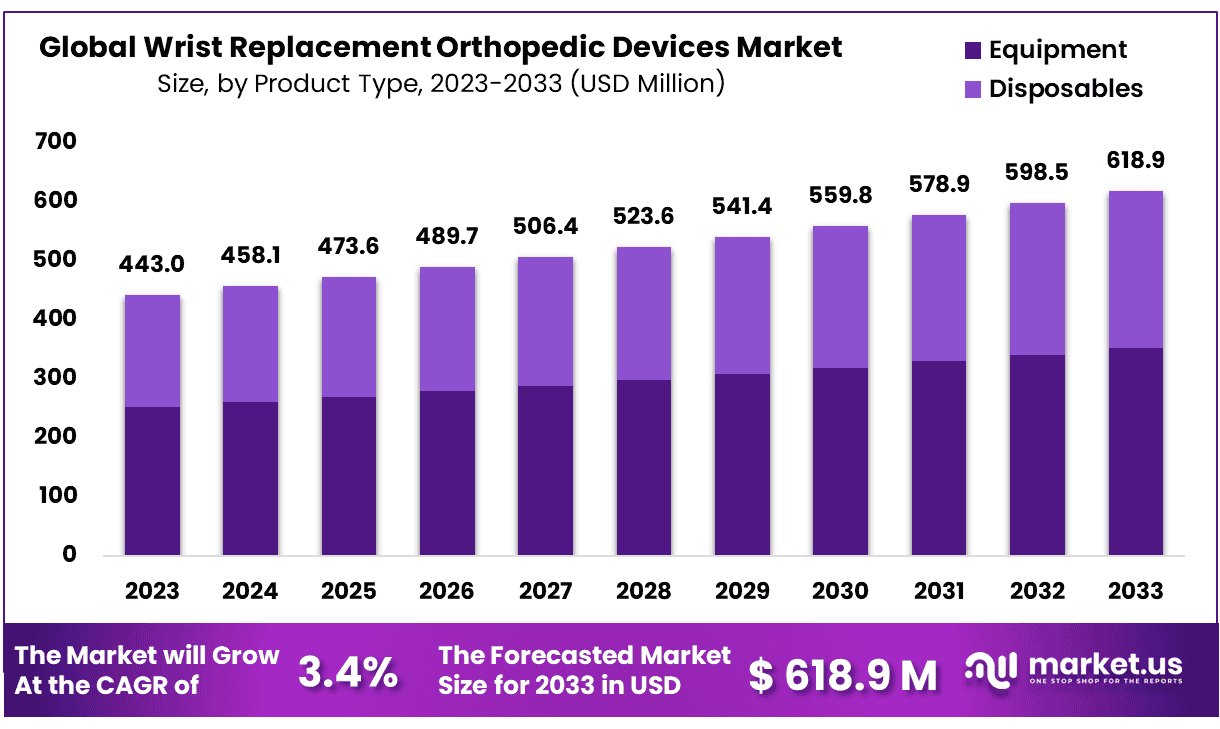
New York, NY – Jan 27, 2026 – The Global Wrist Replacement Orthopedic Devices Market size is expected to be worth around USD 618.9 Million by 2033 from USD 443.0 Million in 2023, growing at a CAGR of 3.4% during the forecast period from 2024 to 2033.
The global wrist replacement orthopedic devices segment is witnessing gradual development, supported by rising prevalence of wrist arthritis, traumatic injuries, and degenerative joint conditions. Wrist replacement devices, also known as total wrist arthroplasty systems, are designed to restore joint function, relieve chronic pain, and improve mobility in patients where conservative treatment options are no longer effective.
The formation of wrist replacement orthopedic devices typically involves advanced biocompatible materials such as titanium alloys, cobalt-chromium, and high-grade polyethylene. These materials are selected to ensure durability, corrosion resistance, and compatibility with human bone and soft tissue. Modern device designs emphasize anatomical accuracy, improved load distribution, and enhanced range of motion to closely replicate natural wrist movement.
Market growth is supported by increasing adoption of minimally invasive surgical techniques, improvements in implant design, and growing awareness among orthopedic surgeons and patients regarding motion-preserving alternatives to wrist fusion. Technological advancements such as modular implant systems and surface-coated components are being incorporated to improve fixation and long-term clinical outcomes.
From a regional perspective, developed healthcare systems are contributing significantly due to higher procedure volumes and access to advanced orthopedic care. Meanwhile, emerging markets are expected to present future opportunities as healthcare infrastructure improves and demand for joint replacement procedures rises.
Overall, the wrist replacement orthopedic devices market is positioned for measured growth. Continued investment in research and development, along with a focus on clinical performance and patient outcomes, is expected to shape the competitive landscape over the coming years.
Key Takeaways
- Market Size: The wrist replacement orthopedic devices market is projected to reach approximately USD 618.9 million by 2033, increasing from USD 443.0 million in 2023.
- Market Growth: Market expansion is anticipated at a compound annual growth rate (CAGR) of 3.4% over the forecast period spanning 2024 to 2033.
- Product Type Analysis: The equipment segment continues to lead the market, accounting for nearly 57% of the total market share, driven by higher adoption of implant systems.
- End-User Analysis: Hospitals and clinics represent the dominant end-user segment, capturing approximately 39% of overall market demand due to higher surgical volumes.
- Regional Analysis: North America maintains a strong market position, holding around 34% market share and generating nearly USD 150 million in revenue in 2023.
- Technological Advancements: Continuous advancements in orthopedic technologies have resulted in the introduction of more durable and efficient wrist replacement devices, supporting improved clinical outcomes and lowering revision rates.
- Increasing Demand: Rising prevalence of arthritis, fractures, and degenerative wrist conditions is contributing to growing demand for wrist replacement devices, a trend expected to sustain market growth over the forecast period.
Regional Analysis
North America continues to maintain a leading position in the wrist replacement orthopedic devices market, accounting for approximately 34% of the total market share and generating nearly USD 150 million in revenue. This dominance is supported by a well-developed healthcare infrastructure, the strong presence of established market players, favorable reimbursement frameworks, and ongoing advancements in minimally invasive surgical technologies. Consistent investments in innovation and clinical research further strengthen the region’s market position.
In contrast, the Asia-Pacific region is expected to register notable growth over the forecast period. Market expansion in this region is being driven by the increasing adoption of direct-to-consumer marketing approaches, a rapidly growing elderly population, and a rising number of road traffic accidents leading to wrist injuries. Additionally, improving healthcare access and growing awareness of advanced orthopedic treatment options are contributing to increased demand, positioning Asia-Pacific as a significant emerging market for wrist replacement orthopedic devices.
Emerging Trends
- Advancements in Implant Design and Materials: Recent innovations have resulted in the development of fourth-generation wrist prostheses, including the ReMotion and Maestro systems. These implants employ biologic fixation techniques, removing the need for bone cement and improving short- to mid-term clinical outcomes compared to earlier designs. Despite these improvements, long-term issues such as loosening of the carpal component continue to present challenges.
- Adoption of 3D Printing Technology: Three-dimensional (3D) printing is increasingly being utilized to manufacture patient-specific implants and surgical guides. This approach enables precise anatomical customization, improving implant fit and functional performance. The technology has demonstrated particular value in managing complex wrist conditions, such as Kienböck’s disease.
- Integration of Smart Implants and Wearable Technologies: The integration of sensor-enabled smart implants allows real-time monitoring of joint mechanics and postoperative healing. In parallel, wearable rehabilitation devices support continuous tracking of patient recovery, enabling personalized rehabilitation protocols and earlier identification of potential complications.
- Expansion of Robotic-Assisted Surgical Techniques: Robotic-assisted systems are gaining adoption in wrist replacement procedures to enhance surgical precision. These technologies support accurate implant placement and execution of complex surgical steps, which may contribute to shorter recovery periods and improved implant durability.
Key Use Cases
- Treatment of Rheumatoid Arthritis: Total wrist arthroplasty (TWA) is widely used in patients with advanced rheumatoid arthritis to reduce pain and restore functional motion. Clinical studies indicate that more than 80% of patients experience meaningful pain relief and improved wrist mobility following the procedure.
- Management of Post-Traumatic Arthritis: Wrist replacement is increasingly considered for patients with post-traumatic arthritis resulting from prior injuries. TWA provides an alternative to wrist fusion, preserving joint movement and enhancing overall quality of life.
- Management of Osteoarthritis in Low-Demand Patients: In carefully selected cases, particularly among low-demand patients, wrist arthroplasty may be used to manage osteoarthritis by alleviating pain while maintaining partial joint mobility. However, due to relatively higher failure rates, strict patient selection criteria remain essential.
- Reconstruction After Complex Wrist Fractures: For complex wrist fractures that are unsuitable for internal fixation, wrist replacement represents a viable reconstructive option. This approach is especially relevant for elderly patients with osteoporotic bone, where functional restoration is prioritized over joint fusion.
Frequently Asked Questions on Wrist Replacement Orthopedic Devices
- Which conditions commonly require wrist replacement surgery?
Wrist replacement procedures are commonly indicated for patients with rheumatoid arthritis, post-traumatic arthritis, osteoarthritis, or severe joint degeneration where pain, stiffness, and functional limitations significantly affect daily activities. - What materials are used in wrist replacement devices?
Wrist replacement devices are typically manufactured using biocompatible materials such as cobalt-chromium alloys, titanium, and polyethylene, which are selected to ensure durability, wear resistance, and long-term compatibility with human bone tissue. - How long do wrist replacement implants typically last?
The lifespan of wrist replacement implants generally ranges between 10 and 15 years, depending on patient activity level, implant design, surgical technique, and adherence to postoperative rehabilitation protocols. - What factors are driving growth in the wrist replacement orthopedic devices market?
Market growth is driven by rising arthritis prevalence, an aging global population, increasing awareness of joint preservation surgeries, and continuous advancements in implant design and biomaterials improving clinical outcomes. - How does technological advancement impact the market?
Technological advancements, including anatomically contoured implants and improved fixation techniques, have enhanced surgical precision and implant longevity, thereby increasing surgeon adoption rates and supporting steady expansion of the wrist replacement devices market. - Which end users primarily contribute to market demand?
Hospitals, orthopedic specialty clinics, and ambulatory surgical centers represent the primary end users, with hospitals accounting for the largest share due to higher procedure volumes and access to advanced surgical infrastructure. - What regional trends are observed in the wrist replacement devices market?
North America and Europe dominate the market due to advanced healthcare systems and higher diagnosis rates, while Asia-Pacific is expected to witness faster growth driven by improving healthcare access and increasing orthopedic surgical volumes.
Conclusion
The global wrist replacement orthopedic devices market is experiencing steady and measured growth, driven by rising incidences of arthritis, traumatic injuries, and degenerative wrist disorders. Advancements in implant materials, anatomical design, and minimally invasive surgical techniques have improved clinical outcomes and expanded surgeon adoption.
While North America continues to dominate due to advanced healthcare infrastructure and higher procedure volumes, Asia-Pacific is emerging as a key growth region supported by demographic shifts and improving access to care. Overall, sustained research and development, combined with increasing awareness of motion-preserving solutions, are expected to support long-term market expansion.
Discuss your needs with our analyst
Please share your requirements with more details so our analyst can check if they can solve your problem(s)




