


Table of Contents
Overview
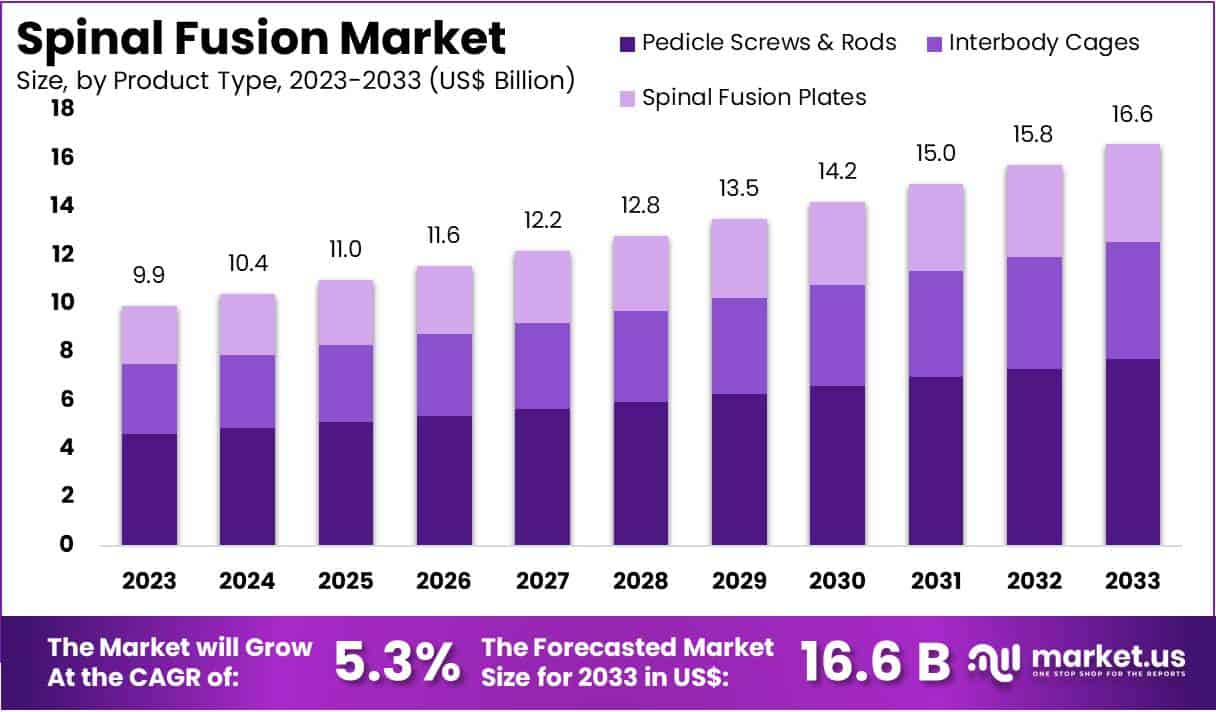
New York, NY – Feb 27, 2026 – The Global Spinal Fusion Market size is expected to be worth around US$ 16.6 Billion by 2033 from US$ 9.9 Billion in 2023, growing at a CAGR of 5.3% during the forecast period 2024 to 2033.
Spinal fusion is a surgical procedure performed to permanently connect two or more vertebrae in the spine, eliminating motion between them. The procedure is commonly recommended for conditions such as degenerative disc disease, spinal instability, scoliosis, fractures, and certain cases of herniated discs. By stabilizing the affected spinal segment, pain reduction and functional improvement can be achieved.
During spinal fusion, bone graft material is placed between the affected vertebrae to stimulate bone growth. Over time, the graft facilitates the formation of a single solid bone structure. The graft material may be obtained from the patient (autograft), a donor (allograft), or synthetic substitutes. In many cases, metal implants such as rods, screws, or plates are used to provide immediate stability and support proper alignment while fusion occurs.
Technological advancements have contributed to improved surgical outcomes. Minimally invasive techniques are increasingly being adopted, resulting in reduced blood loss, shorter hospital stays, and faster recovery timelines. The integration of advanced imaging systems and biologic materials has further enhanced procedural precision and fusion success rates.
Spinal fusion is typically considered after conservative treatment options, including physical therapy and medication, have not provided sufficient relief. Recovery duration varies depending on patient health status and the extent of surgery performed.
Overall, spinal fusion remains a widely performed procedure, offering long-term structural stability and improved quality of life for appropriately selected patients.
Key Takeaways
- In 2023, the spinal fusion market generated revenue of USD 9.9 billion and is projected to reach USD 16.6 billion by 2033, expanding at a CAGR of 5.3% during the forecast period.
- By product type, the market is segmented into interbody cages, spinal fusion plates, and pedicle screws & rods. The pedicle screws & rods segment dominated in 2023, accounting for a revenue share of 46.5%.
- Based on procedure, the market is categorized into posterolateral fusion and interbody fusion. Among these, interbody fusion held the leading position with a share of 57.8%.
- In terms of end users, hospitals represented the largest revenue-contributing segment, capturing 50.6% of the total market share in 2023.
- Regionally, North America emerged as the leading market, securing a revenue share of 39.7% in 2023.
Regional Analysis
North America accounted for the largest share of the spinal fusion market, representing 39.7% of total revenue. Market dominance has been supported by continuous advancements in surgical techniques and the rising prevalence of spinal disorders, including scoliosis and degenerative disc disease.
Increasing preference for minimally invasive procedures has further strengthened regional growth, as these approaches are associated with reduced hospital stays and lower post-operative complications. Clinical research presented at the Scoliosis Research Society 57th Annual Meeting highlighted improved recovery outcomes in pediatric spinal fusion patients, reinforcing innovation-driven adoption. Additionally, a growing geriatric population and favorable reimbursement frameworks have supported sustained demand.
Asia Pacific is projected to register the fastest compound annual growth rate during the forecast period. Rapid population aging, particularly in Japan, alongside increasing incidences of spinal deformities and osteoporosis, is expected to accelerate procedure volumes. Expanding healthcare infrastructure in emerging economies and supportive government initiatives are anticipated to further enhance regional market penetration.
Emerging Trends
- Shift Toward Minimally Invasive Surgery (MIS): Spinal fusion procedures are increasingly performed using minimally invasive techniques that involve smaller incisions, limited tissue disruption, reduced infection risk, faster recovery, shorter hospital stays, improved precision, and enhanced patient satisfaction across advanced healthcare facilities worldwide.
- Rise of 3D-Printed Implants: The adoption of 3D-printed spinal implants is expanding, enabling patient-specific designs that improve anatomical fit, accelerate bone fusion, enhance implant stability, reduce rejection risk, and support personalized surgical solutions across modern orthopedic practices.
- Use of Biologics and Bone Graft Substitutes: Biologics and synthetic bone graft substitutes are increasingly utilized in spinal fusion to stimulate bone growth, reduce donor site complications, shorten surgical time, improve fusion success rates, and enhance post-operative recovery outcomes.
- Smart Implants and Sensor-Based Devices: Smart spinal implants integrated with sensor technology are emerging, enabling real-time intraoperative guidance and post-surgical healing monitoring, improving complication management, enhancing data-driven decision-making, and strengthening overall surgical safety and clinical outcomes.
- Expansion of Outpatient Spinal Fusion Procedures: Outpatient spinal fusion procedures are gaining traction due to improved surgical techniques, advanced pain management, reduced hospitalization costs, same-day discharge benefits, optimized patient flow, and growing adoption across developed healthcare systems.
Use Cases
- Treatment of Degenerative Disc Disease: Spinal fusion is widely performed to manage degenerative disc disease by stabilizing affected vertebrae, reducing chronic lower back pain, improving mobility, and enhancing quality of life when conservative treatments fail.
- Correction of Spinal Deformities Like Scoliosis: Spinal fusion is commonly used to correct scoliosis by straightening abnormal spinal curvature, preventing progression, improving posture, restoring balance, and supporting long-term musculoskeletal and cardiopulmonary health outcomes.
- Injury-Related Spinal Repairs: Spinal fusion is applied in trauma cases involving fractures or instability to realign vertebrae, protect neural structures, prevent further damage, restore structural integrity, and support rehabilitation and functional recovery.
- Spinal Fusion After Tumor Removal: Following spinal tumor resection, fusion procedures are performed to stabilize weakened vertebrae, prevent spinal collapse, safeguard neurological function, and maintain structural support during ongoing oncological recovery.
- Arthritis-Driven Spinal Instability in the Elderly: In elderly patients with advanced spinal arthritis, fusion surgery stabilizes degenerated joints, alleviates persistent pain, enhances mobility, reduces fall risk, and improves overall functional independence when conservative therapies prove insufficient.
Frequently Asked Questions on Spinal Fusion
- Why is spinal fusion performed?
Spinal fusion is performed to treat conditions such as degenerative disc disease, spinal stenosis, scoliosis, fractures, and spondylolisthesis. Pain relief and spinal stabilization are achieved by preventing abnormal movement between affected vertebrae. - How is spinal fusion surgery carried out?
Spinal fusion surgery involves the placement of bone grafts, implants, screws, or rods between vertebrae to facilitate bone healing. Over time, the graft material promotes bone growth, leading to the permanent fusion of targeted spinal segments. - What materials are used in spinal fusion procedures?
Bone grafts used in spinal fusion may be autografts, allografts, or synthetic substitutes. Medical devices such as titanium screws, rods, cages, and plates are commonly utilized to provide structural support and enhance fusion rates. - What is the recovery time after spinal fusion?
Recovery following spinal fusion varies depending on patient health, age, and surgical complexity. Initial healing may occur within weeks, while complete bone fusion can take several months. Physical therapy is often recommended to restore mobility and strength. - What are the potential risks of spinal fusion?
Potential risks include infection, nerve damage, blood loss, implant failure, and incomplete fusion. However, advancements in surgical techniques and minimally invasive approaches have improved safety profiles and reduced complication rates significantly. - Which regions dominate the spinal fusion market?
North America holds a significant market share due to advanced healthcare infrastructure and high procedure adoption rates. Europe follows closely, while Asia-Pacific is experiencing accelerated growth driven by healthcare investments and expanding patient populations. - What technologies are influencing the spinal fusion market?
Technological advancements such as robotic-assisted surgery, 3D-printed implants, biologics innovation, and navigation systems are transforming procedural accuracy and outcomes. These innovations are enhancing surgeon efficiency and improving patient recovery profiles globally.
Conclusion
Spinal fusion remains a critical surgical intervention for managing spinal instability, degenerative disorders, deformities, trauma, and tumor-related complications. Consistent technological advancements, including minimally invasive approaches, biologics, smart implants, and 3D-printed devices, have strengthened clinical outcomes and recovery efficiency.
The global spinal fusion market demonstrates stable growth, supported by rising geriatric populations, increasing procedure volumes, and expanding healthcare infrastructure. North America maintains leadership, while Asia Pacific shows accelerated expansion potential.
With continuous innovation and improving reimbursement frameworks, sustained market development is anticipated, reinforcing spinal fusion as a cornerstone procedure in modern orthopedic and neurosurgical practice.
Discuss your needs with our analyst
Please share your requirements with more details so our analyst can check if they can solve your problem(s)




