


Table of Contents
Overview
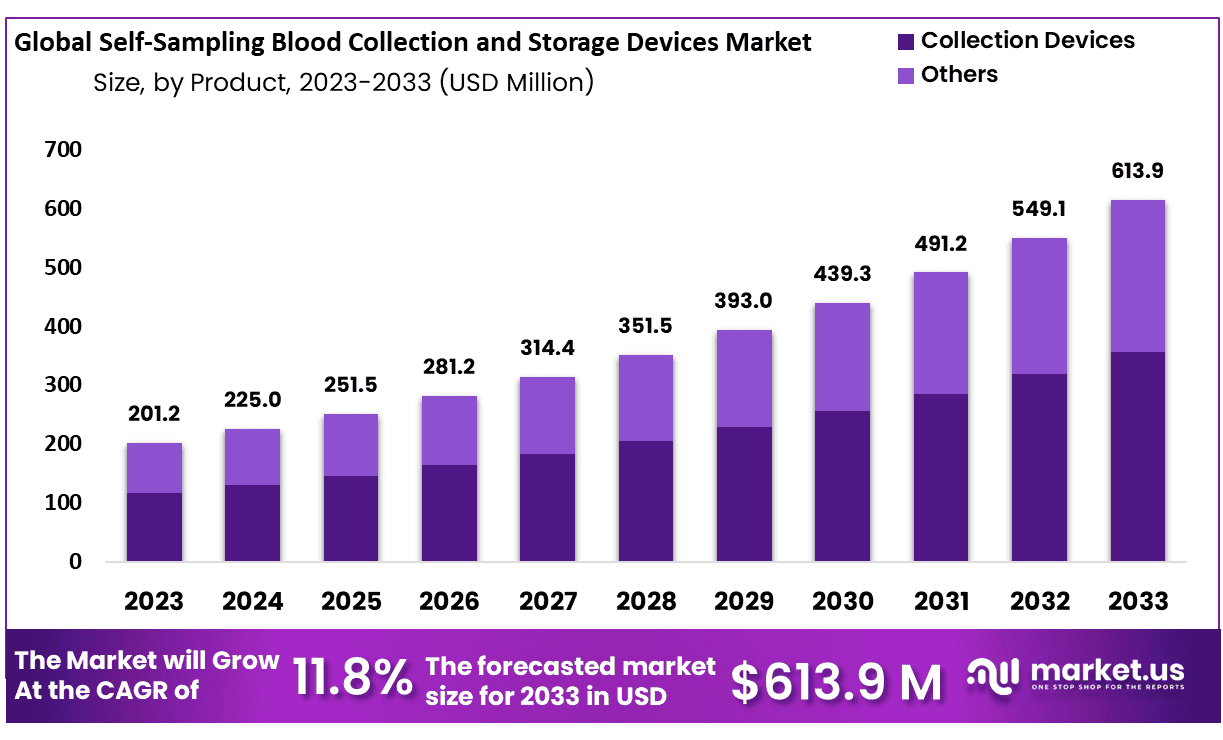
New York, NY – Jan 22, 2026 – The Global Self-Sampling Blood Collection and Storage Devices Market size is expected to be worth around USD 613.9 Million by 2033 from USD 201.2 Million in 2023, growing at a CAGR of 11.8% during the forecast period from 2024 to 2033.
The global healthcare sector is witnessing increasing adoption of self-sampling blood collection and storage devices, driven by the growing demand for patient-centric, decentralized, and cost-efficient diagnostic solutions. These devices are designed to enable individuals to safely collect small volumes of blood at home or in non-clinical settings, which can then be stored and transported for laboratory analysis.
Self-sampling blood collection and storage devices typically include lancets, capillary tubes, dried blood spot (DBS) cards, volumetric absorptive microsampling (VAMS) systems, and secure storage containers. The basic formation of these devices focuses on ease of use, sample integrity, and contamination prevention. Materials are selected to ensure chemical stability of blood samples over extended periods, often without the need for cold-chain logistics. This feature significantly reduces transportation and storage costs while maintaining analytical accuracy.
The adoption of these devices has been supported by the expansion of telemedicine, remote patient monitoring, and population-based screening programs. Chronic disease management, infectious disease testing, pharmacokinetic studies, and genetic testing are among the key application areas benefiting from self-sampling solutions. From a regulatory perspective, manufacturers are increasingly aligning product designs with clinical validation and quality standards to support wider clinical and commercial acceptance.
Looking ahead, continued innovation in micro-sampling technologies and integration with digital health platforms are expected to strengthen market growth. As healthcare systems prioritize accessibility and efficiency, self-sampling blood collection and storage devices are positioned as a reliable and scalable component of modern diagnostic pathways.
Key Takeaways
- Market Size: The self-sampling blood collection and storage devices market is projected to reach approximately USD 613.9 million by 2033, increasing from USD 201.2 million in 2023.
- Market Growth: The market is expected to expand at a compound annual growth rate (CAGR) of 11.8% over the forecast period from 2024 to 2033.
- Product Analysis: Collection devices are identified as the leading product category, accounting for 58.1% of the total market share.
- Application Analysis: Diagnostic applications remain the dominant segment, representing 45.7% of overall market share.
- End-Use Analysis: Diagnostic laboratories constitute the largest end-use segment, holding a 38.1% share of the self-sampling blood collection and storage devices market.
- Regional Analysis: North America leads the market with a 43.6% share, generating approximately USD 87.7 million in revenue in 2023.
Market Dynamics
- Driver: The rising adoption of telehealth and remote patient monitoring has accelerated demand for self-sampling blood collection and storage devices. These solutions support at-home testing and decentralized care models. However, limited usability and lack of supervision may affect data accuracy and treatment outcomes.
- Trend: Advances in artificial intelligence–based predictive analytics are reshaping healthcare through improved disease prediction, treatment optimization, and recovery outcomes. AI-driven analysis of large clinical and genetic datasets supports personalized medicine, although concerns related to data privacy, bias, and accountability remain critical.
- Restraint: Integration of self-sampled data into electronic health records and patient registries remains complex due to challenges in interoperability, data standardization, and dataset completeness. These limitations can restrict seamless data exchange, thereby slowing adoption and affecting clinical decision-making efficiency.
- Opportunity: Saliva-based diagnostics are emerging as a viable, non-invasive alternative to blood testing, offering rapid and scalable screening solutions. Technological advancements have improved sensitivity and automation, creating opportunities for broader disease surveillance and complementary use alongside blood-based diagnostics.
Regional Analysis
Regionally, North America accounted for 43.6% of the market share, generating approximately USD 87.7 million in revenue in 2023. Revenue growth in the region is primarily driven by continuous technological advancements in the healthcare sector, substantial government funding for research and development of therapies for rare diseases, and well-established medical reimbursement policies supporting self-sampling blood collection and storage devices.
In Europe, the self-sampling blood collection and storage devices market is expected to witness robust revenue growth during 2024–2033, supported by increasing awareness of preventive healthcare, routine clinical visits, and regular diagnostic testing to maintain healthy lifestyles.
The Asia Pacific market is projected to register the fastest CAGR over the forecast period. Rapid urbanization, the rising prevalence of chronic diseases, particularly in emerging economies such as China, India, Indonesia, and Malaysia, along with increasing government investments in healthcare infrastructure, are key factors accelerating market expansion in the region.
Emerging Trends
- Integration of Paper-Based Microfluidics: Paper-based microfluidic technologies are gaining traction as affordable and easy-to-use platforms for blood analysis. By using patterned paper substrates, these devices enable point-of-care diagnostics such as blood typing and glucose testing, particularly in low-resource environments.
- Development of 3D Paper-Based Devices: The evolution of three-dimensional paper-based microfluidic systems has expanded diagnostic functionality. Layered paper architectures allow simultaneous multi-analyte testing, improving testing efficiency while minimizing dependence on advanced laboratory instruments and centralized healthcare facilities.
Use Cases
- Blood Typing: Self-sampling devices incorporating paper-based microfluidics enable simple blood group determination. A small blood sample interacts with pre-deposited antibodies on the paper surface, producing visible reactions that indicate blood type without specialized equipment or technical expertise.
- Glucose Monitoring: Paper-based microfluidic self-sampling devices support routine glucose monitoring for diabetes management. Minimal blood volumes trigger chemical reactions with glucose-sensitive indicators, delivering rapid visual results that assist users in maintaining effective glycemic control.
- Disease Screening in Resource-Limited Settings: In underserved regions, paper-based microfluidic self-sampling devices provide accessible diagnostic solutions. Their portability, low cost, and ability to detect multiple biomarkers support early disease identification and timely clinical intervention without reliance on laboratory infrastructure.
Frequently Asked Questions on Self-Sampling Blood Collection and Storage Devices
- What are self-sampling blood collection and storage devices?
Self-sampling blood collection and storage devices are medical tools designed to allow individuals to collect small blood samples at home. These devices enable safe collection, stabilization, and storage for laboratory analysis without clinical supervision. - How do self-sampling blood devices work?
These devices typically use lancets or micro-needles to obtain capillary blood, which is absorbed onto collection media or microtubes. Integrated stabilization mechanisms help preserve sample integrity during transportation and storage before testing. - What are the main advantages of self-sampling blood collection devices?
Key advantages include improved patient convenience, reduced need for clinical visits, lower healthcare costs, and increased testing compliance. These devices also support remote diagnostics and population-level screening initiatives effectively. - Which applications commonly use self-sampling blood devices?
Self-sampling blood devices are widely used in diagnostic testing, chronic disease monitoring, infectious disease screening, genetic testing, and therapeutic drug monitoring. Their use is expanding across clinical research and decentralized clinical trial models. - What factors are driving growth in the self-sampling blood collection devices market?
Market growth is driven by rising demand for home-based diagnostics, increasing prevalence of chronic diseases, expansion of telehealth services, and growing preference for patient-centric healthcare delivery models globally. - How is technological innovation influencing this market?
Technological advancements have improved sample stability, reduced blood volume requirements, and enhanced ease of use. Innovations in microfluidics and dried blood spot technologies are supporting wider clinical acceptance and commercial adoption. - What regional trends are shaping the global market?
North America and Europe dominate due to advanced healthcare infrastructure and strong adoption of remote testing. Asia-Pacific is witnessing rapid growth, supported by expanding healthcare access, digital health investments, and rising awareness of preventive diagnostics.
Conclusion
The self-sampling blood collection and storage devices market is experiencing sustained growth, supported by the global shift toward decentralized, patient-centric healthcare models. Strong adoption of telehealth, remote monitoring, and preventive diagnostics has reinforced demand across clinical and home-based settings.
Technological advancements in microsampling, paper-based microfluidics, and digital health integration continue to enhance usability, accuracy, and scalability. While challenges related to data integration and standardization persist, ongoing regulatory alignment and innovation are expected to address these limitations. With robust regional growth, particularly in Asia Pacific, the market is well positioned for long-term expansion.
Discuss your needs with our analyst
Please share your requirements with more details so our analyst can check if they can solve your problem(s)




