


Table of Contents
Overview
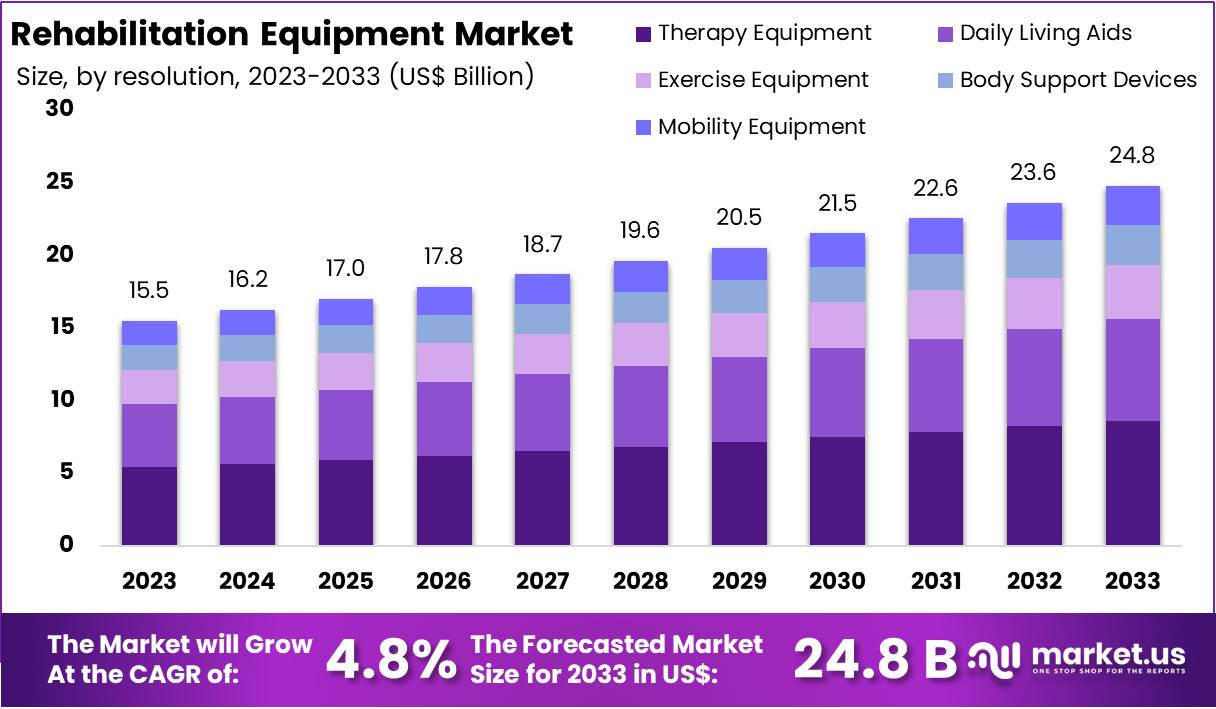
New York, NY – Feb 13, 2026 – The Global Rehabilitation Equipment Market size is expected to be worth around US$ 24.8 Billion by 2033, from US$ 15.5 Billion in 2023, growing at a CAGR of 4.8% during the forecast period from 2024 to 2033.
The global rehabilitation equipment market is witnessing steady growth, driven by the rising prevalence of chronic diseases, musculoskeletal disorders, and age-related mobility limitations. Rehabilitation equipment includes a wide range of devices such as mobility aids, exercise therapy equipment, daily living aids, and physiotherapy instruments designed to restore physical function and improve patient independence.
The growth of the market can be attributed to the increasing geriatric population and the growing incidence of neurological conditions, including stroke and spinal cord injuries. According to global health estimates, a significant proportion of the population requires rehabilitation services at some stage of life, which has strengthened demand for advanced and user-friendly equipment. In addition, the expansion of healthcare infrastructure and the integration of technologically advanced solutions, such as robotic-assisted therapy and smart mobility devices, are supporting market expansion.
Hospitals, rehabilitation centers, and homecare settings represent key end-user segments. The adoption of home-based rehabilitation solutions has increased due to the emphasis on cost-effective care and patient convenience. North America and Europe currently account for a substantial market share, while Asia-Pacific is projected to register notable growth, supported by improving healthcare access and rising healthcare expenditure.
Key Takeaways
- The global rehabilitation equipment market is expected to reach US$ 24.8 billion by 2033, increasing from US$ 15.5 billion in 2023, reflecting a compound annual growth rate (CAGR) of 4.8% during the forecast period.
- Within the product category, therapy equipment accounted for the largest share in 2023, contributing over 34.8% of the total market revenue.
- By application, occupational therapy held a dominant position in 2023, representing more than 69.5% of the overall market share.
- In terms of end-use, hospitals and clinics led the segment in 2023, capturing over 32.3% of the global market share.
- Regionally, North America maintained the leading position in 2023, accounting for 34.9% of the global market, with a valuation of approximately US$ 5.4 billion.
Regional Analysis
In 2023, North America accounted for a leading 34.9% share of the global Rehabilitation Equipment Market, reaching a valuation of US$ 5.4 billion. Market dominance was supported by a well-established healthcare infrastructure, with substantial investments directed toward advanced medical facilities and specialized rehabilitation services. The widespread availability of technologically advanced rehabilitation solutions has further reinforced regional leadership.
The growing geriatric population has significantly increased demand for rehabilitation equipment, as age-related mobility limitations and chronic conditions require long-term therapeutic support. A high incidence of cardiovascular and neurological disorders has also contributed to sustained demand for rehabilitation interventions.
Technological advancement continues to play a central role in market expansion. Innovations such as robotic-assisted rehabilitation systems and tele-rehabilitation platforms have improved treatment efficiency and accessibility. In addition, supportive government initiatives and strong healthcare expenditure per capita have facilitated the adoption of high-cost, innovative technologies, ensuring North America’s continued prominence in the global market.
Emerging Trends in the Rehabilitation Equipment Market
- Integration of Digital Health Platforms: Rehabilitation delivery models are increasingly being integrated with digital health ecosystems, enabling tele-rehabilitation and remote patient monitoring. This transition aligns with global digital health strategies focused on expanding equitable healthcare access through connected devices, mobile platforms, and telehealth infrastructure.
- Broader Access to Assistive Technologies: Healthcare systems are emphasizing integrated provision of multiple assistive products, including wheelchairs, hearing aids, and communication applications. Since many users require more than one device, coordinated service models are being implemented to enhance assessment efficiency, product distribution, and user training outcomes.
- Growing Global Rehabilitation Demand: Approximately 2.4 billion individuals worldwide are estimated to live with health conditions that could benefit from rehabilitation services. This demand is projected to increase further due to demographic aging trends and the rising prevalence of chronic non-communicable diseases globally.
- Advancement of Robotics and Wearable Exoskeletons: Robotic-assisted therapy systems and wearable exoskeletons are being increasingly adopted to support motor recovery, particularly among stroke and spinal cord injury patients. Early-stage implementations have indicated enhanced patient engagement and measurable improvements in functional mobility and rehabilitation outcomes.
- Shift Toward Personalized and Data-Driven Rehabilitation: The use of wearable sensors and AI-enabled analytics is supporting individualized rehabilitation planning. Real-time patient performance metrics are being collected to adjust therapy intensity, monitor recovery progression, and forecast rehabilitation trajectories, thereby improving treatment precision and clinical effectiveness.
Key Use Cases in Rehabilitation Equipment
- Mobility Assistance Through Wheelchairs: An estimated 80 million individuals, representing nearly 1% of the global population, require wheelchairs for mobility support. However, access levels remain limited, with only 5% to 35% of individuals in need receiving appropriate devices, depending on regional healthcare resources.
- Hearing Rehabilitation and Hearing Aids: Globally, around 1.5 billion people experience hearing loss, while current hearing aid production fulfills less than 10% of total demand. This unmet need contributes to an estimated annual global economic burden of approximately US$980 billion due to untreated hearing impairment.
- Stroke Rehabilitation Service Availability: More than 50% of surveyed public healthcare facilities have reported general availability of both acute stroke care and structured rehabilitation services. This indicates moderate progress in integrating rehabilitation into stroke management pathways within public health systems.
- Service Gaps in Low- and Middle-Income Countries: In several low- and middle-income countries, over 50% of individuals requiring rehabilitation services remain untreated. These gaps reflect structural limitations in healthcare delivery systems, insufficient funding, and inadequate infrastructure for specialized rehabilitation services.
- Shortage of Skilled Rehabilitation Professionals: Workforce constraints remain a significant challenge, particularly in low- and middle-income regions where fewer than 10 trained rehabilitation practitioners per 1 million population are available. This shortage restricts access to essential physiotherapy, occupational therapy, and related rehabilitation services.
Frequently Asked Questions on Rehabilitation Equipment
- What are the main types of rehabilitation equipment?
Major categories include mobility equipment, exercise and therapy devices, daily living aids, and body support systems. Common examples include wheelchairs, treadmills, resistance bands, parallel bars, balance trainers, and electrotherapy systems used in physical rehabilitation settings. - Who uses rehabilitation equipment?
Rehabilitation equipment is primarily used by patients recovering from orthopedic injuries, neurological disorders, stroke, spinal cord injuries, and post-surgical conditions. It is also widely utilized by elderly individuals experiencing mobility limitations and chronic musculoskeletal conditions. - Where is rehabilitation equipment typically used?
These devices are commonly deployed in hospitals, rehabilitation centers, physiotherapy clinics, long-term care facilities, and home care environments. The adoption in home settings has increased significantly due to growing preference for outpatient and home-based rehabilitation services. - What factors drive the demand for rehabilitation equipment?
Demand is driven by rising geriatric populations, increasing incidence of chronic diseases, growing cases of sports injuries, and higher rates of road accidents. Technological advancements and increasing awareness regarding early rehabilitation interventions further contribute to market expansion. - What are the key growth drivers of the rehabilitation equipment market?
Market growth can be attributed to aging demographics, increasing prevalence of neurological and orthopedic disorders, and expansion of healthcare infrastructure. Rising healthcare expenditure and technological innovations in robotic rehabilitation systems are also supporting sustained industry growth. - Which regions dominate the rehabilitation equipment market?
North America holds a significant market share due to advanced healthcare infrastructure and strong reimbursement frameworks. Europe follows closely, while Asia-Pacific is witnessing rapid growth driven by expanding healthcare access and increasing investments in medical technologies. - What technological trends are shaping the rehabilitation equipment market?
The market is increasingly influenced by robotics, wearable rehabilitation devices, virtual reality therapy systems, and AI-enabled monitoring tools. These innovations enhance therapy precision, improve patient outcomes, and enable remote rehabilitation through telehealth integration.
Conclusion
The global rehabilitation equipment market is positioned for steady expansion, supported by demographic aging, rising chronic disease burden, and increasing demand for mobility and functional independence. Technological innovation, including robotics, digital health integration, and data-driven therapy solutions, is strengthening treatment efficiency and accessibility.
Strong adoption across hospitals, clinics, and homecare settings is reinforcing market penetration, particularly in developed regions. Meanwhile, Asia-Pacific presents significant growth opportunities due to improving healthcare infrastructure and expenditure. Despite workforce shortages and service gaps in low-income regions, sustained investments and policy support are expected to drive long-term market development and improved rehabilitation outcomes globally.
Discuss your needs with our analyst
Please share your requirements with more details so our analyst can check if they can solve your problem(s)




