


Table of Contents
Overview
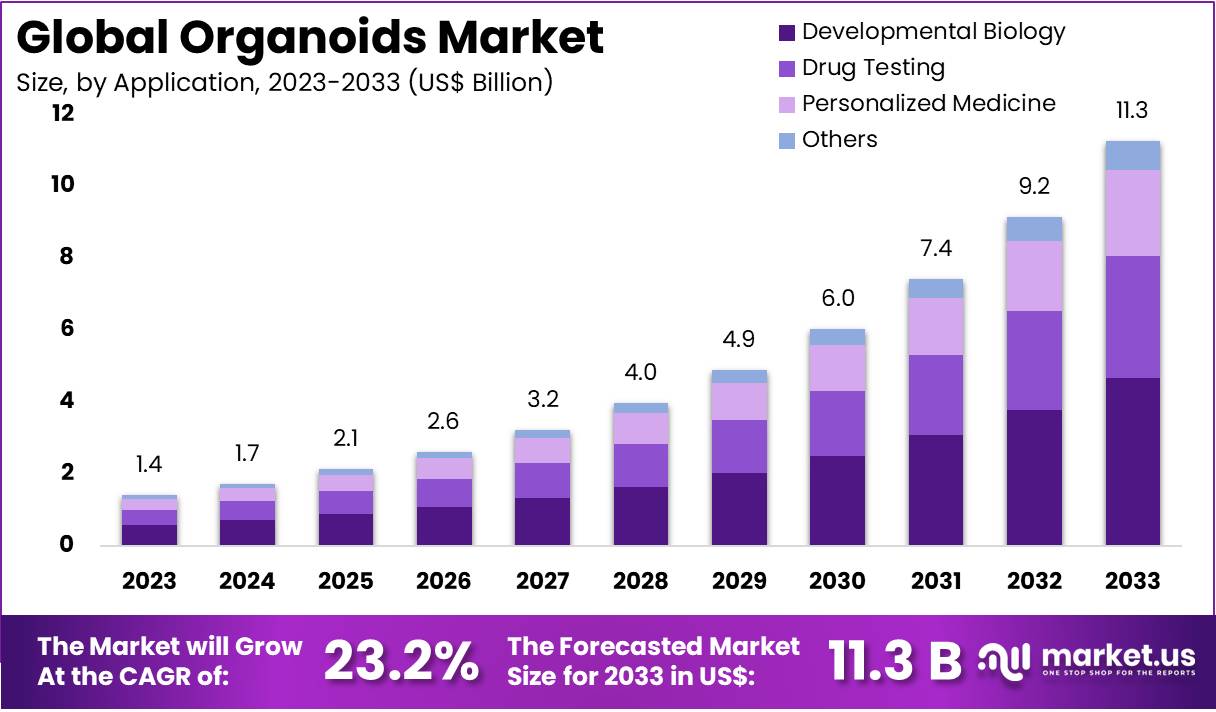
New York, NY – March 12, 2026 – The Organoids Market size is expected to be worth around US$ 11.3 Billion by 2033 from US$ 1.4 Billion in 2023, growing at a CAGR of 23.2% during the forecast period 2024 to 2033. North America held a dominant market position, capturing more than a 41.2% share and holds US$ 0.6 Billion market value for the year.
Organoids are three-dimensional cellular structures that replicate key architectural and functional features of real human organs. Their formation begins with the use of stem cells, most commonly pluripotent stem cells or adult tissue-derived stem cells. Under controlled laboratory conditions, these cells are cultured in specialized growth media that provide essential nutrients, signaling molecules, and growth factors.
During the initial phase, stem cells undergo proliferation and begin to differentiate into specific cell types. This process is guided by biochemical cues that mimic natural developmental pathways observed in human organs. The cells are typically embedded within a supportive extracellular matrix, such as a hydrogel scaffold, which enables the formation of a three-dimensional structure rather than traditional two-dimensional cell layers.
As cell division continues, spatial organization gradually emerges. Different cell populations arrange themselves into layers or clusters that resemble early organ development. Through self-organization, the cells establish functional microenvironments, allowing organoids to develop features similar to tissues found in organs such as the intestine, liver, brain, and kidney.
Over time, these miniature organ-like structures mature and begin to demonstrate limited physiological functions, including cellular signaling, metabolic activity, and tissue-specific responses. The development cycle typically ranges from several days to a few weeks, depending on the organ model and culture conditions.
The formation of organoids has become a transformative advancement in biomedical research, supporting disease modeling, drug screening, and personalized medicine by providing biologically relevant systems that closely mimic human tissue behavior in vitro.
Key Takeaways
- In 2023, the global organoids market generated revenue of US$ 1.4 billion and is projected to expand at a CAGR of 23.2%, reaching approximately US$ 11.3 billion by 2033.
- Based on type, the market is segmented into liver, pancreas, intestine, kidney, heart, and others. Among these, the intestine organoids segment accounted for the leading position in 2023, representing 32% of the total market share.
- In terms of application, the market is categorized into drug testing, personalized medicine, developmental biology, and others. The developmental biology segment dominated the market, capturing a 41.3% share in 2023.
- With respect to end users, the academic and research institutes segment emerged as the primary contributor, holding the largest revenue share of 47.5% in the global organoids market.
- North America maintained a leading regional position, accounting for 41.2% of the global market share in 2023.
Regional Analysis
North America Leading the Organoids Market
North America accounted for the largest share of the global organoids market in 2023, representing 41.2% of total revenue. Market dominance has been supported by significant advancements in biotechnology, increasing investments in regenerative medicine, and expanding drug discovery activities.
In January 2024, HUB Organoids introduced the IntegriGut Screen service globally, utilizing IBD PDO monolayers to support the development of innovative therapies for Inflammatory Bowel Disease. Such developments highlight the growing application of organoid models in generating high-quality human data for therapeutic research. Strong research infrastructure and the presence of major biotechnology and pharmaceutical companies have further reinforced the region’s leadership.
Asia Pacific Expected to Witness the Fastest Growth
The Asia Pacific region is projected to record the highest CAGR during the forecast period, driven by expanding stem cell research, biotechnology advancements, and rising healthcare investments. Countries such as China, Japan, and South Korea are increasingly adopting organoid technologies for drug development, disease modeling, and personalized medicine applications.
Emerging Trends
- Vascularized Organoids Are Becoming More Common: Researchers are developing vascularized organoids that form internal blood vessel networks, improving oxygen and nutrient delivery. These advanced structures enhance organoid survival, stability, and functionality, enabling more accurate disease models and improving applications in drug testing and transplant research.
- Governments and Regulators Support Non-Animal Testing: Governments and regulatory agencies are increasingly encouraging the use of organoids as alternatives to animal testing. Updated policies and research guidelines support human-relevant testing methods, enabling faster drug development, improved safety evaluation, and reduced ethical concerns.
- Artificial Intelligence Is Transforming Organoid Research: Artificial intelligence technologies are being integrated into organoid research to monitor growth patterns, analyze complex biological data, and predict drug responses. AI-driven insights improve experimental accuracy, accelerate therapeutic discovery, and strengthen disease modeling capabilities.
- Combined Organoids Are Creating Better Disease Models: Scientists are combining different organoid types to create “assembloids” that replicate interactions between multiple organs or tissues. These complex models support advanced research on neurological, developmental, and multi-organ diseases by simulating realistic biological systems.
Use Cases
- Testing Medicines Safely: Organoids provide highly accurate human tissue models for testing new medicines. Their human-cell origin improves prediction of drug effectiveness and side effects, helping researchers conduct safer, faster, and more reliable preclinical drug evaluation.
- Developing Personalized Cancer Treatments: Patient-derived tumor organoids enable scientists to test multiple cancer treatments in the laboratory. By observing how these organoids respond to therapies, physicians can identify the most effective personalized treatment strategies for individual patients.
- Improving Understanding of Gut and Liver Functions: Intestinal and liver organoids allow researchers to study digestion, metabolism, microbial interactions, and drug processing in controlled environments. These models also support investigations into infections, inflammation, and chronic gastrointestinal disorders.
- Replacing or Repairing Damaged Tissues: Organoids demonstrate strong potential for regenerative medicine by supporting tissue repair and replacement. Experimental studies indicate that transplanted organoids may restore damaged tissues, offering promising future therapeutic solutions for chronic diseases and organ failure.
Frequently Asked Questions on Organoids
- How are organoids formed in the laboratory?
Organoids are developed by culturing stem cells in specialized growth media containing signaling molecules and nutrients. These cells are embedded within an extracellular matrix that supports three-dimensional growth, enabling self-organization and differentiation into tissue structures resembling specific human organs. - What are the major applications of organoids?
Organoids are widely used in drug discovery, developmental biology, disease modeling, and personalized medicine. They enable researchers to study disease progression and therapeutic responses more accurately, providing human-relevant biological systems that improve the efficiency of biomedical research and pharmaceutical development. - What factors are driving the growth of the organoids market?
The market growth is driven by rising investments in biotechnology, increasing demand for personalized medicine, and advancements in stem cell research. Additionally, the need for more accurate drug testing models compared to traditional animal studies is significantly boosting adoption. - Which organoid type segment dominates the market?
Among different organoid types, intestine organoids have held a leading position in the market. Their dominance is attributed to extensive applications in gastrointestinal disease research, drug screening, and studies related to intestinal development and microbial interactions. - Which application segment holds the largest share in the organoids market?
Developmental biology represents one of the largest application segments in the organoids market. Organoid models enable scientists to replicate early organ development processes, providing valuable insights into cell differentiation, tissue formation, and genetic influences during organ formation. - Who are the primary end users in the organoids market?
Academic and research institutes represent the largest end-user segment in the organoids market. These institutions utilize organoid technology extensively for fundamental biological research, disease modeling, and experimental studies aimed at advancing regenerative medicine and therapeutic innovation. - Which region dominates the global organoids market?
North America currently leads the global organoids market due to strong biotechnology infrastructure, significant research funding, and the presence of major pharmaceutical companies. Continuous innovation and increasing adoption of organoid-based research tools support the region’s market leadership.
Conclusion
The global organoids market demonstrates strong growth potential, supported by rapid progress in stem cell research, regenerative medicine, and advanced drug discovery platforms. Organoids provide highly accurate human tissue models that enhance disease modeling, therapeutic testing, and personalized medicine approaches.
Increasing adoption by academic and research institutes, along with expanding pharmaceutical applications, continues to strengthen market demand. North America currently maintains a leading position due to its advanced biotechnology ecosystem, while Asia Pacific is expected to witness the fastest growth driven by rising research investments. Overall, organoid technology is anticipated to play an increasingly critical role in biomedical innovation and next-generation therapeutic development.
Discuss your needs with our analyst
Please share your requirements with more details so our analyst can check if they can solve your problem(s)




