


Table of Contents
Overview
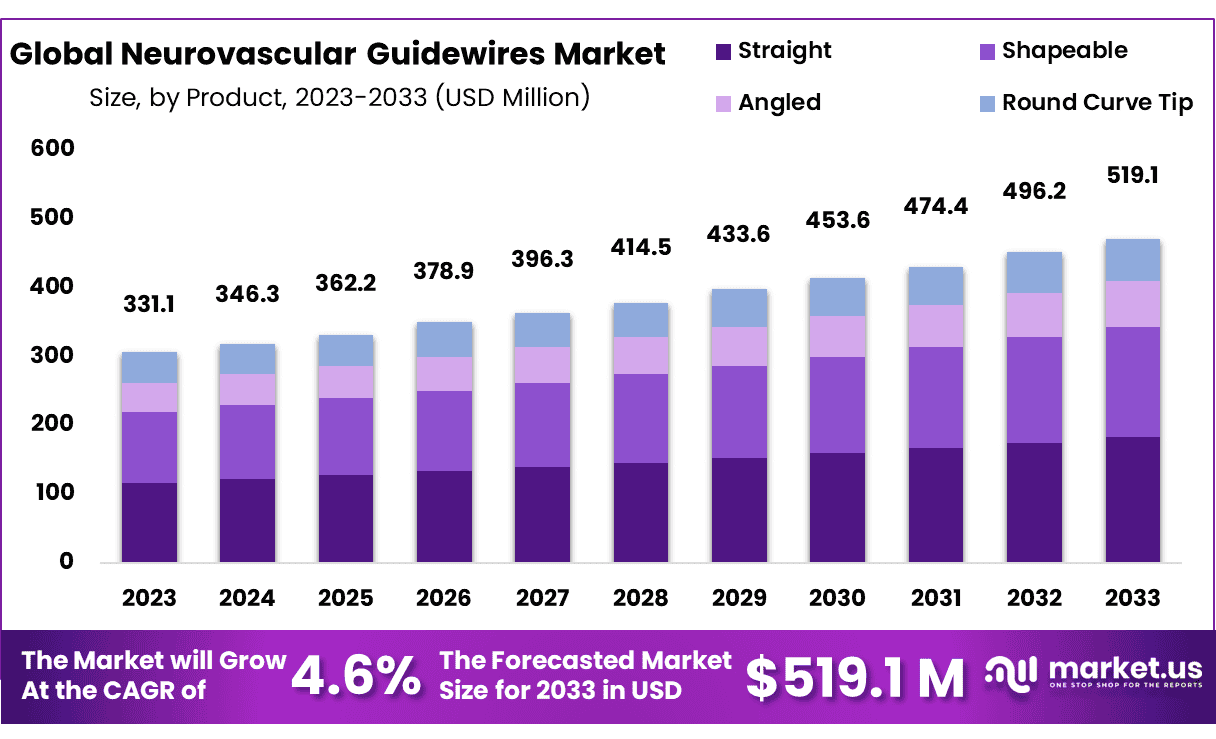
New York, NY – Jan 21, 2026 – The Global Neurovascular Guidewires Market size is expected to be worth around USD 519.1 Million by 2033 from USD 331.1 Million in 2023, growing at a CAGR of 4.6% during the forecast period from 2024 to 2033.
The basic formation of neurovascular guidewires represents a critical foundation in the advancement of minimally invasive neurointerventional procedures. Neurovascular guidewires are essential medical devices designed to navigate complex and delicate cerebral blood vessels, supporting the accurate delivery of catheters, coils, stents, and other therapeutic devices used in the treatment of stroke, aneurysms, and other neurovascular disorders.
The formation of a neurovascular guidewire is primarily defined by its core material, coating, tip design, and flexibility profile. Typically, these guidewires are manufactured using high-performance alloys such as nitinol or stainless steel, which provide an optimal balance between strength, torque control, and shape memory. The core structure is engineered to ensure precise maneuverability while maintaining sufficient support for device delivery in tortuous vascular pathways.
Surface coatings play a significant role in guidewire performance. Hydrophilic or hybrid coatings are commonly applied to reduce friction, enabling smoother navigation through narrow and sensitive vessels. The distal tip is carefully shaped and softened to minimize vessel trauma, while proximal sections are designed to enhance pushability and tactile feedback for clinicians.
The basic formation also incorporates varying stiffness zones along the length of the guidewire. This graduated design improves control and safety during navigation within the neurovascular system. As a result, procedural efficiency and clinical outcomes can be enhanced.
Continuous innovation in the basic formation of neurovascular guidewires is being driven by rising demand for endovascular treatments and increasing prevalence of neurological disorders. Ongoing advancements are expected to further improve precision, safety, and procedural success in neurointerventional care.
Key Takeaways
- Market Size: The Neurovascular Guidewires Market is projected to reach approximately USD 519.1 million by 2033, increasing from USD 331.1 million in 2023.
- Market Growth: Market expansion is anticipated at a compound annual growth rate (CAGR) of 4.6% over the forecast period from 2024 to 2033.
- Product Analysis: The straight guidewire segment is observed to hold a leading position, accounting for around 35.1% of the total market share.
- Coating Type Analysis: Hydrophilic-coated guidewires dominate the market, representing nearly 62.5% of overall demand due to enhanced navigation and reduced friction.
- Regional Analysis: North America leads the global market with a share of 42.6%, generating approximately USD 141 million in revenue from neurovascular guidewires.
- Aging Population Impact: The rising aging population is contributing to increased incidence of neurovascular conditions such as aneurysms and arteriovenous malformations, thereby supporting market demand.
- Product Segmentation Trends: Straight-tip guidewires used in spinal and cervical procedures are witnessing growing adoption, supported by continuous improvements in material technology, coatings, and structural design.
- Favorable Reimbursement Policies: Supportive government reimbursement frameworks in selected regions are positively influencing market adoption and overall growth.
Regional Analysis
Based on regional analysis, the Global Neurovascular Guidewires Market is segmented into North America, Europe, Asia Pacific, and the Rest of the World. North America dominates the market with a share of 42.6%, generating approximately USD 141 million in revenue. This leadership position is primarily supported by the early adoption of advanced medical technologies and the growing volume of minimally invasive neurovascular procedures across the region.
North America has emerged as a major contributor to the Neurovascular Guidewires Market due to its strong inclination toward innovative healthcare solutions and well-established medical infrastructure. The region demonstrates a high acceptance rate of cutting-edge neurointerventional devices, reflecting clinician preference for precision-driven and minimally invasive treatment approaches.
Additionally, the increasing number of neurovascular interventions has reinforced North America’s influence on global market trends, positioning the region as a benchmark for technological advancement and procedural adoption in neurovascular guidewires.
Emerging Trends
- Adoption of Nitinol and Hybrid Configurations: Nitinol, a nickel–titanium alloy, is increasingly utilized in guidewire cores due to its high flexibility, shape memory, and resistance to kinking. Hybrid configurations, which combine nitinol shafts with softer, hydrophilic-coated distal tips, are being adopted to improve trackability and maneuverability within complex and tortuous vascular anatomies.
- Integration of Sensors and Fiber-Optic Technologies: Advanced guidewire designs are incorporating microsensors and fiber-optic components at the distal tip to enable real-time feedback during procedures. This technological integration is intended to enhance procedural accuracy and improve navigation across challenging neurovascular pathways.
- Development of Robotically Steerable Guidewires: Ongoing research is focused on robotic-assisted guidewire systems that allow precise and controlled navigation through intricate vascular structures. Although these systems remain in the developmental stage, they are expected to improve procedural precision and contribute to better clinical outcomes over the long term.
Key Use Cases
- Aneurysm Management: Guidewires play a critical role in the delivery of coils and stents used to stabilize weakened vessel walls. The growing prevalence of intracranial aneurysms has contributed to increased utilization of guidewire-assisted endovascular interventions.
- Stroke Intervention: In the management of ischemic stroke, guidewires are essential for navigating catheters to the site of occlusion for clot retrieval. Given that stroke remains a leading cause of mortality and disability worldwide, the clinical importance of guidewires in neurointerventional procedures continues to expand.
- Treatment of Arteriovenous Malformations (AVMs): Guidewires enable accurate catheter positioning for the delivery of embolic materials, facilitating controlled reduction of blood flow to abnormal vascular connections. Rising diagnostic rates of AVMs have supported higher procedural volumes requiring advanced guidewire technologies.
- Intracranial and Extracranial Angioplasty: Guidewires support the placement of balloons and stents to dilate stenotic arteries and restore adequate blood flow. The increasing incidence of atherosclerotic disease has driven demand for angioplasty procedures, reinforcing the importance of reliable and high-performance guidewires.
Frequently Asked Questions on Neurovascular Guidewires
- What factors are driving growth in the neurovascular guidewires market?
The growth of the neurovascular guidewires market can be attributed to the increasing incidence of stroke and cerebral aneurysms, rising preference for minimally invasive procedures, technological advancements in guidewire design, and improved access to neurointerventional care. - What are the primary clinical applications of neurovascular guidewires?
Neurovascular guidewires are widely used in procedures such as mechanical thrombectomy, aneurysm coiling, flow diversion, and embolization, where accurate navigation through complex cerebral vasculature is essential for procedural success and patient safety. - How does technology impact the neurovascular guidewires market?
Technological advancements, including enhanced torque control, hydrophilic coatings, and improved tip flexibility, have significantly improved procedural precision, reduced vessel trauma, and increased clinician confidence, thereby positively influencing market adoption and product demand. - Who are the key end users of neurovascular guidewires?
Hospitals and specialized neurology or stroke centers represent the primary end users, as these facilities manage complex neurovascular conditions and are equipped with advanced imaging systems required for high-precision endovascular interventions. - Which regions currently lead the neurovascular guidewires market?
North America dominates the market due to advanced healthcare infrastructure, high awareness of stroke treatment, and strong presence of leading manufacturers, while Asia Pacific is projected to experience faster growth supported by improving healthcare access. - How do reimbursement policies affect the market?
Favorable reimbursement frameworks in developed countries support the adoption of neurovascular interventions, encouraging hospitals to invest in advanced guidewires, whereas limited reimbursement in emerging markets may hinder procedural growth and technology penetration. - What competitive strategies are shaping the neurovascular guidewires market?
Market players emphasize product innovation, clinical validation, regulatory approvals, and strategic partnerships to strengthen their portfolios, while geographic expansion and physician training programs are increasingly adopted to enhance market presence and competitiveness.
Conclusion
In conclusion, the neurovascular guidewires market is positioned for steady growth, supported by rising demand for minimally invasive neurointerventional procedures and continuous advancements in guidewire formation and design. The optimized combination of high-performance materials, advanced coatings, and graduated flexibility profiles has improved procedural precision, safety, and clinical outcomes.
Market expansion is further reinforced by an aging population, increasing prevalence of neurovascular disorders, and favorable reimbursement policies in developed regions. North America continues to lead adoption, while emerging innovations such as sensor-enabled and robotic guidewires are expected to shape future clinical practice and market competitiveness.
Discuss your needs with our analyst
Please share your requirements with more details so our analyst can check if they can solve your problem(s)




