


Table of Contents
Overview
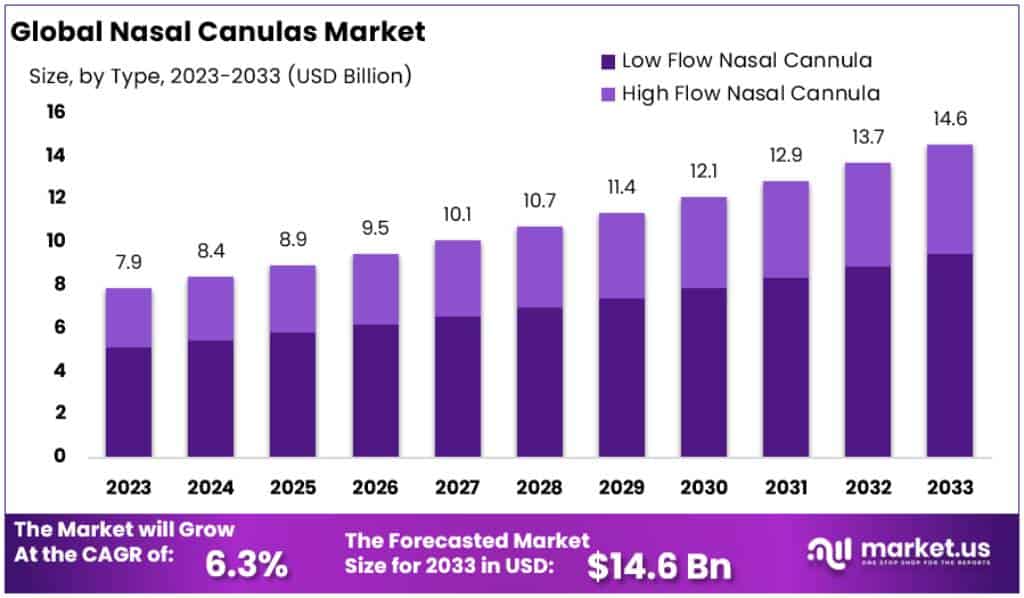
New York, NY – Jan 20, 2026 – The Global Nasal Cannula Market size is expected to be worth around USD 14.6 Billion by 2033, from USD 7.9 Billion in 2023, growing at a CAGR of 6.3% during the forecast period from 2024 to 2033.
A nasal cannula is a widely used medical device designed to deliver supplemental oxygen to patients who require respiratory support. It consists of a lightweight, flexible tube with two small prongs that are placed into the nostrils, allowing oxygen to flow directly into the nasal passages. The device is commonly connected to an oxygen source such as an oxygen concentrator, compressed gas cylinder, or wall outlet in clinical settings.
Nasal cannulas are primarily used in hospitals, clinics, ambulatory care centers, and home healthcare environments. They are indicated for patients with mild to moderate oxygen requirements, including individuals with chronic obstructive pulmonary disease (COPD), asthma, pneumonia, or post-operative respiratory conditions. The oxygen flow rate typically ranges from 1 to 6 liters per minute, depending on patient needs and clinical guidance.
The widespread adoption of nasal cannulas can be attributed to their ease of use, patient comfort, and cost-effectiveness. Unlike oxygen masks, nasal cannulas allow patients to speak, eat, and move more freely, which supports improved compliance and overall patient experience. The design also enables continuous oxygen delivery without causing significant discomfort or claustrophobia.
Advancements in material technology have led to the development of soft-touch, kink-resistant tubing that reduces skin irritation and enhances durability. Additionally, disposable and single-use nasal cannulas are increasingly preferred to minimize the risk of cross-contamination and hospital-acquired infections.
Overall, nasal cannulas remain a fundamental component of oxygen therapy, supporting effective respiratory care across diverse healthcare settings. Their reliability, simplicity, and adaptability continue to reinforce their role in modern medical practice.
Key Takeaways
- The global nasal cannula market is projected to reach nearly USD 14.6 billion by 2033.
- In 2023, the nasal cannula market was valued at approximately USD 7.9 billion.
- A compound annual growth rate (CAGR) of 6.3% is expected during the forecast period from 2023 to 2033.
- Around 41% of chronic respiratory disease cases contribute to increased morbidity, primarily driven by asthma and chronic obstructive pulmonary disease (COPD).
- Low-flow nasal cannulas accounted for more than 65% of the total market share in 2023, maintaining a dominant position.
- Plastic nasal cannulas captured over 85.3% of the market share in 2023, largely due to their cost-effectiveness.
- Hospitals represented the leading end-use segment in 2023, holding more than 44.9% of the overall market share.
- North America dominated the global market in 2023 with a share of 42.3%, supported by the growing prevalence of respiratory disorders.
Regional Analysis
In 2023, North America dominated the nasal cannula market, capturing a 42.3% share and generating approximately USD 3.3 billion in revenue. This strong market position is largely attributed to the growing burden of respiratory conditions such as chronic obstructive pulmonary disease (COPD) and asthma, which together account for nearly 80% of chronic disease–related healthcare expenditure in the region.
The widespread presence of both domestic and global manufacturers has enhanced the availability and affordability of technologically advanced nasal cannulas, thereby supporting market expansion. For example, the U.S. market alone contributed more than USD 2.9 billion in revenue in 2022.
A key industry development includes the introduction of the Luisa advanced ventilator by Movair in October 2021, designed to seamlessly alternate between high-flow nasal cannula (HFNC) therapy and non-invasive ventilation.
The Asia Pacific region is expected to register the fastest growth over the forecast period. This growth is driven by the high prevalence of asthma and COPD, along with a rapidly aging population. Additionally, rising healthcare investments and the increasing presence of regional manufacturers are strengthening market development across the region.
Emerging Trends
- Advancements in High-Flow Nasal Cannula (HFNC) Therapy: Continuous innovation in High-Flow Nasal Cannula technology has improved the efficiency and precision of oxygen delivery. Clinical evidence indicates that early use of HFNC as respiratory support in children under five years of age with acute hypoxemic respiratory failure caused by severe community-acquired pneumonia results in significantly lower treatment failure rates compared to conventional low-flow oxygen therapy. These findings support the growing clinical preference for HFNC in early-stage respiratory intervention.
- Rising Adoption in Pediatric Care: The adoption of HFNC systems in pediatric healthcare settings has increased notably. A recent study conducted in Italy revealed that approximately 66% of children hospitalized for bronchiolitis received HFNC during the most recent seasonal outbreak, compared to 35–38% during pre-pandemic periods. This upward trend reflects increased clinical confidence in HFNC therapy for managing pediatric respiratory disorders.
- Integration with Nebulized Drug Delivery: Technological developments have enabled the integration of nebulized therapy with HFNC systems through compatible adapter designs. These advancements allow for the simultaneous administration of aerosolized medications and humidified oxygen, improving treatment efficiency and patient outcomes, particularly in cases requiring combination respiratory therapies.
- Innovative Cannula Modifications to Improve Oxygen Delivery: Recent research has introduced cost-effective modifications to conventional nasal cannulas aimed at enhancing oxygen concentration. The incorporation of reservoir mechanisms to minimize ambient air dilution has shown potential in improving oxygen delivery efficiency, especially in critical care and high-dependency settings.
- Variability in Humidification Performance: Clinical studies have identified considerable variation in humidification performance across different HFNC devices. Parameters such as gas flow rates, system design, and patient interface configuration significantly influence the temperature and humidity of delivered oxygen. Addressing these variations is essential for maximizing patient comfort and ensuring consistent therapeutic effectiveness.
Key Use Cases
- Treatment of Acute Hypoxemic Respiratory Failure in COVID-19 Patients: During the COVID-19 pandemic, HFNC therapy emerged as a critical non-invasive treatment option for patients with acute hypoxemic respiratory failure. Retrospective clinical analyses indicate that HFNC use helped approximately 48.2% of critically ill COVID-19 patients avoid progression to mechanical ventilation.
- Application in Pediatric Asthma Management: HFNC therapy has been increasingly utilized in pediatric patients experiencing severe asthma exacerbations to reduce respiratory distress. However, evidence suggests an association with longer hospital stays, highlighting the importance of appropriate patient selection and continuous clinical monitoring.
- Reduction in Need for Invasive Ventilation: HFNC is widely used as an alternative to invasive mechanical ventilation across multiple acute care settings. Its application has been linked to lower rates of intubation and reduced mortality among patients with acute respiratory conditions, reinforcing its role in modern respiratory care protocols.
Frequently Asked Questions on Nasal Cannula
- How does a nasal cannula work?
A nasal cannula functions by supplying a controlled flow of oxygen from a source such as a concentrator or cylinder directly into the nasal passages, ensuring improved oxygen saturation while allowing patients to speak and eat comfortably. - What are the main types of nasal cannulas available?
Nasal cannulas are commonly categorized into low-flow and high-flow types. Low-flow cannulas deliver limited oxygen volumes, while high-flow nasal cannulas provide heated, humidified oxygen at higher flow rates for advanced respiratory support. - What materials are nasal cannulas made from?
Most nasal cannulas are manufactured using medical-grade plastics due to their flexibility, durability, and cost-effectiveness. Silicone-based options are also available, offering enhanced comfort for long-term oxygen therapy applications. - What factors are driving the growth of the nasal cannula market?
Market growth is driven by the increasing prevalence of respiratory diseases such as asthma and COPD, rising geriatric populations, growing demand for home-based oxygen therapy, and continuous advancements in respiratory care technologies. - Which end-use segment dominates the nasal cannula market?
Hospitals dominate the nasal cannula market due to high patient admissions, availability of advanced respiratory equipment, and increased usage during acute and chronic respiratory treatments across emergency and intensive care units. - Which region leads the global nasal cannula market?
North America leads the global nasal cannula market, supported by well-established healthcare infrastructure, high healthcare expenditure, strong presence of key manufacturers, and a rising incidence of chronic respiratory disorders. - What is the future outlook of the nasal cannula market?
The nasal cannula market is expected to witness steady growth, driven by technological innovation, expanding healthcare access in emerging economies, and increasing adoption of high-flow nasal cannula systems for advanced respiratory management.
Conclusion
The nasal cannula market continues to demonstrate steady and sustained growth, supported by the rising prevalence of chronic respiratory diseases, expanding geriatric populations, and increasing demand for non-invasive oxygen therapy. Its widespread adoption is reinforced by clinical effectiveness, patient comfort, and cost efficiency across hospital and homecare settings.
Technological advancements, particularly in high-flow nasal cannula systems, are improving therapeutic outcomes in both adult and pediatric care. Regional expansion, especially in Asia Pacific, further strengthens market potential. Overall, nasal cannulas remain an essential component of modern respiratory care, with long-term growth driven by innovation, accessibility, and evolving clinical needs.
Discuss your needs with our analyst
Please share your requirements with more details so our analyst can check if they can solve your problem(s)




