


Table of Contents
Overview
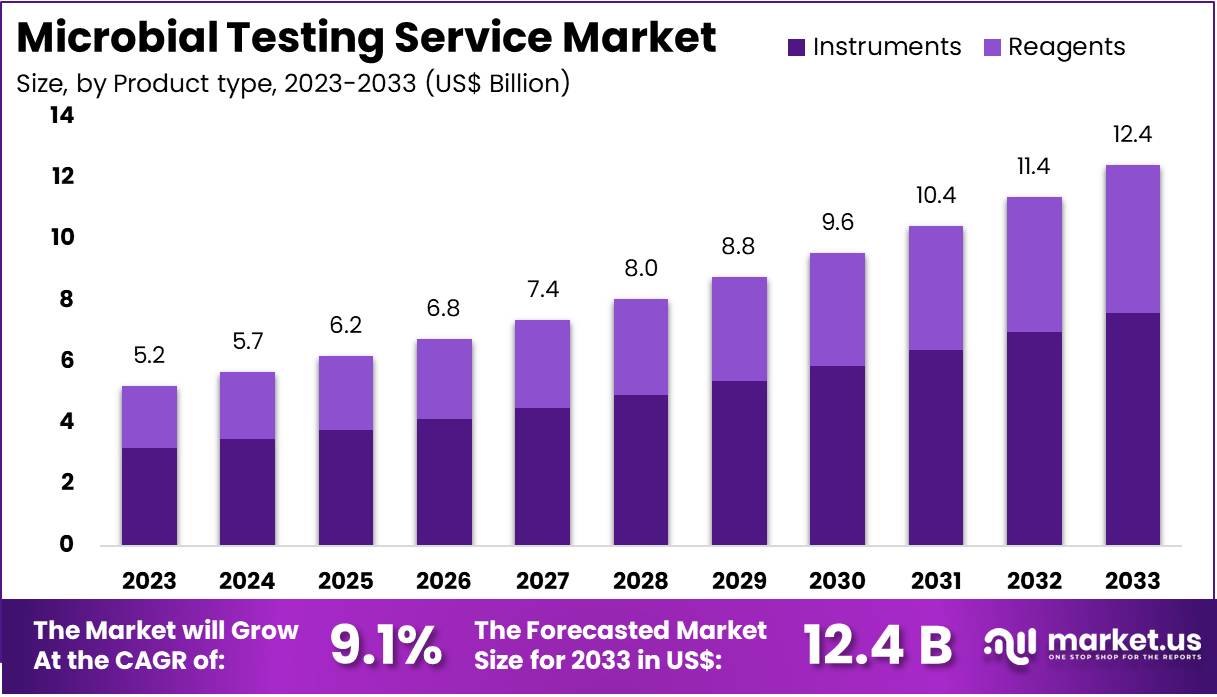
New York, NY – March 12, 2026 – The Microbial Testing Service Market size is expected to be worth around US$ 12.4 billion by 2033 from US$ 5.2 billion in 2023, growing at a CAGR of 9.1% during the forecast period 2024 to 2033. North America held a dominant market position, capturing more than a 40.5% share and holds US$ 2.1 Billion market value for the year.
A new Microbial Testing Service has been introduced to support industries in maintaining high standards of product safety, regulatory compliance, and quality assurance. The service is designed to provide accurate detection and identification of microorganisms that may affect product quality, consumer safety, and shelf life across multiple sectors, including food and beverages, pharmaceuticals, cosmetics, water, and environmental samples.
Microbial testing plays a critical role in ensuring that products meet national and international quality standards. The newly launched service utilizes advanced laboratory technologies and standardized testing protocols to detect bacteria, yeast, molds, and other microbial contaminants. Comprehensive analysis methods such as total viable count, pathogen detection, and microbial limit testing are incorporated to provide reliable and reproducible results.
The service has been developed to assist manufacturers in strengthening their quality control processes and minimizing the risks associated with microbial contamination. Through systematic testing and monitoring, companies can improve product integrity, comply with regulatory requirements, and protect brand reputation in competitive markets.
Additionally, the testing facility operates with stringent laboratory practices and follows globally recognized testing guidelines to ensure accuracy and consistency in results. Detailed analytical reports and technical insights are provided to help organizations understand microbial risks and implement effective corrective measures.
The introduction of this Microbial Testing Service is expected to contribute significantly to improved product safety standards and enhanced regulatory compliance across various industrial applications.
Key Takeaways
- In 2023, the Microbial Testing Service market generated revenue of US$ 5.2 billion and is projected to reach US$ 12.4 billion by 2033, expanding at a CAGR of 9.1% during the forecast period.
- Based on product type, the market is segmented into instruments and reagents, with the instruments segment dominating the market in 2023, accounting for a 62.2% revenue share.
- By test type, the market is categorized into viral, bacterial, and fungal testing, with the bacterial segment holding the largest share of 59.4% in 2023.
- In terms of application, the gastrointestinal diseases segment emerged as the leading category, capturing a 35.2% revenue share in the market.
- Based on end users, the market is divided into hospitals, academic & research institutes, diagnostic centers, and others, where the hospitals segment led the market with a 48.9% share in 2023.
- North America dominated the global market, securing the highest regional market share of 40.5% in 2023.
Regional Analysis
North America held the leading position in the Microbial Testing Service Market, accounting for approximately 40.5% of total revenue. Market dominance is attributed to the growing demand for accurate pathogen detection and the increasing awareness of infectious diseases and antimicrobial resistance.
The adoption of antimicrobial susceptibility testing has expanded significantly, as it enables healthcare professionals to diagnose infections effectively and identify appropriate treatment options. According to research highlighted by the National Center for Biotechnology Information (NCBI) in October 2022, such testing supports targeted therapies and improves patient outcomes.
Additionally, strong healthcare infrastructure, continuous microbiology research, and advancements in diagnostic technologies have strengthened market development. Regulatory support and the rising healthcare needs of the aging population in the United States and Canada have also supported the expansion of microbial testing services.
The Asia Pacific region is projected to register the fastest growth rate during the forecast period. Increasing infectious disease prevalence, expanding healthcare infrastructure, and rising investments in healthcare technology across China, India, and Japan are expected to drive significant market growth.
Emerging Trends
- Shift Toward Rapid Testing Methods: Microbial testing is shifting toward rapid methods such as PCR, immunoassays, and DNA sequencing. These technologies deliver results within hours, enabling faster decisions, improved outbreak response, reduced risks, and stronger safety management.
- Advancements in DNA and Genomic Testing: DNA-based technologies, including next-generation sequencing and metagenomics, enable detection of multiple microbes simultaneously. These advanced tools identify rare or unknown pathogens, accelerate contamination source tracking, and improve microbial surveillance and decision-making.
- Rising Demand for Water and Air Quality Monitoring: Microbial monitoring of water and air environments is increasing due to stronger public health concerns. Continuous testing of drinking water, wastewater, and indoor air helps prevent outbreaks and maintain safe environments.
- Use of Cloud-Based and Remote Testing Platforms: Cloud-based microbial testing platforms enable laboratories to store, analyze, and share data remotely. These systems improve collaboration, streamline workflows, support decentralized labs, and enable faster decision-making during outbreaks and emergencies.
Use Cases
- Food Safety: Food manufacturers use microbial testing to detect pathogens such as Salmonella and E. coli in ingredients, equipment, and finished products, ensuring regulatory compliance, preventing contamination, protecting consumers, and minimizing costly recalls.
- Pharmaceutical and Biotech Quality Control: Pharmaceutical and biotechnology companies conduct microbial testing in cleanrooms, production equipment, and water systems to maintain sterile manufacturing conditions, ensure regulatory compliance, and protect product quality and patient safety.
- Clinical Diagnostics: Hospitals and diagnostic laboratories use microbial testing to identify infection-causing bacteria, viruses, and fungi. Rapid detection enables accurate diagnosis, supports effective treatment decisions, improves patient outcomes, and helps control disease spread.
- Air and Surface Testing in Healthcare: Healthcare facilities perform microbial testing of air, surfaces, and medical equipment in critical areas such as ICUs and operating rooms to prevent hospital-acquired infections and maintain strict hygiene standards.
Frequently Asked Questions on Microbial Testing Service
- Why is microbial testing important for industries?
Microbial testing is essential for ensuring product safety, maintaining regulatory compliance, and protecting consumer health. Industries such as pharmaceuticals, food and beverages, cosmetics, and healthcare rely on microbial analysis to detect contamination risks and maintain high production and hygiene standards. - Which industries commonly use microbial testing services?
Microbial testing services are widely used across pharmaceuticals, biotechnology, food and beverage, cosmetics, agriculture, and environmental monitoring sectors. These industries require routine microbial analysis to ensure product quality, comply with safety regulations, and minimize contamination during manufacturing processes. - What types of tests are included in microbial testing services?
Microbial testing services generally include pathogen detection, total microbial count analysis, sterility testing, environmental monitoring, and microbial identification. These tests are conducted using standardized laboratory methods to evaluate contamination levels and ensure product safety and regulatory compliance. - What regulatory standards govern microbial testing services?
Microbial testing is governed by regulatory standards established by authorities such as food safety regulators, pharmaceutical agencies, and international quality organizations. These standards define acceptable microbial limits, testing procedures, and validation requirements to ensure product safety and quality assurance. - What factors are driving the growth of the microbial testing service market?
Market growth is driven by increasing regulatory requirements, rising food safety concerns, expanding pharmaceutical manufacturing, and growing awareness regarding contamination risks. Additionally, the adoption of advanced microbiological testing technologies has strengthened demand for specialized laboratory testing services globally. - Which regions dominate the microbial testing service market?
North America and Europe currently represent leading regions in the microbial testing service market due to strict regulatory frameworks and advanced laboratory infrastructure. Meanwhile, Asia-Pacific is experiencing rapid expansion driven by industrial growth, pharmaceutical manufacturing, and increasing food safety regulations. - What technologies are commonly used in microbial testing services?
Microbial testing services utilize technologies such as polymerase chain reaction (PCR), immunoassays, rapid microbial detection systems, culture-based methods, and automated microbial identification platforms. These technologies improve detection accuracy, reduce testing time, and support regulatory compliance across industries.
Conclusion
The microbial testing service market is witnessing steady expansion, supported by rising regulatory requirements, increasing safety standards, and growing demand for accurate pathogen detection across industries. Advanced technologies such as PCR, genomic sequencing, and rapid detection platforms have significantly improved testing efficiency and reliability.
Strong adoption in food safety, pharmaceuticals, healthcare, and environmental monitoring continues to strengthen market growth. North America remains a leading region due to advanced healthcare infrastructure and regulatory frameworks, while Asia-Pacific is expected to record the fastest growth. Overall, microbial testing services will remain essential for ensuring product quality, public health protection, and regulatory compliance in an increasingly safety-focused global market.
Discuss your needs with our analyst
Please share your requirements with more details so our analyst can check if they can solve your problem(s)




