


Table of Contents
Overview
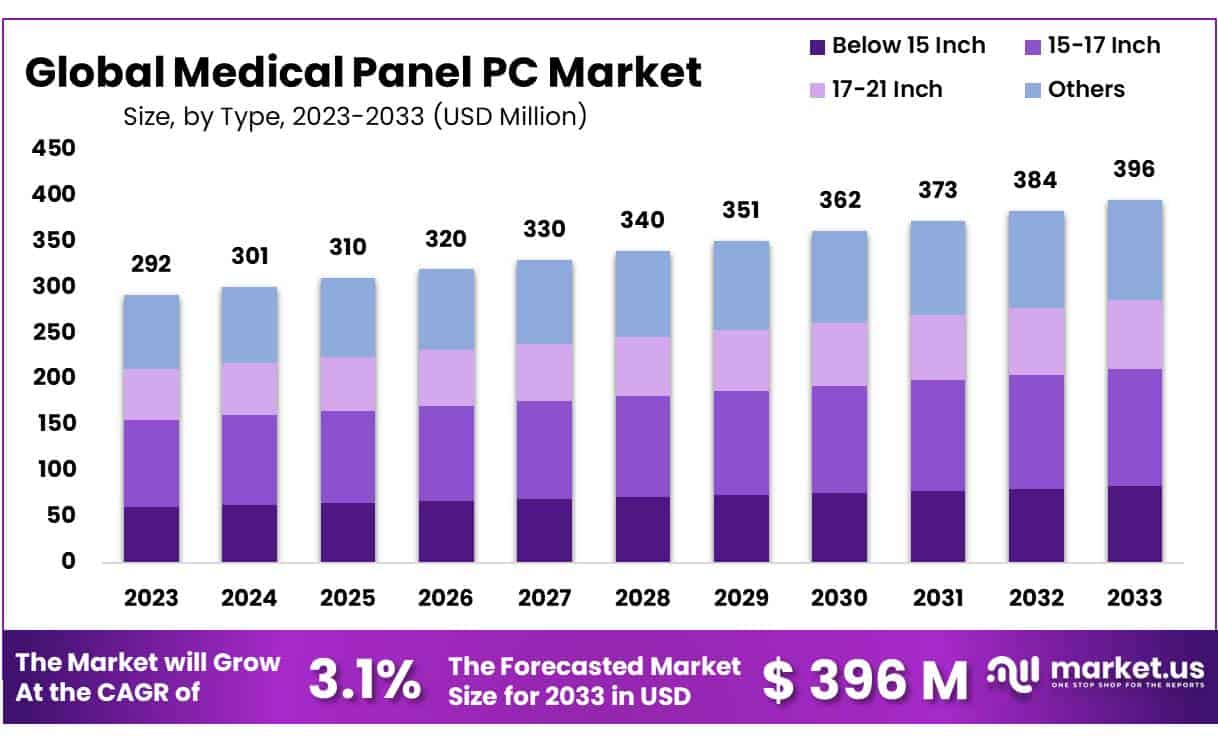
New York, NY – Jan 30, 2026 – Global Medical Panel PC Market size is expected to be worth around USD 396 Million by 2033 from USD 292 Million in 2023, growing at a CAGR of 3.1% during the forecast period from 2024 to 2033.
The Medical Panel PC has been developed as an essential computing solution designed specifically for clinical and healthcare environments. Its basic formation focuses on combining reliability, hygiene compliance, and operational efficiency to support modern medical workflows.
A Medical Panel PC is typically formed with an all-in-one structure, integrating the display, processor, storage, and input interfaces into a single compact unit. This design reduces cable clutter and simplifies installation in hospitals, clinics, laboratories, and diagnostic centers. The enclosure is generally made of medical-grade aluminum or antimicrobial-coated materials, ensuring durability and ease of cleaning in sterile environments.
From a hardware perspective, the basic formation includes a high-resolution touchscreen, often supporting multi-touch functionality for intuitive operation. Fanless architecture is commonly adopted, enabling silent operation and minimizing dust accumulation, which is critical for infection control. The system is powered by energy-efficient processors to ensure stable, continuous performance during long clinical shifts.
Connectivity forms a core part of the Medical Panel PC structure. Standard configurations include multiple USB ports, LAN connectivity, serial ports, and optional wireless modules, allowing seamless integration with medical devices, hospital information systems, and electronic health records.
In terms of compliance, the basic formation adheres to international medical safety and electromagnetic compatibility standards. This ensures reliable performance in sensitive clinical settings while meeting regulatory requirements.
Key Takeaways
- Market Size: The Medical Panel PC market is projected to reach approximately USD 396 million by 2033, rising from USD 292 million in 2023.
- Market Growth: Market expansion is anticipated at a compound annual growth rate (CAGR) of 3.1% throughout the forecast period spanning 2024 to 2033.
- Type Analysis: Within the Medical Panel PC market, the 15–17 inch segment represents a significant portion, accounting for 32.4% of the total market share.
- End-Use Analysis: Hospitals remain the leading end-use segment, contributing 33.2% of overall market revenue.
- Regional Analysis: North America emerged as the dominant region, capturing approximately 38.1% of global revenue in 2023.
Regional Analysis
North America accounted for approximately 38.1% of global Medical Panel PC revenue in 2023, maintaining a leading market position. This regional dominance is primarily driven by the strong presence of established industry participants focused on continuous innovation to meet evolving healthcare requirements.
Key areas of emphasis include patient safety, data protection, and strict compliance with regulatory standards. In addition, the region has demonstrated advanced levels of healthcare digitization, with hospitals increasingly integrating touchscreen-based systems and medical-grade computing solutions to support telemedicine and digital clinical workflows, thereby accelerating overall market growth.
The Asia Pacific region is experiencing rapid growth in Medical Panel PC adoption, supported by significant advancements in healthcare technologies and a rising inclination toward digital health solutions. These systems, equipped with intuitive touch interfaces and robust hardware designs, are being widely deployed across hospitals, clinics, and ambulatory care facilities.
Market expansion in the region is further driven by the growing demand for point-of-care services and ongoing investments in healthcare infrastructure development. Collectively, these factors are strengthening demand for Medical Panel PCs and positively influencing regional market dynamics.
Emerging Trends
- Integration of Advanced Technologies: Medical Panel PCs are increasingly being integrated with artificial intelligence (AI) and machine learning (ML) capabilities. These technologies are being utilized to support clinical diagnostics, enable predictive analytics, and assist healthcare professionals in decision-making. As a result, improvements in diagnostic accuracy and patient outcomes are being observed.
- Enhanced Mobility and Portability: Demand for mobile and portable Medical Panel PCs is rising across healthcare facilities. These systems enable clinicians to access patient information directly at the point of care. Improved mobility supports real-time data entry, reduces documentation errors, and enhances overall workflow efficiency within hospitals and clinics.
- Focus on Hygiene and Infection Control: Manufacturers are prioritizing infection control by incorporating antimicrobial coatings, sealed enclosures, and fanless designs into Medical Panel PCs. These features help limit microbial growth and reduce contamination risks, which is particularly critical in operating rooms, intensive care units, and other sterile environments.
- Telemedicine Compatibility: With the rapid expansion of telehealth services, Medical Panel PCs are being designed with integrated high-definition cameras, microphones, and advanced connectivity solutions. These capabilities support remote consultations and virtual care delivery, a trend that has accelerated due to global healthcare disruptions and increased demand for remote access.
- Regulatory Compliance and Certifications: Compliance with international medical safety standards, including IEC 60601-1, is being emphasized by manufacturers and healthcare providers. Devices meeting these certifications are increasingly preferred, as regulatory compliance ensures operational safety, reliability, and long-term performance in clinical environments.
Use Cases
- Electronic Health Records (EHR) Management: Medical Panel PCs are widely used for accessing and updating electronic health records. In a 500-bed hospital, these systems can support the management of more than 2,000 patient records per day, ensuring efficient data handling, improved accuracy, and continuity of care.
- Diagnostic Imaging: Equipped with high-resolution and color-accurate displays, Medical Panel PCs support radiologists in reviewing and analyzing medical images. A diagnostic center performing approximately 300 imaging procedures daily can enhance diagnostic precision and workflow efficiency through the use of these systems.
- Operating Room Integration: In surgical environments, Medical Panel PCs provide real-time access to patient records, imaging data, and procedural information. An operating room conducting around 15 surgeries per day benefits from immediate data availability, which supports clinical decision-making during procedures.
- Patient Monitoring: Medical Panel PCs play a critical role in intensive care units by displaying real-time patient vitals. In a 20-bed ICU, continuous monitoring of parameters such as heart rate, blood pressure, and oxygen saturation enables faster clinical response and improved patient safety.
- Telemedicine Services: These systems support virtual consultations by integrating video conferencing and communication tools. A clinic managing approximately 50 telemedicine consultations per day can use Medical Panel PCs to improve access to healthcare services and extend clinical reach beyond physical locations.
- Pharmacy Management: Hospital pharmacies use Medical Panel PCs for medication dispensing, prescription verification, and inventory management. A pharmacy processing around 1,000 prescriptions daily can reduce medication errors and improve stock control through integrated digital systems.
Frequently Asked Questions on Medical Panel PC
- Where are Medical Panel PCs commonly used in healthcare facilities?
Medical panel PCs are widely used in operating rooms, intensive care units, nurse stations, and diagnostic laboratories, where reliable computing, real-time data access, and space-efficient designs are required to support critical medical operations. - What features distinguish Medical Panel PCs from standard industrial PCs?
Medical panel PCs are distinguished by antimicrobial housings, fanless designs, compliance with medical safety standards, high ingress protection ratings, and compatibility with hospital information systems, ensuring safe, hygienic, and continuous operation in clinical settings. - Why is touchscreen technology important in Medical Panel PCs?
Touchscreen technology enables quick, intuitive interaction for healthcare professionals, supporting glove operation and frequent disinfection, while reducing peripheral dependency and enhancing efficiency during time-sensitive medical procedures and patient data management tasks. - How do Medical Panel PCs support infection control?
Medical panel PCs support infection control through sealed enclosures, smooth surfaces, and antimicrobial coatings, which limit bacterial growth and allow frequent cleaning with hospital-grade disinfectants without compromising system performance or durability. - What factors are driving the growth of the Medical Panel PC market?
The growth of the medical panel PC market is driven by increasing digitalization of healthcare systems, rising demand for point-of-care computing, expansion of hospital infrastructure, and the growing adoption of electronic medical records across healthcare facilities. - How does technological advancement impact the Medical Panel PC market?
Technological advancements such as high-resolution displays, edge computing capabilities, and improved connectivity are enhancing system performance, enabling real-time clinical decision-making, and increasing the adoption of medical panel PCs across diverse healthcare applications. - Which healthcare settings contribute most to market demand?
Hospitals contribute the largest share of demand due to high patient volumes and complex workflows, while clinics and diagnostic centers are increasingly adopting medical panel PCs to improve operational efficiency and enhance patient care delivery.
Conclusion
The Medical Panel PC has emerged as a critical component of modern healthcare infrastructure, combining hygienic design, reliable performance, and seamless system integration. Its all-in-one, fanless, and medical-grade construction supports infection control while ensuring continuous operation in demanding clinical environments.
Market growth is being steadily driven by healthcare digitalization, expanding hospital infrastructure, and rising adoption of electronic health records and telemedicine. With North America leading adoption and Asia Pacific showing rapid expansion, Medical Panel PCs are expected to play an increasingly strategic role in improving clinical workflows, patient safety, and overall healthcare efficiency over the forecast period.
Discuss your needs with our analyst
Please share your requirements with more details so our analyst can check if they can solve your problem(s)




