


Table of Contents
Overview
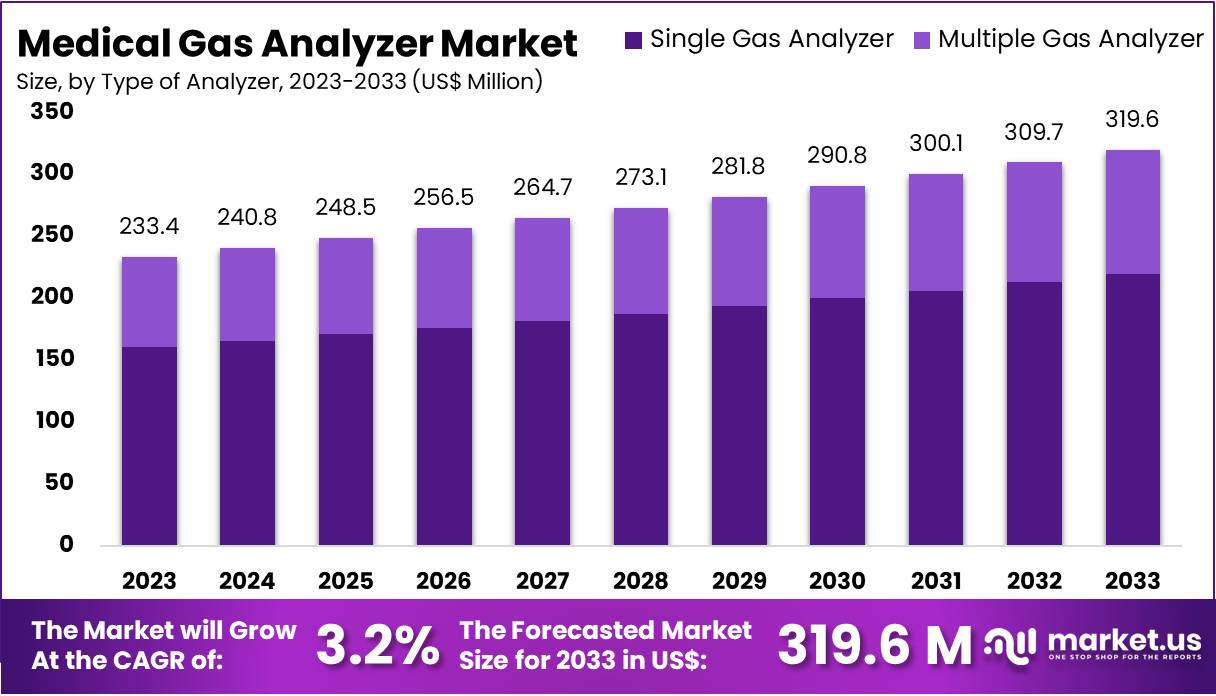
New York, NY – Feb 17, 2026 – The Global Medical Gas Analyzer Market size is expected to be worth around US$ 319.6 Million by 2033, from US$ 233.4 Million in 2023, growing at a CAGR of 3.2% during the forecast period from 2024 to 2033.
The global medical gas analyzer market is experiencing steady growth, supported by the increasing demand for accurate and continuous monitoring of medical gases across healthcare facilities. Medical gas analyzers are critical devices used to measure and verify the concentration, flow, and purity of gases such as oxygen, carbon dioxide, nitrous oxide, and anesthetic agents in hospitals, diagnostic centers, and ambulatory surgical units.
The growth of the market can be attributed to the rising number of surgical procedures, expanding hospital infrastructure, and the growing emphasis on patient safety and regulatory compliance. The increasing prevalence of chronic respiratory diseases and the higher adoption of advanced anesthesia delivery systems have further strengthened the demand for reliable gas monitoring technologies. In addition, strict quality standards and healthcare regulations have encouraged healthcare providers to implement advanced gas analysis systems to ensure operational efficiency and minimize clinical risks.
Technological advancements, including portable and real-time monitoring solutions, have enhanced device accuracy and usability. Integration with digital monitoring systems and automated calibration features has improved workflow efficiency in critical care and operating room environments.
Regionally, North America is expected to maintain a significant share due to advanced healthcare infrastructure, while Asia-Pacific is projected to witness notable growth driven by healthcare investments and hospital expansion initiatives. Overall, stable demand and ongoing innovation are expected to support sustained market expansion in the coming years.
Key Takeaways
- The Medical Gas Analyzer Market is anticipated to expand from US$ 233.4 million in 2023 to US$ 319.6 million by 2033, reflecting a compound annual growth rate (CAGR) of 3.2% during the forecast period.
- In 2023, the Single Gas Analyzer segment accounted for the largest share of the market at 68.7%, establishing its leading position among analyzer types.
- The Infrared technology segment secured a 46.3% share in 2023, making it the dominant technology category within the market.
- Benchtop Analyzers represented 41.1% of the total market share in 2023, maintaining a strong presence within the modality segment.
- Hospitals constituted the primary end-user segment in 2023, holding 39.5% of the overall Medical Gas Analyzer Market.
- North America led the global market in 2023 with a 32.2% share, corresponding to a market valuation of US$ 75.1 million.
Regional Analysis
In 2023, North America secured a leading position in the Medical Gas Analyzer Market, accounting for over 32.2% of the global share and generating approximately US$ 75.1 million in revenue. Market dominance has been supported by well-established healthcare infrastructure and strict regulatory frameworks governing medical gas safety. In the United States, oversight by agencies such as the U.S. Food and Drug Administration and the Occupational Safety and Health Administration has strengthened compliance standards, driving consistent demand for advanced gas monitoring systems.
Ongoing investments in healthcare innovation have accelerated the development of multi-gas detection and real-time monitoring technologies. The presence of major medical device manufacturers has further reinforced research and development activities across the region. In addition, a strong medical manufacturing base ensures reliable supply to hospitals and clinical facilities. Rising chronic disease prevalence and an increased focus on patient safety continue to support sustained adoption of precise medical gas analysis solutions.
Emerging Trends
- Integration of Artificial Intelligence in Gas Sensing: Artificial intelligence is increasingly embedded into gas sensing systems to enhance analytical precision and reduce response time in clinical environments. Improved algorithm-based calibration and predictive analytics are supporting faster diagnostics and minimizing measurement variability across healthcare facilities.
- Adoption of IoT-Based Monitoring Systems: Internet of Things–enabled monitoring platforms are being deployed to supervise medical gas distribution networks in real time. Continuous data transmission across hospital infrastructures enhances safety, optimizes gas consumption, and supports preventive maintenance strategies in large healthcare establishments.
- Development of Compact Real-Time Carbon Dioxide Analyzers: Compact carbon dioxide analyzers with rapid response capabilities are gaining adoption for continuous respiratory monitoring. These systems facilitate accurate ventilation assessment and environmental control within hospitals, thereby strengthening patient safety protocols in intensive and critical care units.
- Emergence of Photoacoustic and Multi-Gas Technologies: Advanced photoacoustic and multi-gas analyzer technologies are enabling simultaneous detection of multiple medical gases with high sensitivity. These innovations improve operational efficiency, reduce equipment redundancy, and ensure compliance with stringent healthcare monitoring standards.
Use Cases
- COVID-19 Severity Assessment: Arterial blood gas evaluation was conducted among hospitalized COVID-19 patients to determine disease severity and optimize ventilator configurations. Clinical data from 51 patients supported stratified care decisions and improved respiratory management outcomes in critical care settings.
- Emergency Medical Support During Marathon Events: Point-of-care blood gas analyzers were deployed during the Vienna City Marathon 2023 to evaluate runners requiring medical attention. On-site analysis enabled rapid clinical decisions, strengthening emergency response efficiency and reducing treatment delays in field conditions.
- Laboratory Diagnostics in Riyadh Healthcare Facilities: In a leading Riyadh hospital, blood gas analyzers were integrated into routine laboratory workflows for oncology diagnostics. Approximately 24% of specialists utilized the ABL 90 system, while 20.9% relied on the ABL 800 platform, reflecting structured adoption in clinical laboratories.
- Noncontact Infectious Disease Screening Applications: Photoacoustic monitors and tracer-gas analyzers were implemented in modular screening clinics to assess concentrations of SF6, CO2, and N2O. These systems supported airflow validation and infection control, enhancing biosafety compliance in infectious disease management environments.
- Hospital Gas Pipeline Monitoring and Compliance: IoT-enabled gas sensors are being used to continuously monitor oxygen and nitrous oxide pressure and flow across multi-building hospital complexes. Real-time tracking ensures adherence to safety regulations, prevents leakage risks, and improves operational reliability of centralized gas supply systems.
Frequently Asked Questions on Medical Gas Analyzer
- Why is a Medical Gas Analyzer important in healthcare facilities?
The importance of a medical gas analyzer lies in its role in ensuring patient safety and regulatory compliance. Accurate gas concentration monitoring reduces the risk of hypoxia, overdose, or contamination, thereby supporting effective respiratory therapy, anesthesia management, and critical care operations. - What types of gases are typically analyzed?
Medical gas analyzers are commonly used to measure oxygen, nitrous oxide, carbon dioxide, nitrogen, and various anesthetic agents. In certain advanced applications, helium and medical air are also analyzed to ensure appropriate composition and safe therapeutic administration. - What technologies are used in Medical Gas Analyzers?
Medical gas analyzers utilize technologies such as infrared spectroscopy, paramagnetic oxygen sensing, electrochemical sensors, and mass spectrometry. These technologies enable high sensitivity, rapid response times, and reliable measurement accuracy across diverse clinical and laboratory environments. - Where are Medical Gas Analyzers commonly used?
Medical gas analyzers are widely deployed in hospitals, ambulatory surgical centers, diagnostic laboratories, and home healthcare settings. They are particularly essential in operating rooms, intensive care units, and neonatal care units where precise gas monitoring is critical. - How often should Medical Gas Analyzers be calibrated?
Calibration frequency depends on manufacturer guidelines and regulatory standards; however, routine calibration is generally recommended monthly or quarterly. Regular calibration ensures measurement accuracy, prevents drift in sensor performance, and maintains compliance with healthcare quality standards. - Which regions dominate the Medical Gas Analyzer Market?
North America currently holds a significant share due to advanced healthcare infrastructure and stringent regulatory frameworks. Europe follows closely, while Asia-Pacific is projected to witness the fastest growth owing to expanding hospital networks and rising healthcare expenditure. - Who are the major players in the Medical Gas Analyzer Market?
The competitive landscape includes established medical device manufacturers focusing on innovation, product accuracy, and regulatory compliance. Companies are increasingly investing in research and development to introduce compact, cost-effective, and technologically advanced gas analysis systems.
Conclusion
The global medical gas analyzer market is positioned for stable and sustained expansion, supported by rising surgical volumes, increasing chronic respiratory conditions, and stringent regulatory standards governing medical gas safety. Technological advancements, including artificial intelligence integration, IoT-enabled monitoring, and multi-gas detection systems, are enhancing accuracy and operational efficiency across healthcare facilities.
North America continues to lead due to strong infrastructure and compliance frameworks, while Asia-Pacific demonstrates significant growth potential driven by healthcare investments. With steady innovation, expanding hospital infrastructure, and growing emphasis on patient safety, the market is expected to maintain consistent growth through 2033.
Discuss your needs with our analyst
Please share your requirements with more details so our analyst can check if they can solve your problem(s)




