


Table of Contents
Overview
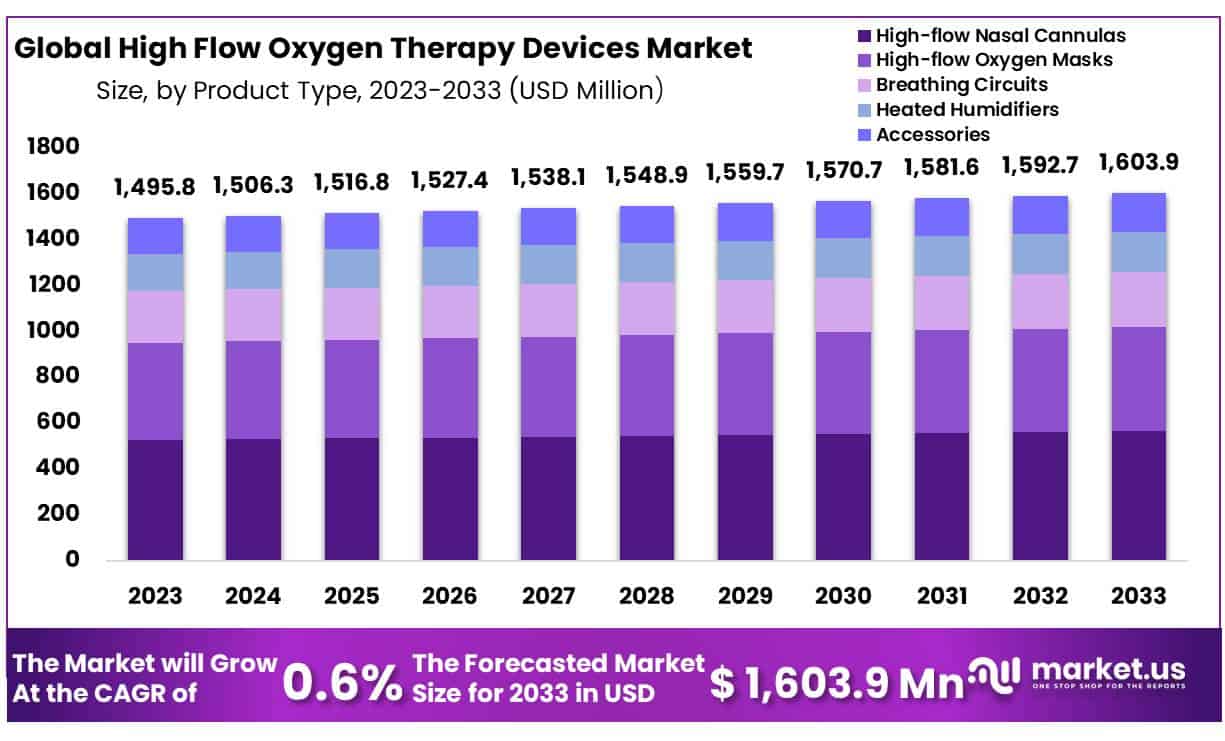
New York, NY – Jan 28, 2026 – The Global High Flow Oxygen Therapy Devices Market size is expected to be worth around USD 1,603.9 Million by 2033 from USD 1,495.8 Million in 2023, growing at a CAGR of 0.6% during the forecast period from 2024 to 2033.
The global High Flow Oxygen Therapy (HFOT) Devices market is witnessing steady expansion, supported by the growing prevalence of respiratory disorders and increasing demand for advanced, non-invasive respiratory support solutions. High flow oxygen therapy devices are designed to deliver heated and humidified oxygen at high flow rates, improving patient comfort, oxygenation efficiency, and clinical outcomes across a wide range of care settings.
These devices are widely used in hospitals, intensive care units, emergency departments, and neonatal care units for the management of conditions such as acute hypoxemic respiratory failure, chronic obstructive pulmonary disease (COPD), pneumonia, and post-operative respiratory complications. The ability of HFOT systems to reduce the need for invasive ventilation has further strengthened their adoption among healthcare providers.
Market growth is being driven by technological advancements, including precise flow control, integrated humidification systems, and enhanced monitoring capabilities. In addition, the rising geriatric population and increasing burden of chronic respiratory diseases are contributing to higher utilization of oxygen therapy solutions globally. The expansion of critical care infrastructure and improved access to advanced respiratory care in emerging economies are also supporting market development.
From a clinical perspective, high flow oxygen therapy devices are valued for their ability to improve patient tolerance, reduce work of breathing, and support faster recovery. As healthcare systems continue to focus on improving respiratory care outcomes and optimizing hospital resources, high flow oxygen therapy devices are expected to remain an essential component of modern respiratory management strategies during the forecast period.
Key Takeaways
- Market Size: The High Flow Oxygen Therapy Devices market is projected to reach approximately USD 1,603.9 million by 2033, increasing from USD 1,495.8 million in 2023.
- Market Growth: The global market is expected to expand at a compound annual growth rate (CAGR) of 0.6% during the forecast period from 2024 to 2033.
- Product Type: High-flow nasal cannulas represent the leading product segment, accounting for nearly 35% of the total market share, reflecting their widespread clinical adoption.
- Application: Chronic Obstructive Pulmonary Disease (COPD) remains the dominant application area, capturing approximately 45% of overall market demand.
- End-Use: Hospitals with fewer than 100 beds constitute the largest end-use segment, contributing around 43% of the market share.
- Regional Analysis: North America leads the global market with an estimated 37% share, generating approximately USD 553.4 million in revenue in 2023.
Regional Analysis
North America accounted for approximately 37% of the global market share, generating around USD 553.4 million in revenue in 2023, and is expected to remain a highly profitable region throughout the forecast period. The region’s market leadership is primarily driven by the rising prevalence of chronic diseases, which continues to stimulate demand for advanced respiratory care solutions.
Within North America, the United States holds a dominant position, supported by the strong presence of key industry participants and increasing investments in research and development related to high-flow oxygen therapy devices.
The Asia Pacific region is anticipated to emerge as the fastest-growing market for high-flow oxygen therapy devices during the forecast period from 2024 to 2033, registering a robust compound annual growth rate.
Market expansion in this region is being fueled by a high burden of respiratory disorders, rapid population growth, and improving access to healthcare infrastructure. These factors collectively create substantial opportunities for the adoption and development of high-flow oxygen therapy devices across Asia Pacific.
Emerging Trends
- Technological Advancements and Portability: High flow oxygen therapy devices have undergone notable technological advancement, with newer models becoming increasingly compact and portable. These developments support home-based and ambulatory care, reduce hospital dependency, and improve patient convenience. Continuous flow and hybrid systems further enhance oxygen delivery efficiency and ventilation outcomes.
- Expanded Clinical Applications: The clinical use of high flow oxygen therapy has expanded beyond acute hypoxemic respiratory failure. It is increasingly applied in managing chronic obstructive pulmonary disease, asthma, heart failure, and post-surgical recovery. Its non-invasive nature supports broader adoption across diverse patient populations and care settings.
- Integration with Telemedicine Platforms: The incorporation of telemedicine capabilities has reshaped high flow oxygen therapy delivery. Devices equipped with remote monitoring enable real-time tracking of respiratory parameters, supporting early clinical intervention. This integration enhances personalized care, reduces hospital visits, and aligns with the growing adoption of digital health solutions.
- Increased Utilization in Emergency Care: Emergency departments are increasingly adopting high flow oxygen therapy due to its rapid oxygen delivery and clinical effectiveness. Early intervention with high flow systems can stabilize patients, reduce intubation rates, and lower intensive care unit admissions, reinforcing its value in acute respiratory management.
- Emphasis on Patient Comfort and Therapy Compliance: Manufacturers are prioritizing patient comfort to improve adherence to therapy. Heated and humidified oxygen delivery, along with ergonomically designed nasal cannulas, minimizes airway irritation. These improvements enhance long-term compliance and contribute to improved clinical outcomes across care settings.
Use Cases
- Management of Acute Hypoxemic Respiratory Failure: High flow oxygen therapy devices are widely used in treating acute hypoxemic respiratory failure. By delivering high-flow, humidified oxygen, they improve oxygenation while reducing the need for invasive ventilation. Clinical evidence indicates lower intubation rates and improved patient tolerance.
- Support for Chronic Obstructive Pulmonary Disease (COPD) Patients: In COPD management, high flow oxygen therapy reduces respiratory workload and supports carbon dioxide clearance. The therapy enhances patient comfort, exercise tolerance, and quality of life. Its suitability for both hospital and home use supports long-term disease management and reduced hospitalizations.
- Postoperative Respiratory Support: Following cardiothoracic and major surgical procedures, high flow oxygen therapy is used to prevent respiratory complications. It improves oxygenation, facilitates secretion clearance, and reduces reintubation risk. Clinical adoption has been associated with faster recovery and shorter hospital stays.
- Emergency Management of Respiratory Distress: High flow oxygen therapy is increasingly applied in emergency settings for patients with acute respiratory distress. The therapy provides immediate oxygen support while avoiding invasive procedures. Early use has been shown to improve stabilization and reduce escalation to intensive care treatment.
- Palliative Care for Respiratory Symptom Relief: In palliative care, high flow oxygen therapy is used to relieve dyspnea and improve patient comfort. The delivery of humidified oxygen reduces mucosal dryness and respiratory discomfort, contributing to improved quality of life for patients with advanced or terminal respiratory conditions.
Frequently Asked Questions on High Flow Oxygen Therapy Devices
- How do high flow oxygen therapy devices work?
These devices function by delivering a precise mixture of oxygen and air at controlled flow rates through nasal cannulas, while maintaining optimal humidity and temperature, which helps prevent airway dryness and improves gas exchange efficiency. - What clinical conditions require high flow oxygen therapy devices?
High flow oxygen therapy devices are commonly used in conditions such as acute hypoxemic respiratory failure, chronic obstructive pulmonary disease, pneumonia, post-operative respiratory support, and viral infections requiring enhanced oxygen delivery and respiratory stabilization. - Where are high flow oxygen therapy devices typically used?
These devices are widely utilized in hospitals, intensive care units, emergency departments, and increasingly in homecare settings, driven by advancements in portable designs and the growing emphasis on non-invasive respiratory support solutions. - What factors are driving the growth of the high flow oxygen therapy devices market?
Market growth can be attributed to increasing cases of chronic respiratory disorders, aging populations, expanding critical care infrastructure, and heightened awareness of advanced oxygen therapy benefits among healthcare professionals and clinical institutions. - Which end-user segment dominates the high flow oxygen therapy devices market?
Hospitals represent the dominant end-user segment due to high patient volumes, availability of skilled professionals, and extensive use of high flow oxygen therapy devices in intensive care and emergency treatment environments. - How is technological advancement influencing the market?
Technological advancements, including smart flow controls, integrated monitoring systems, and compact device designs, are enhancing clinical efficiency and patient outcomes, thereby strengthening adoption rates and contributing positively to overall market expansion.
Conclusion
The global High Flow Oxygen Therapy Devices market is positioned for steady, long-term growth, driven by rising respiratory disease prevalence, technological innovation, and expanding adoption of non-invasive respiratory care solutions.
Advances in portability, monitoring capabilities, and patient comfort continue to strengthen clinical effectiveness across hospital, emergency, and homecare settings. North America maintains market leadership, while Asia Pacific presents significant growth opportunities due to improving healthcare infrastructure.
As healthcare systems prioritize efficient respiratory management and improved patient outcomes, high flow oxygen therapy devices are expected to remain integral to modern respiratory care strategies throughout the forecast period.
Discuss your needs with our analyst
Please share your requirements with more details so our analyst can check if they can solve your problem(s)




