


Table of Contents
Overview
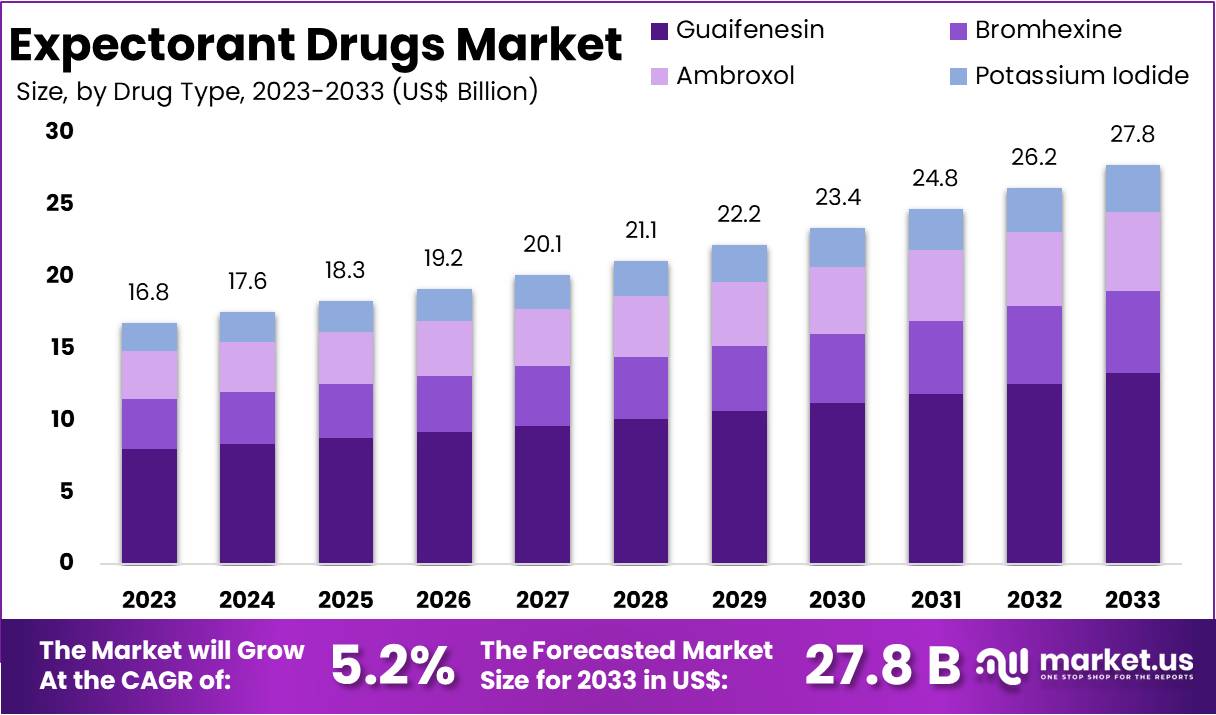
New York, NY – March 10, 2026 – The Global Expectorant Drugs Market Size is expected to be worth around US$ 27.8 Billion by 2033, from US$ 16.8 Billion in 2023, growing at a CAGR of 5.2% during the forecast period from 2024 to 2033.
Expectorant drugs are widely utilized in the treatment of respiratory conditions characterized by excessive mucus accumulation in the airways. These medications support the clearance of mucus by reducing its viscosity and promoting productive coughing, thereby improving airway function. The increasing prevalence of respiratory disorders such as Chronic Obstructive Pulmonary Disease, Bronchitis, and Asthma has contributed to the sustained demand for expectorant-based formulations in both prescription and over-the-counter segments.
The basic formation of expectorant drugs typically involves active pharmaceutical ingredients designed to stimulate bronchial secretions or modify mucus consistency. One of the most commonly used active ingredients is Guaifenesin, which functions by increasing the volume and reducing the thickness of respiratory tract secretions. Additional expectorant agents such as Potassium Iodide and Ammonium Chloride are also incorporated in certain therapeutic formulations to enhance mucolytic activity.
In pharmaceutical manufacturing, expectorant formulations are commonly produced in dosage forms including syrups, tablets, capsules, and oral solutions. The formulation process generally includes the combination of the active ingredient with excipients such as stabilizers, sweeteners, flavoring agents, and preservatives to improve drug stability, palatability, and shelf life. Syrup-based formulations remain particularly prominent due to their ease of administration among pediatric and geriatric populations.
Growing investments in respiratory therapeutics and continuous innovation in drug delivery technologies are expected to strengthen the development of advanced expectorant formulations, supporting improved patient outcomes and expanding market opportunities within the global respiratory care sector.
Key Takeaways
- The global Expectorant Drugs Market is anticipated to reach approximately US$ 27.8 billion by 2033, expanding at a compound annual growth rate (CAGR) of 5.2% during the forecast period from 2024 to 2033.
- In 2023, Guaifenesin emerged as the leading category within the drug type segment, accounting for more than 47.9% of the overall market share.
- Tablets represented the most prominent formulation segment in 2023, securing over 40.5% of the total Expectorant Drugs Market share.
- The oral route of administration dominated the market in 2023, contributing more than 68.5% of the overall share, primarily due to convenience and high patient compliance.
- Chronic Obstructive Pulmonary Disease (COPD) was identified as the leading indication segment in 2023, holding approximately 35.4% of the market share.
- North America accounted for the largest regional share in 2023, representing 32.2% of the global market, with a market value of approximately US$ 5.41 billion.
Regional Analysis
In 2023, North America maintained a leading position in the Expectorant Drugs Market, accounting for more than 32.20% of the global share and reaching a market value of approximately US$ 5.41 billion. Market dominance in the region is primarily supported by the high prevalence of respiratory disorders, including Chronic Bronchitis and Asthma. Rising levels of air pollution, combined with the increasing size of the aging population, have contributed to a higher incidence of these respiratory conditions, thereby driving demand for expectorant medications.
The region also benefits from a well-established healthcare infrastructure and high healthcare spending, which support widespread access to respiratory treatments. In addition, a robust regulatory environment enables faster approval and commercialization of new therapeutic formulations.
The presence of major pharmaceutical companies with substantial investments in research and development further promotes innovation and product availability. High public awareness of respiratory health, along with strong distribution of over-the-counter medications, continues to support sustained market growth across the region.
Emerging Trends
- Rising Demand for Herbal and Natural Expectorants: Demand for herbal expectorants is increasing as consumers prefer natural ingredients such as eucalyptus, ivy leaf, and licorice. These formulations are perceived as safer with fewer side effects, encouraging pharmaceutical companies to expand plant-based respiratory products.
- Increased Use of Combination Therapies: Combination therapies are gaining popularity as expectorants are formulated with antihistamines, decongestants, or bronchodilators. These multi-symptom medications simplify treatment, improve patient compliance, and provide faster relief from cough, mucus buildup, and nasal congestion.
- Growth in Pediatric and Geriatric Formulations: Pharmaceutical companies are developing expectorant formulations specifically for children and elderly patients. Syrups, flavored liquids, and dissolvable tablets improve administration convenience while ensuring safer dosing and better treatment outcomes for age-sensitive populations.
- More Focus on Self-Care and OTC Sales: Rising consumer awareness and improved access to pharmacies and online platforms are driving over-the-counter expectorant sales. Patients increasingly manage mild respiratory symptoms independently, contributing to stronger demand for accessible self-care respiratory medications.
- Expansion into Veterinary Applications: Expectorant drugs are increasingly used in veterinary medicine for pets and livestock with respiratory issues. Veterinary clinics recommend these formulations to clear mucus and improve breathing, expanding the market beyond traditional human healthcare applications.
Use Cases
- Treatment of Common Cold and Flu: Expectorants are widely used to manage mucus congestion during cold and flu episodes. By thinning mucus and supporting productive coughing, these medications provide relief from chest tightness and respiratory discomfort in seasonal infections.
- Managing Chronic Conditions like COPD and Bronchitis: Patients with chronic respiratory diseases such as Chronic Obstructive Pulmonary Disease and Bronchitis frequently use expectorants to reduce mucus buildup, improve breathing, and support long-term respiratory management within comprehensive treatment plans.
- Supportive Care in Asthma Treatment: In patients with Asthma, expectorants help loosen mucus during flare-ups, supporting easier airway clearance. When combined with inhalers or bronchodilators, they contribute to improved respiratory comfort and symptom control.
- Post-Infection Recovery: Expectorants are commonly recommended after respiratory infections such as Pneumonia to remove residual mucus from the lungs. Their use during recovery supports improved breathing, reduces complications, and aids overall respiratory healing.
- Veterinary Use in Farm and Companion Animals: Expectorants are also applied in veterinary medicine for animals suffering from respiratory congestion. Ingredients such as Guaifenesin help clear mucus in horses, dogs, and cattle, supporting improved respiratory health in livestock and companion animals.
Frequently Asked Questions on Expectorant Drugs
- How do expectorant drugs work in the respiratory system?
Expectorant drugs function by increasing the hydration of mucus secretions and reducing their viscosity. This process allows mucus to be expelled more easily through coughing, which helps relieve airway congestion and improves overall respiratory function. - Which conditions are commonly treated with expectorant drugs?
Expectorant medications are frequently used in the management of respiratory conditions such as Bronchitis, Asthma, and Chronic Obstructive Pulmonary Disease. These drugs help alleviate symptoms associated with mucus buildup and support improved airway clearance. - What are the common active ingredients used in expectorant drugs?
Several active pharmaceutical ingredients are commonly used in expectorant formulations, including Guaifenesin, Ammonium Chloride, and Potassium Iodide. These ingredients help loosen mucus and enhance secretion clearance from the respiratory tract. - What dosage forms are available for expectorant drugs?
Expectorant drugs are produced in multiple dosage forms to support patient convenience and treatment adherence. Common forms include syrups, tablets, capsules, and oral solutions, with syrup formulations widely preferred for pediatric and geriatric patient populations. - What factors are driving the growth of the Expectorant Drugs Market?
Market growth is largely supported by the rising prevalence of respiratory diseases, increasing air pollution levels, and expanding awareness of respiratory health. Growth in over-the-counter medication sales and continuous pharmaceutical research further contribute to market expansion. - Which regions are leading the Expectorant Drugs Market?
Regions such as North America and Europe hold significant shares in the Expectorant Drugs Market due to advanced healthcare infrastructure, high healthcare expenditure, and strong presence of pharmaceutical manufacturers involved in respiratory drug development. - What trends are shaping the future of the Expectorant Drugs Market?
The market is influenced by ongoing pharmaceutical innovation, increasing adoption of combination therapies, and expansion of over-the-counter respiratory treatments. Rising investments in respiratory research and improved drug delivery technologies are expected to support long-term market growth.
Conclusion
In conclusion, the global Expectorant Drugs Market is experiencing steady growth driven by the rising prevalence of respiratory disorders such as Chronic Obstructive Pulmonary Disease, Bronchitis, and Asthma. Increasing air pollution, aging populations, and greater awareness of respiratory health are strengthening demand for effective mucus-clearing medications.
Pharmaceutical innovation, including herbal formulations, combination therapies, and patient-friendly dosage forms, is further supporting market expansion. Strong healthcare infrastructure and high treatment accessibility in regions such as North America continue to reinforce market leadership. Overall, ongoing research investments and expanding therapeutic applications are expected to enhance treatment outcomes and sustain long-term growth in the global respiratory care sector.
Discuss your needs with our analyst
Please share your requirements with more details so our analyst can check if they can solve your problem(s)




