


Table of Contents
Overview
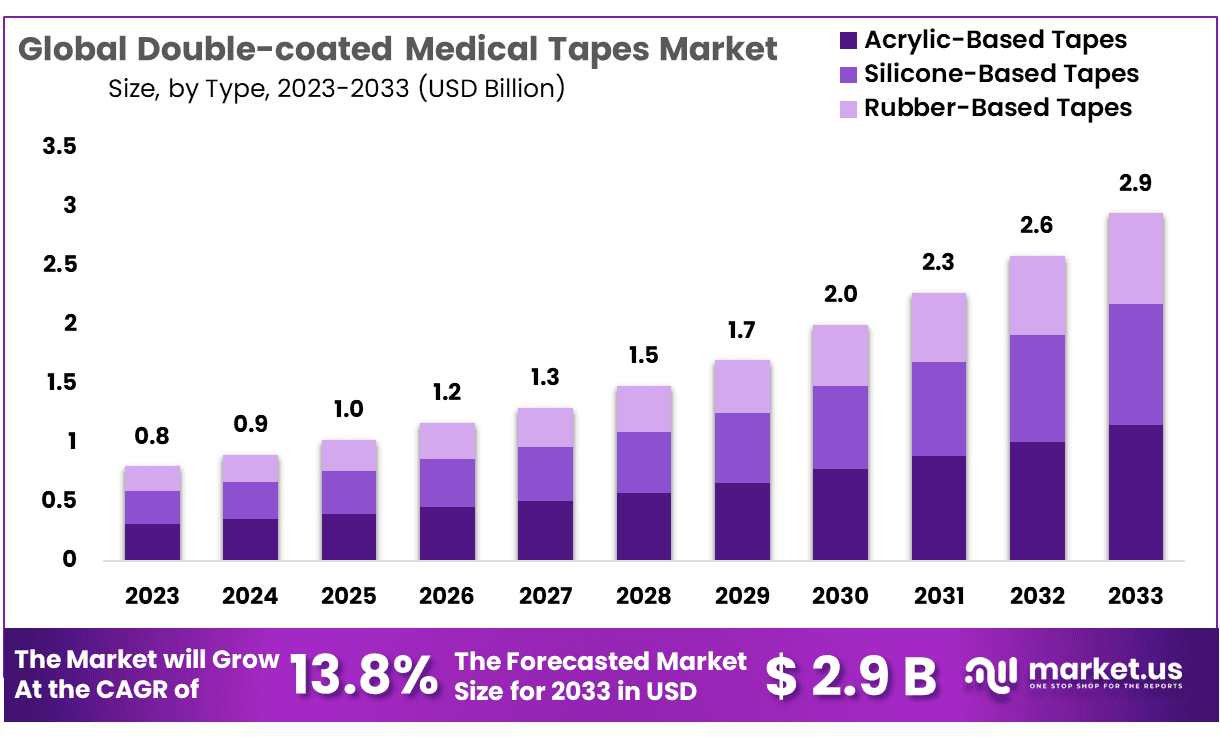
New York, NY – Jan 27, 2026 – The Global Double-coated Medical Tapes Market size is expected to be worth around USD 2.9 Billion by 2033 from USD 0.8 Billion in 2023, growing at a CAGR of 13.8% during the forecast period from 2023 to 2033.
Double-coated medical tapes are widely used in healthcare settings due to their reliable adhesion, flexibility, and compatibility with medical devices and skin contact applications. The basic formation of double-coated medical tapes involves a layered structure designed to ensure consistent performance, safety, and durability.
At the core of the tape is a carrier material, which may be composed of tissue, film, foam, nonwoven fabric, or polyester. This carrier provides structural integrity, thickness control, and flexibility, allowing the tape to conform to body contours and medical device surfaces. The selection of the carrier material is determined by the intended clinical application, such as wound care, device fixation, or surgical use.
On both sides of the carrier, pressure-sensitive adhesives are evenly coated. These adhesives are typically acrylic, silicone, or rubber-based, each offering specific performance characteristics. Acrylic adhesives are commonly used due to their strong bonding strength, aging resistance, and skin compatibility. Silicone adhesives are preferred for sensitive skin applications, as they allow gentle removal with minimal trauma.
Release liners are applied to both adhesive surfaces to protect the tape during storage and handling. These liners are removed prior to application, enabling efficient placement and secure bonding. The entire structure is manufactured under controlled conditions to meet medical regulatory standards, ensuring cleanliness, biocompatibility, and consistent quality.
Overall, the formation of double-coated medical tapes is optimized to deliver reliable adhesion, patient comfort, and performance stability, supporting their growing adoption across hospitals, clinics, and medical device manufacturing applications worldwide.
Key Takeaways
- Market Size: The Double-coated Medical Tapes Market is projected to reach approximately USD 2.9 billion by 2033, rising from USD 0.8 billion in 2023.
- Market Growth: The market is anticipated to expand at a compound annual growth rate (CAGR) of 13.8% over the forecast period from 2023 to 2033.
- Type Analysis: Acrylic-based tapes dominate the market, capturing nearly 39% of the total market share.
- Application Analysis: Wound care applications account for about 35% of overall market revenue, highlighting their significant contribution.
- Material Type Analysis: Polyethylene Terephthalate (PET) emerges as a leading material, representing approximately 35% of the market share.
- End-Use Analysis: Hospitals remain the primary end users, accounting for 56% of the market share in 2023.
- Regional Analysis: North America leads the global market with a 53% share, generating an estimated USD 0.47 billion in revenue.
Regional Analysis
The geographic analysis of the Global Double-coated Medical Tapes Market provides a strategic foundation for industry participants seeking to identify untapped revenue streams and regional expansion opportunities. In 2023, North America emerged as the dominant market, capturing approximately 53% of the global share and generating revenues of around USD 0.47 billion, reflecting strong healthcare infrastructure and high adoption of advanced medical adhesive solutions.
Each regional and country-level segment of the Global Double-coated Medical Tapes Market has been comprehensively evaluated using key indicators such as market size, market share, compound annual growth rate (CAGR), future growth outlook, and other critical performance metrics. This structured assessment enables a clear understanding of regional market positioning and competitive dynamics.
Distinct market patterns are observed across different geographies, influenced by variations in healthcare spending, regulatory frameworks, medical device usage, and technological adoption. Recognizing these regional disparities, the report incorporates detailed, region-specific analyses to capture localized trends and growth drivers. This approach ensures a holistic and comparative understanding of the market landscape, supporting informed strategic planning and data-driven decision-making for stakeholders operating across global markets.
Emerging Trends
- Advanced Adhesive Technologies: Manufacturers are increasingly focused on developing high-performance adhesives that deliver strong bonding while minimizing skin trauma. Innovations such as breathable medical tapes enable extended wear—up to seven days—while ensuring gentle removal and reduced risk of skin damage.
- Biocompatible and Skin-Friendly Materials: There is a growing preference for biocompatible materials, including silicone- and hydrocolloid-based adhesives, due to their superior compatibility with sensitive skin. These materials help lower the incidence of allergic reactions and improve patient comfort during prolonged use.
- Integration with Wearable Medical Devices: The expanding adoption of wearable health monitoring devices has driven demand for medical tapes capable of securely affixing devices to the skin over extended periods. These tapes are designed to maintain adhesion without compromising comfort or skin integrity.
- Customization for Application-Specific Needs: Product customization has emerged as a key trend, with manufacturers offering tapes in varying thicknesses, adhesive strengths, and material compositions. This approach enhances performance across diverse medical applications and clinical requirements.
Use Cases
- Wound Care: Double-coated medical tapes are widely used to secure wound dressings, ensuring stability and protection against infection while supporting effective healing. The wound care segment accounted for approximately 35% of total market revenue.
- Surgical Applications: In surgical settings, these tapes are utilized to secure drapes and medical equipment, contributing to the maintenance of sterile environments. The surgical application segment represented a significant market share, valued at USD 0.76 billion in 2023.
- Medical Device Assembly: These tapes play a critical role in the assembly of medical devices by providing consistent and reliable adhesion between components. This application segment was valued at USD 0.32 billion in 2023.
- Orthopedic Support: Within orthopedic care, double-coated tapes are used to secure braces and support devices, enhancing patient mobility and comfort. The orthopedic segment was valued at USD 0.15 billion in 2023.
- Dermatology: In dermatological applications, these tapes are employed to secure therapeutic patches and skin-monitoring devices, ensuring consistent skin contact and improved treatment effectiveness.
Frequently Asked Questions on Double-coated Medical Tapes
- What materials are commonly used in double-coated medical tapes?
These tapes are typically manufactured using foam, nonwoven fabric, polyethylene, or polyester carriers combined with acrylic, silicone, or rubber-based adhesives, selected based on adhesion strength, breathability, moisture resistance, and skin sensitivity requirements. - Where are double-coated medical tapes commonly used?
Double-coated medical tapes are widely used in wound dressings, wearable medical devices, diagnostic sensors, ostomy products, and surgical drapes, where secure fixation, conformability, and patient comfort are critical performance parameters. - Are double-coated medical tapes safe for sensitive skin?
Medical-grade double-coated tapes are formulated to meet regulatory standards for skin contact, offering hypoallergenic properties, controlled adhesion, and residue-free removal, making them suitable for prolonged use on sensitive or compromised skin. - What factors are driving growth in the double-coated medical tapes market?
Market growth is driven by rising demand for wearable medical devices, increasing surgical procedures, expanding home healthcare adoption, and continuous innovation in skin-friendly adhesive technologies across global healthcare systems. - Which healthcare segments contribute most to market demand?
Hospitals, ambulatory surgical centers, diagnostic laboratories, and home healthcare settings represent key demand segments, supported by growing utilization of disposable medical products and device fixation solutions requiring reliable adhesive performance. - How does regulatory compliance impact the market?
Strict regulatory frameworks governing medical adhesives influence product development, manufacturing processes, and market entry, encouraging investments in certified materials, biocompatibility testing, and quality assurance to ensure patient safety and clinical effectiveness. - What is the outlook for the double-coated medical tapes market?
The market outlook remains cautiously optimistic, supported by steady healthcare expenditure growth, technological advancements in adhesives, and increasing focus on patient comfort, indicating sustained demand across both developed and emerging economies.
Conclusion
The global double-coated medical tapes market demonstrates strong and sustained growth, supported by expanding healthcare infrastructure, rising surgical volumes, and increasing adoption of wearable medical devices. The layered construction of these tapes ensures reliable adhesion, patient comfort, and compatibility with sensitive skin applications, reinforcing their importance across wound care, surgical, and device assembly uses.
Acrylic-based adhesives and PET carriers continue to dominate due to balanced performance characteristics. Regional leadership by North America reflects advanced clinical practices and regulatory compliance. Overall, continuous innovation in biocompatible materials and application-specific customization is expected to maintain long-term market momentum.
Discuss your needs with our analyst
Please share your requirements with more details so our analyst can check if they can solve your problem(s)




