


Table of Contents
Overview
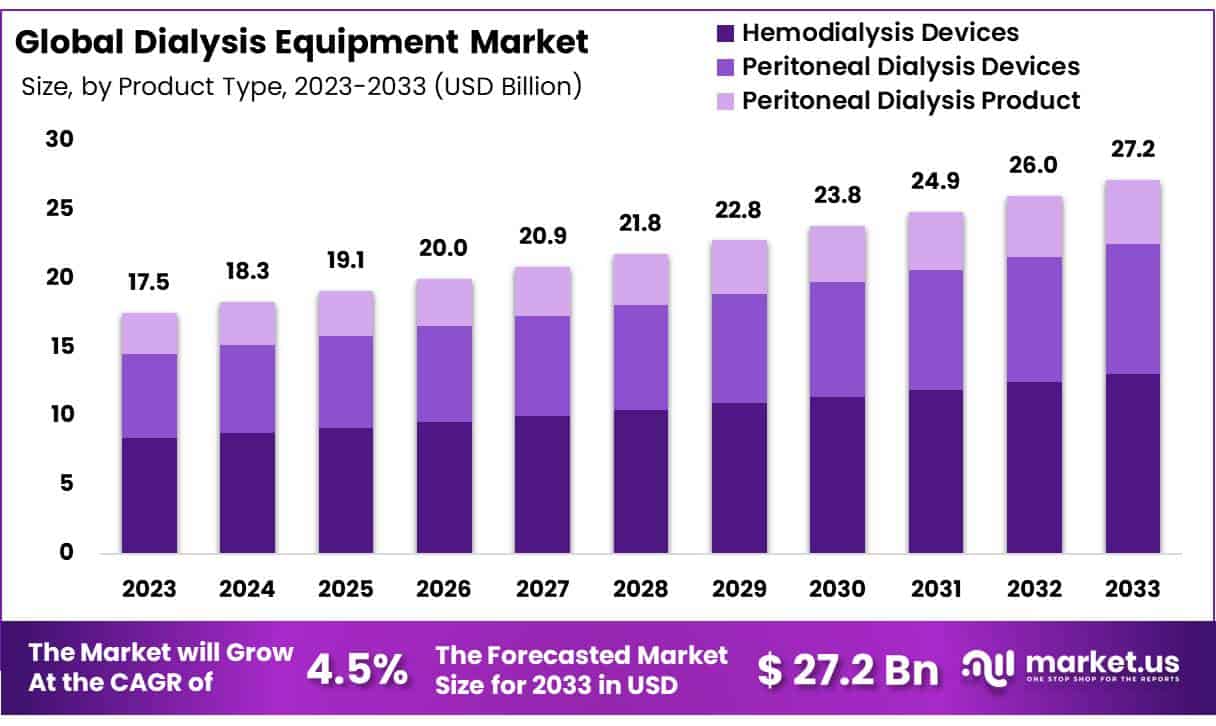
New York, NY – Jan 29, 2026 – The Global Dialysis Equipment Market size is expected to be worth around USD 27.2 Billion by 2033 from USD 17.5 Billion in 2023, growing at a CAGR of 4.5% during the forecast period from 2024 to 2033.
Dialysis equipment plays a critical role in the management of chronic kidney disease (CKD) and end-stage renal disease (ESRD), conditions in which the kidneys are no longer able to effectively remove waste, excess fluids, and toxins from the blood. Dialysis equipment is designed to replicate key kidney functions and support patient survival and quality of life.
Dialysis systems are broadly categorized into hemodialysis equipment and peritoneal dialysis equipment. Hemodialysis equipment consists of dialysis machines, dialyzers (artificial kidneys), blood tubing systems, and water treatment units. During treatment, blood is circulated outside the body through a dialyzer, where waste products and excess fluids are removed before the blood is returned to the patient. Water treatment systems are considered essential, as high-purity water is required to ensure patient safety and treatment effectiveness.
Peritoneal dialysis equipment includes dialysis solutions, catheters, transfer sets, and automated cyclers. This method uses the patient’s peritoneal membrane as a natural filter, allowing waste and fluids to be removed internally. Peritoneal dialysis is commonly adopted in home-care settings due to its flexibility and reduced dependence on clinical infrastructure.
The development of dialysis equipment has been driven by rising global prevalence of kidney disorders, aging populations, and increasing incidence of diabetes and hypertension. Technological advancements have focused on improving treatment efficiency, reducing complications, and enhancing patient comfort. Portable and home-based dialysis equipment has gained increasing attention, supporting the shift toward decentralized care models.
Overall, dialysis equipment remains an indispensable component of renal care. Continued innovation and investment are expected to support improved clinical outcomes, broader accessibility, and long-term sustainability of dialysis therapies worldwide.
Key Takeaways
- Market Size: The dialysis equipment market is projected to reach approximately USD 27.2 billion by 2033, increasing from USD 17.5 billion in 2023.
- Market Growth: The market is anticipated to expand at a CAGR of 4.5% during the forecast period from 2024 to 2033.
- Product Analysis: Peritoneal dialysis devices accounted for a significant share of the market in 2023.
- End-Use Analysis: Hospitals dominated the market, holding nearly 48% of the total dialysis equipment market share.
- Regional Analysis: North America is expected to remain the leading regional market, accounting for around 30% of the global dialysis equipment market share.
Regional Analysis
North America is estimated to be the most productive region in the global dialysis equipment market, accounting for approximately 30% of the total market share. The region is expected to register the highest CAGR during the forecast period, supported by advanced R&D infrastructure and a high rate of technological adoption.
The widespread introduction of innovative dialysis technologies across kidney care facilities is a key growth driver. Additionally, the COVID-19 pandemic has contributed to an increased incidence of kidney-related disorders, further supporting market expansion, alongside rising healthcare expenditure and awareness initiatives.
Asia-Pacific represents a significant share of global sales due to high prevalence of diabetes and hypertension, increasing disposable incomes, and strong adoption of advanced medical technologies. Growth is further supported by expanding dialysis centers, rising chronic kidney disease cases, and increasing healthcare investments across emerging economies.
Emerging Trends in Dialysis Equipment
- Portable and Wearable Dialysis Devices: Advancements in miniaturization, sensor technology, and nanotechnology have enabled the development of portable and wearable dialysis systems. These innovations support patient mobility during treatment, contributing to improved lifestyle flexibility and enhanced overall quality of life.
- Expansion of Home-Based Dialysis Therapies: Home-based dialysis solutions, including home hemodialysis and peritoneal dialysis, are gaining adoption due to their convenience and patient-centric nature. These therapies reduce dependency on clinical facilities while enabling personalized treatment schedules.
- Integration of Telemedicine in Dialysis Care: Telemedicine integration is transforming dialysis management through remote monitoring, real-time data transmission, and virtual consultations. This approach improves treatment adherence, supports early intervention, and enhances access to care for patients in geographically underserved regions.
- Development of Artificial Kidney Technologies: Ongoing research into implantable bioartificial kidneys aims to replicate comprehensive renal functions. These technologies have the potential to significantly reduce reliance on conventional dialysis by offering long-term, continuous renal support for end-stage renal disease patients.
- Advancements in Hemodiafiltration Techniques: Hemodiafiltration technology continues to evolve, combining diffusion and convection mechanisms to improve the clearance of middle and large molecular toxins. This advancement has demonstrated potential in improving clinical outcomes and reducing dialysis-associated complications.
Use Cases of Dialysis Equipment
- In-Center Hemodialysis: In-center hemodialysis remains a widely used treatment approach, requiring patients to attend dialysis facilities multiple times per week. This setting ensures consistent access to trained healthcare professionals, advanced equipment, and continuous clinical supervision.
- Home Hemodialysis (HHD): Home hemodialysis allows patients to perform treatments independently using compact dialysis machines. Increased treatment frequency and flexible scheduling have been associated with improved cardiovascular outcomes and enhanced patient satisfaction.
- Peritoneal Dialysis (PD): Peritoneal dialysis utilizes the peritoneal membrane as a natural filtration surface. This method supports greater patient autonomy, flexible treatment timing, and, in many cases, fewer dietary and fluid intake restrictions.
- Wearable Artificial Kidney Applications: Wearable artificial kidney systems, currently under development, are designed to provide continuous renal replacement therapy. These devices aim to minimize lifestyle disruption while improving toxin removal efficiency and overall treatment effectiveness.
- Pediatric Dialysis Applications: Specialized dialysis equipment tailored for pediatric patients has been developed to address unique physiological needs. These systems enhance safety, precision, and treatment efficacy for infants and children requiring renal replacement therapy.
Frequently Asked Questions on Dialysis Equipment
- What are the main types of dialysis equipment available?
The primary types of dialysis equipment include hemodialysis machines, peritoneal dialysis systems, dialyzers, blood tubing sets, and water treatment systems. Each type is designed to support specific dialysis modalities and clinical requirements. - How does a hemodialysis machine work?
A hemodialysis machine functions by circulating the patient’s blood through a dialyzer, where waste products and excess fluids are filtered out using a semipermeable membrane before the cleansed blood is returned to the body. - What factors influence the selection of dialysis equipment?
The selection of dialysis equipment is influenced by factors such as patient condition, treatment setting, frequency of dialysis, ease of operation, safety features, and compliance with regulatory and clinical quality standards. - How often does dialysis equipment require maintenance?
Dialysis equipment requires regular preventive maintenance and calibration to ensure accuracy, safety, and infection control. Maintenance schedules are typically defined by manufacturers and healthcare regulations to minimize equipment failure and treatment risks. - What are the key growth drivers of the dialysis equipment market?
Market growth is primarily driven by the increasing incidence of diabetes and hypertension, rising end-stage renal disease cases, technological advancements in dialysis systems, and improved healthcare infrastructure in emerging economies. - Which regions dominate the dialysis equipment market?
North America and Europe dominate the dialysis equipment market due to advanced healthcare systems and high treatment adoption rates. However, Asia-Pacific is experiencing faster growth driven by improving healthcare access and large patient populations. - What role does technology play in market development?
Technological advancements, including portable dialysis machines, automated peritoneal dialysis systems, and improved biocompatible materials, are enhancing treatment efficiency and patient convenience, thereby positively influencing overall market expansion.
Conclusion
Dialysis equipment remains a cornerstone of chronic kidney disease and end-stage renal disease management, enabling effective waste removal and fluid balance when renal function fails. Market growth is being supported by the rising burden of diabetes, hypertension, and aging populations worldwide.
Technological progress has enhanced treatment efficiency, safety, and patient comfort, while the shift toward home-based and portable dialysis systems reflects evolving care models. North America continues to lead in adoption, with Asia-Pacific showing strong growth potential. Overall, sustained innovation, expanding access, and healthcare investment are expected to strengthen long-term market development and patient outcomes.
Discuss your needs with our analyst
Please share your requirements with more details so our analyst can check if they can solve your problem(s)




