


Table of Contents
Overview
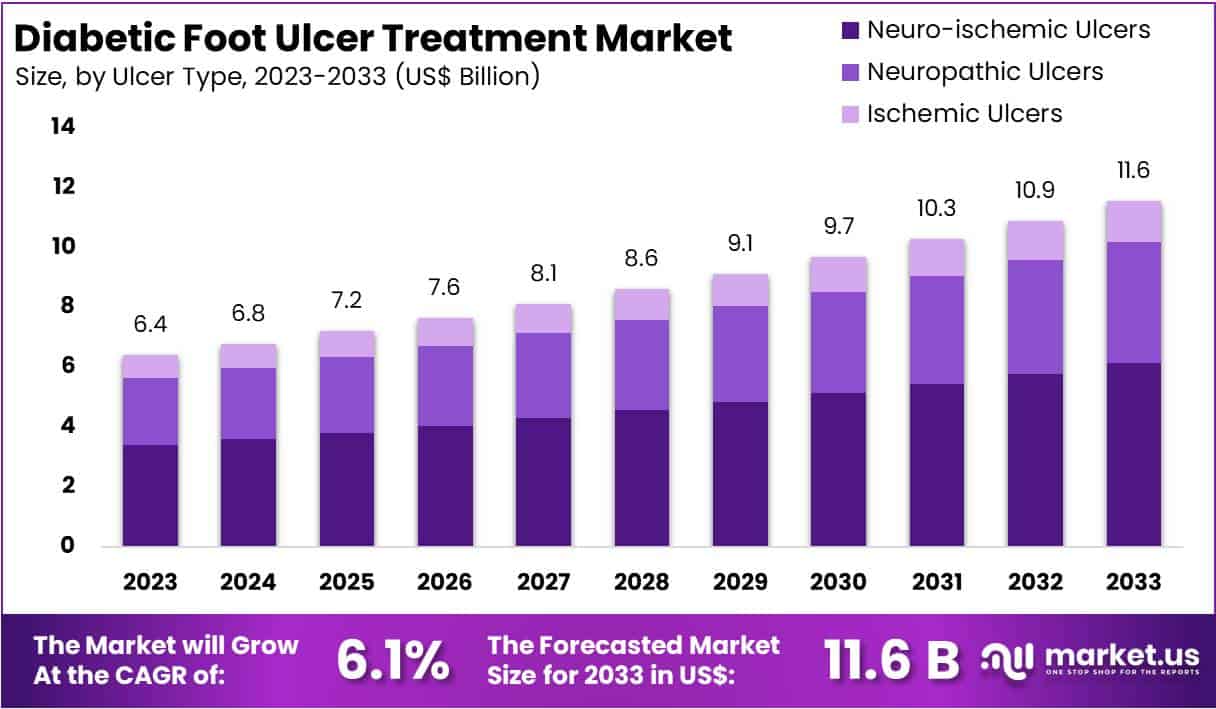
New York, NY – March 04, 2026 – The Global Diabetic Foot Ulcer Treatment Market size is expected to be worth around US$ 11.6 Billion by 2033, from US$ 6.4 Billion in 2023, growing at a CAGR of 6.1% during the forecast period from 2024 to 2033.
The global diabetic foot ulcer treatment market is witnessing steady growth, driven by the rising prevalence of diabetes and increasing awareness regarding advanced wound care solutions. Diabetic foot ulcers are among the most common and severe complications associated with diabetes, often leading to infection, hospitalization, and in severe cases, amputation. Effective and timely treatment remains critical to reducing long-term healthcare burden and improving patient outcomes.
The growth of the market can be attributed to the increasing adoption of advanced therapies such as bioengineered skin substitutes, negative pressure wound therapy, and antimicrobial dressings. Technological advancements in wound management products have improved healing rates and reduced recovery time. In addition, supportive government initiatives and reimbursement policies in developed regions have strengthened patient access to specialized care.
North America is expected to maintain a significant share of the market due to high diabetes prevalence, well-established healthcare infrastructure, and strong presence of key industry participants. Meanwhile, Asia-Pacific is projected to register notable growth, supported by expanding healthcare facilities and rising patient awareness.
Key companies operating in the diabetic foot ulcer treatment market are focusing on product innovation, strategic collaborations, and geographic expansion to strengthen their market position. Continuous research and development activities are anticipated to create new growth opportunities in the coming years.
Key Takeaways
- The global diabetic foot ulcer treatment market was valued at US$ 6.4 billion in 2023 and is projected to reach approximately US$ 11.6 billion by 2033, expanding at a compound annual growth rate (CAGR) of 6.1% during the forecast period.
- In 2023, the wound-care dressings segment accounted for the largest share of the market, contributing 42% of the total revenue.
- Based on ulcer type, the neuro-ischemic ulcers segment held a significant position, representing 53% of overall market revenue.
- Within the end-user category, hospitals and clinics dominated the market, capturing 43% of the total revenue share.
- Regionally, North America led the global diabetic foot ulcer treatment market, holding more than 38% of the overall revenue in 2023.
Regional Analysis
North America accounted for 38% of the global diabetic foot ulcer treatment market revenue in 2023, maintaining a leading regional position. Market growth in the region is primarily driven by the high prevalence of diabetes, particularly in the United States, which has increased the demand for advanced diabetic foot ulcer (DFU) management solutions.
A well-developed healthcare infrastructure has facilitated the adoption of innovative treatment modalities, including negative pressure wound therapy (NPWT), skin substitutes, and growth factor-based therapies. In addition, the strong presence of established market participants and ongoing investments in research and development activities have reinforced regional market expansion.
Supportive reimbursement frameworks and heightened awareness of diabetic foot complications among patients and healthcare providers have further strengthened treatment uptake. Strategic collaborations are also contributing to market growth. For example, in June 2023, Siksika Health Services partnered with Orpyx Medical Technologies and GMAK Consulting to launch a pilot program focused on improving foot health outcomes among individuals with type 2 diabetes.
Emerging Trends
- Rise of Smart Wound Care Technology: Smart wound dressings equipped with embedded sensors are increasingly adopted in diabetic foot ulcer management. These devices monitor moisture, temperature, and infection indicators, enabling remote assessment, early intervention, reduced complications, and improved healing outcomes, particularly in underserved regions.
- Growth in Regenerative Therapies: Regenerative therapies, including bioengineered skin substitutes and stem cell applications, are gaining traction in advanced ulcer care. These solutions promote tissue repair, enhance circulation, accelerate healing in complex cases, and are expected to become integral to standard treatment protocols.
- Personalized Treatment Plans: A personalized treatment approach is being emphasized in diabetic foot ulcer care. Individual assessments of circulation, neuropathy, and infection status guide customized interventions, improving healing efficiency, minimizing recurrence risk, and optimizing overall clinical outcomes across diverse patient populations.
- Telemedicine for Wound Monitoring: Telemedicine solutions are increasingly integrated into wound management practices. Digital image sharing, remote consultations, and virtual follow-ups enable timely clinical decisions, early infection detection, reduced hospital visits, and cost-effective monitoring, especially benefiting patients residing in remote locations.
Use Cases
- Hospital Wound Care Units: Hospital-based wound care units manage a significant proportion of diabetic foot ulcer cases through debridement, advanced dressings, antibiotics, and surgical interventions. Multidisciplinary teams ensure infection control, vascular support, faster recovery, and prevention of severe complications including amputations.
- Home-Based Treatment Programs: Home-based treatment programs support mild to moderate ulcer management using advanced dressings and guided wound care routines. With appropriate patient education and monitoring, healing outcomes remain effective while reducing hospitalization costs and improving patient comfort during recovery.
- Use in Elderly Patient Management: Long-term care facilities increasingly incorporate diabetic foot ulcer management for elderly patients. Routine foot inspections, timely dressing application, and infection monitoring reduce hospitalization rates, prevent severe complications, and enhance quality of life among aging diabetic populations.
- Rural Health Clinics and Mobile Units: Rural clinics and mobile health units play a critical role in expanding ulcer care access. Portable negative pressure wound therapy devices and trained healthcare workers enable effective treatment delivery, minimizing travel burdens and supporting consistent wound management in remote communities.
Frequently Asked Questions on Diabetic Foot Ulcer Treatment
- What are the primary treatment options available for diabetic foot ulcers?
Primary treatment options include debridement, wound dressings, antibiotic therapy, pressure-relieving footwear, and advanced therapies such as skin substitutes and growth factors. In severe cases, surgical intervention may be required to remove infected tissue and reduce the risk of amputation. - How does infection management influence diabetic foot ulcer outcomes?
Infection management plays a critical role in improving healing rates and reducing complications. Prompt antibiotic therapy, regular monitoring, and proper wound care are essential to prevent the spread of infection, which can otherwise lead to hospitalization or lower limb amputation. - What role does offloading play in diabetic foot ulcer treatment?
Offloading reduces pressure on the affected foot area, allowing the wound to heal effectively. Devices such as total contact casts, removable cast walkers, and specialized footwear are commonly used to minimize mechanical stress and promote tissue regeneration. - Are advanced therapies effective in treating diabetic foot ulcers?
Advanced therapies, including bioengineered skin substitutes, negative pressure wound therapy, and growth factor treatments, have demonstrated improved healing rates in chronic ulcers. These technologies are increasingly adopted in clinical practice to enhance patient outcomes and reduce recovery time. - What is driving growth in the diabetic foot ulcer treatment market?
Market growth is primarily driven by the increasing prevalence of diabetes globally, rising geriatric population, and growing awareness of advanced wound care solutions. Technological innovations and improved healthcare infrastructure are also contributing to sustained market expansion. - Which regions dominate the diabetic foot ulcer treatment market?
North America currently dominates the market due to high diabetes prevalence, strong reimbursement frameworks, and advanced healthcare systems. Europe follows closely, while Asia-Pacific is expected to witness the fastest growth due to expanding healthcare access and rising patient awareness. - What are the key product segments in the diabetic foot ulcer treatment market?
Key product segments include wound care dressings, biologics, therapy devices, and antibiotic medications. Among these, advanced wound dressings and biologic skin substitutes are experiencing strong demand due to their effectiveness in accelerating wound healing and reducing recurrence rates. - Who are the major players in the diabetic foot ulcer treatment market?
Major companies operating in the market include Smith & Nephew, 3M, Mölnlycke Health Care, and ConvaTec Group plc, all of which focus on product innovation and strategic partnerships to strengthen their global market presence.
Conclusion
The global Diabetic Foot Ulcer Treatment Market is projected to demonstrate steady and sustained growth over the forecast period, driven by the rising prevalence of diabetes and increasing awareness regarding advanced wound care solutions. The market valuation is expected to expand from US$ 6.4 billion in 2023 to approximately US$ 11.6 billion by 2033, reflecting a CAGR of 6.1% between 2024 and 2033.
Technological advancements, improved access to healthcare services, and growing adoption of innovative therapies are anticipated to support market expansion. Overall, favorable clinical outcomes and expanding patient pools are likely to reinforce long-term growth prospects.
Discuss your needs with our analyst
Please share your requirements with more details so our analyst can check if they can solve your problem(s)




