


Table of Contents
Overview
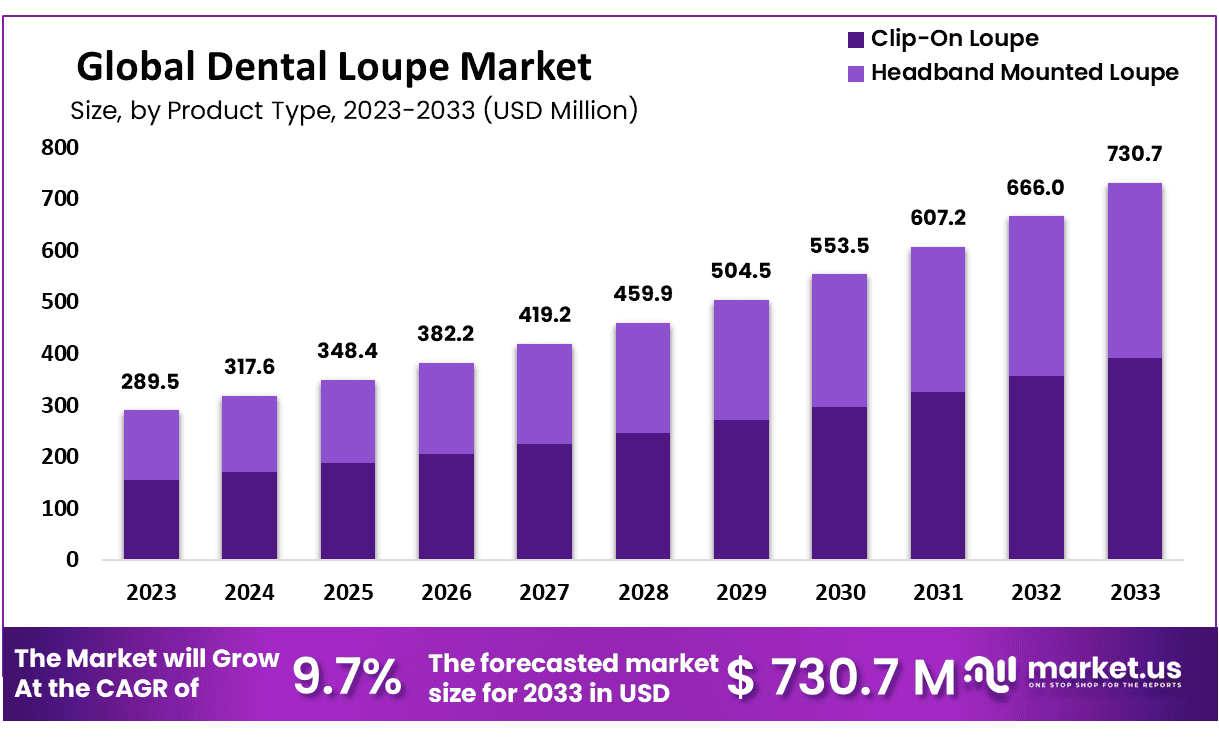
New York, NY – Jan 21, 2026 – The Global Dental Loupe Market size is expected to be worth around USD 730.7 Million by 2033 from USD 289.5 Million in 2023, growing at a CAGR of 9.7% during the forecast period from 2024 to 2033.
Dental loupes are being increasingly adopted across dental practices as an essential tool to improve clinical accuracy, posture, and overall treatment outcomes. These optical devices are designed to provide magnification and enhanced visualization of the oral cavity, allowing dental professionals to perform procedures with greater precision and confidence.
Dental loupes consist primarily of magnifying lenses mounted on lightweight frames, often integrated with illumination systems such as LED headlights. Magnification levels commonly range from 2.0x to 6.0x, with lower magnifications preferred for general dentistry and higher magnifications used in specialized procedures such as endodontics and microsurgery. The selection of magnification is typically influenced by the practitioner’s specialty, working distance, and clinical requirements.
The use of dental loupes is associated with improved ergonomics. By enabling a neutral working posture, loupes help reduce musculoskeletal strain, which is a common occupational concern among dental professionals. Over time, this ergonomic benefit is expected to contribute to longer professional longevity and reduced work-related fatigue.
Market adoption of dental loupes has been supported by growing awareness of preventive ergonomics and the rising demand for minimally invasive dental procedures. Technological advancements in optics and materials have also resulted in lighter, more comfortable designs with improved optical clarity.
As dentistry continues to move toward precision-based care, dental loupes are positioned as a foundational instrument within modern clinical setups. Their role in supporting accuracy, efficiency, and practitioner well-being is increasingly being recognized across both developed and emerging dental markets.
Key Takeaways
- Market Size: The global dental loupe market is projected to reach approximately USD 730.7 million by 2033, increasing from USD 289.5 million in 2023.
- Market Growth: Market expansion is expected to occur at a compound annual growth rate (CAGR) of 9.7% over the forecast period from 2024 to 2033.
- Product Type Analysis: Clip-on loupes represent the leading product segment, accounting for a substantial 53.6% share of the overall dental loupe market.
- End-Use Analysis: Dental clinics constitute the dominant end-use segment, holding an estimated 61.2% market share, driven by high procedure volumes and routine clinical adoption.
- Regional Analysis: North America is anticipated to maintain its leading position, generating approximately USD 137.8 million in revenue and capturing around 48.2% of the global market share.
- Procedural Need: The demand for dental loupes is primarily driven by the requirement for enhanced precision in complex dental procedures, particularly endodontic treatments such as root canal therapies and advanced periodontal interventions.
- National Centre of Health Statistics (NCHS): Data published by the NCHS highlights the growing importance of dental loupes in managing widespread oral health issues, including high prevalence of dental caries and untreated tooth decay, thereby supporting their increased clinical utilization.
Regional Analysis
- Market Size: The global dental loupe market is projected to reach approximately USD 730.7 million by 2033, increasing from USD 289.5 million in 2023.
- Market Growth: Market expansion is expected to occur at a compound annual growth rate (CAGR) of 9.7% over the forecast period from 2024 to 2033.
- Product Type Analysis: Clip-on loupes represent the leading product segment, accounting for a substantial 53.6% share of the overall dental loupe market.
- End-Use Analysis: Dental clinics constitute the dominant end-use segment, holding an estimated 61.2% market share, driven by high procedure volumes and routine clinical adoption.
- Regional Analysis: North America is anticipated to maintain its leading position, generating approximately USD 137.8 million in revenue and capturing around 48.2% of the global market share.
- Procedural Need: The demand for dental loupes is primarily driven by the requirement for enhanced precision in complex dental procedures, particularly endodontic treatments such as root canal therapies and advanced periodontal interventions.
- National Centre of Health Statistics (NCHS): Data published by the NCHS highlights the growing importance of dental loupes in managing widespread oral health issues, including high prevalence of dental caries and untreated tooth decay, thereby supporting their increased clinical utilization.
Emerging Trends in Dental Loupes
- Growing Emphasis on Ergonomics and Practitioner Well-being: Dental professionals are increasingly adopting dental loupes to support improved posture and reduce musculoskeletal stress. Proper ergonomic alignment is widely recognized as a critical factor in preventing chronic neck, back, and shoulder disorders. By enabling clinicians to maintain a neutral spine position during procedures, loupes help minimize physical strain and long-term occupational injuries. This trend reflects heightened awareness of practitioner health and has driven the demand for ergonomically optimized loupe designs across dental practices.
- Advancements in Magnification and Illumination Technologies: Recent developments in dental loupe technology have focused on enhanced magnification levels and superior illumination systems. Modern loupes provide clearer, more detailed visualization of the oral cavity, supporting higher procedural accuracy. Integrated LED lighting delivers consistent, shadow-free illumination, improving visibility even in complex clinical situations. These technological improvements allow dental professionals to perform procedures with greater precision, efficiency, and confidence, representing a significant advancement over earlier optical solutions.
- Increased Focus on Infection Control and Loupe Maintenance: Rising standards for infection prevention have led to greater attention on the cleaning and disinfection of dental loupes. Proper maintenance protocols are essential, as inadequately cleaned loupes may act as vectors for microbial contamination. Emphasis is being placed on routine disinfection between patient appointments to ensure compliance with strict infection control guidelines. This trend aligns with broader patient safety initiatives and reinforces the importance of hygiene in dental environments.
Use Cases of Dental Loupes
- Enhanced Diagnostic Accuracy: Dental loupes significantly improve visual acuity, enabling earlier and more accurate detection of dental caries, periodontal conditions, and other oral abnormalities. Magnified visualization supports precise differentiation between minor defects, stains, and pathological lesions that may not be easily visible to the naked eye. This improved diagnostic capability facilitates timely clinical intervention and supports more accurate treatment planning.
- Improved Precision in Surgical and Endodontic Procedures: In complex procedures such as endodontic therapy, dental loupes provide critical magnification for identifying intricate anatomical structures, including accessory root canals. Enhanced visibility supports thorough cleaning, shaping, and obturation, reducing the risk of procedural errors and post-treatment complications. The use of magnification is associated with improved procedural outcomes due to greater attention to detail.
- Ergonomic Advantages and Career Longevity: The use of dental loupes promotes an upright working posture, reducing repetitive strain on the neck and spine. By minimizing excessive forward head movement and spinal flexion, loupes help lower the incidence of work-related musculoskeletal disorders. Improved ergonomic alignment contributes to greater practitioner comfort, sustained productivity, and extended professional longevity within the dental field.
Frequently Asked Questions on Dental Loupe
- What magnification strengths are commonly preferred by dental professionals?
Dental professionals typically select magnification levels ranging from 2.0x to 6.0x based on procedural complexity. General dentistry often uses lower magnification, while higher levels are favored for endodontic, periodontal, and surgical dental applications. - What are the key product types available in the dental loupe market?
The dental loupe market includes clip-on, flip-up, and through-the-lens loupes. Clip-on loupes are widely adopted due to flexibility and cost efficiency, while through-the-lens models offer superior optical alignment and long-term ergonomic benefits. - Which factors are driving growth in the dental loupe market?
Market growth is driven by increasing prevalence of oral diseases, rising demand for precision dentistry, and growing awareness of ergonomic safety. Advancements in lightweight materials, optical clarity, and integrated illumination systems further accelerate adoption. - Who are the major end users of dental loupes?
Dental clinics are the primary end users of dental loupes due to high procedural volumes and routine clinical requirements. Hospitals, academic institutions, and specialty dental centers also contribute to market demand through advanced treatment offerings. - Which region currently dominates the dental loupe market?
North America dominates the dental loupe market, supported by strong healthcare infrastructure, high awareness of oral health issues, and widespread adoption of advanced dental technologies across clinics and specialty practices. - How do dental loupes contribute to ergonomic benefits?
Dental loupes support improved ergonomics by promoting neutral posture and optimal working distance. This reduces neck, back, and shoulder strain, helping dental professionals minimize work-related injuries and extend their clinical careers. - What is the future outlook for the dental loupe market?
The dental loupe market is expected to witness consistent growth, driven by technological innovation, increasing dental procedure volumes, and rising investments in modern dental equipment across both developed and emerging healthcare markets.
Conclusion
The dental loupe market is positioned for sustained growth as precision-based dentistry, ergonomic awareness, and technological innovation continue to shape clinical practices. Rising demand for minimally invasive procedures, coupled with the need for improved visualization and practitioner well-being, has reinforced the role of dental loupes as an essential clinical instrument.
Advancements in magnification, illumination, and lightweight design have further enhanced adoption across dental clinics, particularly in North America. As oral disease prevalence remains high and clinical accuracy becomes increasingly critical, dental loupes are expected to remain a foundational component of modern dental care worldwide.
Discuss your needs with our analyst
Please share your requirements with more details so our analyst can check if they can solve your problem(s)




