


Table of Contents
Overview
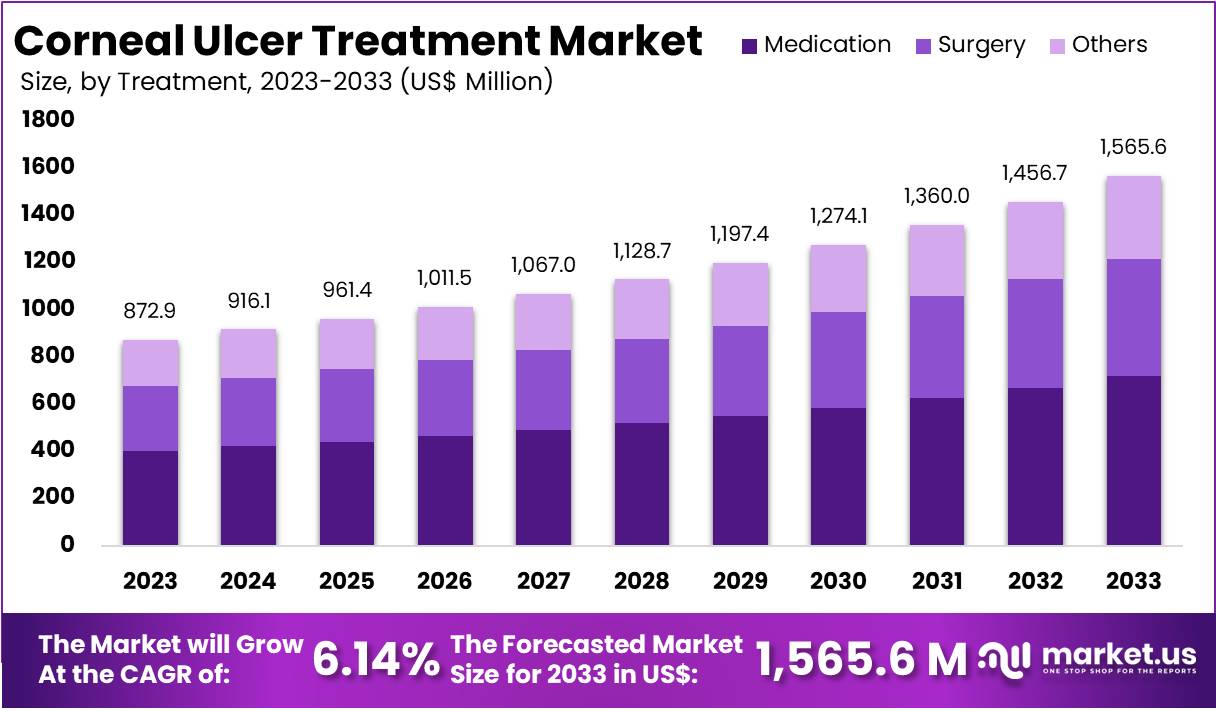
New York, NY – March 09, 2026 – The Global Corneal Ulcer Treatment Market size is expected to be worth around US$ 1565.6 Million by 2034, from US$ 872.9 Million in 2024, growing at a CAGR of 6.14% during the forecast period from 2025 to 2034.
The global corneal ulcer treatment landscape is experiencing steady growth as the incidence of eye infections, trauma, and contact lens–related complications continues to increase. Corneal ulcers are open sores that develop on the cornea due to bacterial, viral, fungal, or parasitic infections. If left untreated, these ulcers can lead to severe visual impairment or permanent vision loss.
Treatment approaches focus on eliminating infection, reducing inflammation, and promoting corneal healing. Antibiotic eye drops are widely prescribed as the first line of treatment for bacterial infections, while antifungal and antiviral medications are used for fungal and viral ulcers respectively. In severe cases, corticosteroids may be administered to reduce inflammation under careful medical supervision. Advanced treatment options, including therapeutic contact lenses and corneal transplantation, are also considered for complicated or non-responsive cases.
Healthcare providers emphasize early diagnosis and timely treatment to prevent complications. The rising adoption of diagnostic technologies such as slit-lamp examinations and microbial culture testing has improved the accuracy of infection identification and treatment planning.
In addition, increasing awareness regarding eye hygiene and proper contact lens usage is expected to support preventive care. Ongoing research activities and the development of targeted antimicrobial therapies are anticipated to enhance treatment effectiveness in the coming years.
Overall, the corneal ulcer treatment segment continues to evolve with improved clinical approaches, growing patient awareness, and advancements in ophthalmic therapeutics.
Key Takeaways
- Market Growth: The global corneal ulcer treatment market is anticipated to reach US$ 1,565.6 million by 2034, expanding at a compound annual growth rate (CAGR) of 6.14% during the forecast period.
- Treatment Segment: In 2023, the medications segment represented the largest share within treatment categories, accounting for over 45.9% of the total market.
- Diagnosis Segment: The fluorescein eye stain test emerged as the leading diagnostic method in 2023, capturing more than 51.7% of the overall market share.
- Symptoms Segment: Severe pain was identified as the most prevalent symptom associated with corneal ulcers in 2023, contributing approximately 31.8% of the segment share.
- Dosage Segment: Within dosage forms, tablets maintained a dominant position in 2023, securing over 41.2% of the market share.
- Route of Administration: Oral administration held the leading position in this category in 2023, accounting for more than 56.2% of the market.
- End Users Segment: Hospitals represented the primary end-user segment in 2023, contributing over 56.2% of the total market share.
- Distribution Channel: Hospital pharmacies led the distribution channel segment in 2023, capturing more than 55.1% of the market share.
- Regional Analysis: North America dominated the global corneal ulcer treatment market in 2023, holding a 34.3% share, with the regional market valued at US$ 299.4 million.
Regional Analysis
In 2023, North America maintained a leading position in the corneal ulcer treatment market, accounting for over 34.3% of the global share, with the regional market valued at US$ 299.4 million. This dominance is primarily supported by the region’s well-established healthcare infrastructure and the availability of advanced diagnostic and treatment technologies. Medical institutions across the region are equipped with modern ophthalmic devices, enabling accurate detection and effective management of corneal ulcers.
The increasing prevalence of corneal ulcers has also contributed to market expansion. Factors such as prolonged digital screen exposure, extensive contact lens usage, and environmental pollutants have increased the risk of eye infections. Consequently, demand for effective treatment solutions has risen, encouraging pharmaceutical companies to focus on the development of advanced therapeutic options.
Supportive regulatory frameworks and approvals from agencies such as the U.S. Food and Drug Administration have further strengthened market development. Continuous investments in research and innovation by pharmaceutical companies and research institutions continue to reinforce North America’s leadership in the global market.
Emerging Trends
- Advanced Drug Formulations: Pharmaceutical companies are introducing advanced eye drops and gels that remain longer on the eye surface. These formulations release medication slowly, improving treatment effectiveness, patient comfort, and reducing the frequency of application.
- Rise in Combination Therapies: Combination therapy is increasingly adopted, where antibiotics, antifungals, and anti-inflammatory drugs are used together. This approach targets multiple infection causes simultaneously, accelerates recovery, and improves treatment outcomes for complex corneal ulcer cases.
- Increased Use of Amniotic Membrane Transplants: Amniotic membrane transplants are gaining acceptance for severe corneal ulcers. The natural tissue promotes healing, reduces inflammation, relieves pain, and prevents scarring, making it effective for ulcers that do not respond to standard treatments.
- Artificial Intelligence in Diagnosis: Artificial intelligence tools are being tested to analyze eye images for faster corneal ulcer diagnosis. These systems improve accuracy, support early detection, and assist clinics lacking specialists, particularly in rural or underserved regions.
- Personalized Eye Care: Personalized eye care is emerging as doctors design treatments based on infection type, severity, and patient characteristics. This tailored approach improves healing outcomes, minimizes side effects, and increases patient satisfaction during corneal ulcer management.
- Teleophthalmology Services: Teleophthalmology services enable remote consultations through digital platforms. Patients receive faster medical advice and follow-up monitoring without travel. This improves access to eye care, particularly for rural populations and individuals in underserved areas.
Use Cases
- Treating Contact Lens-Related Infections: Contact lens misuse often causes corneal ulcers due to poor hygiene or prolonged wear. Treatment involves antibiotic or antifungal drops, temporary discontinuation of lenses, and patient education on safe lens practices.
- Managing Eye Injuries in Rural and Agricultural Workers: Agricultural and outdoor workers frequently experience eye injuries from dust or plant materials. Treatment includes cleaning the eye, antibiotic drops, and sometimes minor procedures, while awareness programs promote early medical care.
- Supporting Patients with Pre-Existing Eye Conditions: Patients with conditions such as dry eye, corneal dystrophies, or prior surgeries face higher ulcer risk. Customized care plans, protective drops, and regular checkups help prevent infections and reduce long-term complications.
- Post-Surgical Eye Infections: Corneal ulcers may develop after eye surgeries including cataract removal or LASIK. Doctors closely monitor patients post-surgery and provide immediate antibiotic treatment if infection appears to prevent serious vision damage.
- Treating Pediatric and Elderly Populations: Children and elderly individuals are vulnerable to corneal ulcers due to hygiene issues, weak immunity, or dry eyes. Treatment involves antibiotic drops, supportive care, and caregiver education on hygiene and medication use.
- Hospital and Emergency Room Interventions: Severe corneal ulcers require urgent hospital care. Patients presenting intense pain or vision loss receive strong antibiotics, close monitoring, and sometimes surgical intervention to control infection and prevent permanent blindness.
Frequently Asked Questions on Corneal Ulcer Treatment
- What are the common causes of corneal ulcers requiring treatment?
Corneal ulcers are commonly caused by bacterial, viral, fungal, or parasitic infections affecting the cornea. Risk factors include contact lens misuse, eye trauma, dry eye syndrome, and poor ocular hygiene. Prompt treatment is essential to prevent permanent corneal damage. - What medications are commonly used in corneal ulcer treatment?
Treatment usually involves antibiotic, antifungal, or antiviral eye drops depending on the infection type. Additional medications such as corticosteroids, cycloplegic drops, and lubricants may be prescribed to reduce inflammation, relieve pain, and support corneal healing. - How long does corneal ulcer treatment usually take?
The duration of corneal ulcer treatment varies depending on severity and infection type. Mild ulcers may heal within one to two weeks, while severe infections can require several weeks of treatment and close ophthalmologic monitoring to ensure proper recovery. - Can corneal ulcers lead to permanent vision loss if untreated?
If left untreated, corneal ulcers can result in severe complications including corneal scarring, perforation, and permanent vision impairment. Early diagnosis and appropriate antimicrobial therapy significantly reduce the risk of long-term visual damage. - What is the global outlook for the corneal ulcer treatment market?
The corneal ulcer treatment market is expected to witness steady growth due to increasing prevalence of ocular infections, rising contact lens usage, and improved access to ophthalmic healthcare. Growing awareness regarding early diagnosis also supports market expansion. - What factors are driving growth in the corneal ulcer treatment market?
Market growth is driven by increasing cases of microbial keratitis, aging populations, and expanding ophthalmic healthcare infrastructure. Additionally, advancements in antimicrobial formulations and improved diagnostic technologies are supporting more effective treatment options. - Which regions dominate the corneal ulcer treatment market?
North America and Europe currently hold significant shares due to advanced healthcare infrastructure and high diagnosis rates. However, Asia-Pacific is experiencing faster growth, supported by large patient populations, rising healthcare spending, and increasing ophthalmology services.
Conclusion
The corneal ulcer treatment market is expected to witness stable growth due to the rising prevalence of ocular infections, increasing contact lens usage, and growing awareness of eye health. Advancements in diagnostic technologies and improved antimicrobial therapies are strengthening treatment outcomes and supporting early disease detection.
The availability of diverse treatment options, including medications, surgical interventions, and supportive care, is enhancing patient management. In addition, expanding healthcare infrastructure and continuous research activities are contributing to market development. With increasing adoption of innovative therapies and preventive measures, the global corneal ulcer treatment landscape is projected to progress steadily in the coming years.
Discuss your needs with our analyst
Please share your requirements with more details so our analyst can check if they can solve your problem(s)




